



Exams Prep Master
Hydrofluoric acid is the hydride of Fluorine. It is also known as an electron-rich hydride. Electron rich, because HF has three lone pairs of electrons. These are also included among the class of hydride of group 17 elements (halogens). One molecule of Hydrofluoric Acid contains one atom of Hydrogen and one atom of Fluorine. Hydrofluoric Acid is formed when Hydrogen fluoride is dissolved in water. Thus an aqueous solution of hydrogen fluoride is Hydrofluoric Acid. Hydrogen fluoride is a highly harmful compound. If swallowed as liquid, it may damage the internal organs and might be fatal, if not treated immediately. If this gas is inhaled then it may cause a burning sensation and irritation in the eyes, nose, and throat. Prolonged exposure to Hydrogen fluoride gas may lead to serious respiratory disorders. Here, we will learn about the formula, formation, and structure of hydrofluoric acid.
| Table of Content |
Key Takeaways: Hydrogen, fluorine, acid, hydrofluoric, ion, atom
Read More: Number of Moles Formula
Formation of Hydrogen Fluoride
[Click Here for Sample Questions]
Hydrogen fluoride is formed when the halogen atom (Fluorine) combines with Hydrogen under suitable conditions.
H2 + F2 → 2HF (dark)
CaF2 + H2SO4 → 2HF + CaSO 4
Formation of Hydrofluoric Acid
[Click Here for Sample Questions]
When hydrogen fluoride is dissolved in water, it ionizes to form a Hydrofluoric Acid. The Hydrogen fluoride dissociates weakly in water to liberate hydronium ions (H+) making the solution acidic.
Fluorine is an electron-rich atom and also the most electronegative element of the periodic table. It has a strong affinity for electrons and readily combines with a Hydrogen atom through a covalent bond. The covalent bond formed is highly polar. As a result, when Hydrogen fluoride is dissolved in water the water molecules orient themselves around the HF molecules so that the dipoles of the water molecules interact with and stabilize the highly polarized H-F bond.
In addition, stabilization offered by the water molecules also leads to the weakening of the H-F bond. This is caused by the formation of Hydrogen bonds between Hydrogen atoms of HF and oxygen atoms of H2O. As a result of this weakening, the H—F bond stretches (the bond length increases) and then fully breaks. The hydrogen that was hydrogen-bonded to the water molecule now becomes fully bonded to the oxygen, forming the species H3O+ (the hydronium ion) and the fluorine now exists as a fluoride anion. This is known as the process of acid dissociation.
Hydrogen fluoride dissociates in water as follows:
HF (aq) + H2O(l) → H3O+ (aq) + F– (aq)
HF (aq) + H2O(l) ← H3O+ (aq) + F– (aq)
The overall reaction is:-
HF (aq) + H2O(l) ⇔ H3O+ (aq) + F– (aq) Eq
The products of the reaction, fluoride anion and the hydronium ion, are oppositely charged ions, and they will be attracted to each other. If they do come in contact, it is also reasonable to suggest that the process of hydrogen transfer that we described above can be reversed. That is, H3O+ can hydrogen bond to the fluoride ion and the hydrogen can be transferred back, to form HF and water. These two reactions do occur simultaneously (and very rapidly) in solution. It is a set of forward- and back- reactions that occur together on a very fast time scale.
Also Read: Periodic Classification of Elements
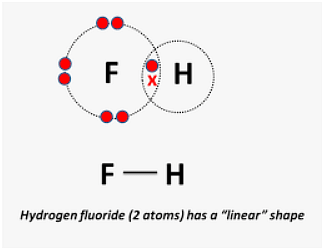
Lewis structure of Hydrofluoric Acid
[Click Here for Sample Questions]
Uses of Hydrogen fluoride
[Click Here for Sample Questions]
- Hydrogen fluoride is used to make refrigerants, herbicides, pharmaceuticals, aluminum, plastics, electrical components, and fluorescent light bulbs. Sixty percent of the hydrogen fluoride used in manufacturing is for processes to make refrigerants.
- Hydrogen fluoride is also used for etching glass and metal.
Also Read: Classification of Haloalkanes and Haloarenes
Things to Remember
- Hydrofluoric Acid is a hydride of fluorine. It is a colorless liquid with a strongly irritating odor. It is highly corrosive and can cause severe burns if it falls on the skin.
- Hydrofluoric Acid is the aqueous solution of hydrogen fluoride gas dissolved in water.
- The Lewis structure of Hydrogen fluoride clearly shows that HF has a total of 3 lone pairs of electrons, making it an electron-rich hydride. One pair of electrons is shared between hydrogen and Fluorine.
- The bond between Hydrogen and Fluorine atoms of Hydrogen fluoride is covalent and highly polarized.
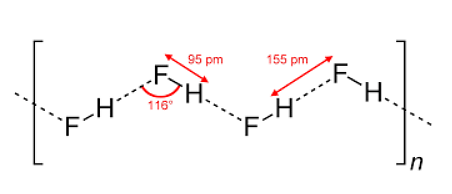
- Hydrofluoric Acid undergoes hydrogen bonding in which the hydrogen atoms of HF form bonds with oxygen atoms of water.
- Hydrogen fluoride can be prepared in the laboratory from calcium fluoride and concentrated sulphuric acid.
Also Read:
Sample Questions
Ques. Write about the reducing character of Hydrofluoric Acid. (1 mark)
Ans. The H-F bond in Hydrofluoric Acid is very stable and does not dissociate easily to release hydrogen. This is why HF does not show reducing properties.
Ques. Why does HF exist as a liquid and have a relatively high boiling point? (2 marks)
Ans. HF exists as a liquid and has a relatively high boiling point because of the presence of hydrogen bonding. Due to hydrogen bonding, the HF molecules associate with each other, leading to an increase in the boiling point, and the presence of hydrogen bonding makes it soluble in water.
Ques. Why is HF the weakest acid among all the hydrides of group 17? (2 marks)
Ans. The strength of a halogen acid depends upon the ease with which the H-X bond present in it dissociates. This in turn is governed by the bond dissociation energy of the bond. Lesser the bond dissociation energy of the H-X bond more is the increase with which it dissociates. The bond dissociation energy is the least in Hydrofluoric Acid and hence it is a weak acid.
Ques. How does Hydrofluoric Acid dissociate in an aqueous solution? (2 marks)
Ans. In an aqueous solution, hydrogen fluoride dissociates to form a hydrogen ion (H+ ) and a fluoride ion (F-) as the anion. Now, this hydrogen ion with a water molecule forms hydronium ion(H3O+).
Ques. Mention the deviation in the behavior of hydrogen fluoride from that of the other hydrides of group 17. (2 marks)
Ans. Due to the presence of hydrogen bonding, the behavior of hydrogen fluoride is different from the other halogen acids. For example,
- Hydrofluoric Acid is a liquid while all the other acids are gasses under ordinary conditions.
- Hydrofluoric Acid is a weak acid, while all the other halogen acids are strong.
Ques. What kind of Acid is Hydrofluoric Acid? Write down two of its properties. (2 marks)
Ans. Hydrofluoric Acid is a weak Acid but highly corrosive and can cause severe burns.
- It is a liquid at room temperature.
- It has an irritating odor.
Ques. Write the equations showing the simultaneously occurring forward and backward reactions that take place in an aqueous solution of hydrogen fluoride? (2 marks)
Ans. Hydrogen fluoride dissociates in water as follows:
HF (aq) + H2O(l) → H3O+ (aq) + F– (Forward reaction)
HF (aq) + H2O(l) ← H3O+ (aq) + F– (aq) (Backward reaction)
The overall reversible reaction can be written as follows:-
HF (aq) + H2O(l) ⇔ H3O+ (aq) + F– (aq) Eq
Ques. Briefly describe the Lewis structure of Hydrofluoric Acid? (2 marks)
Ans. In the Lewis structure of Hydrofluoric Acid, there are a total of two atoms, of which one is hydrogen and the other one is Fluorine in one molecule of hydrogen fluoride. Both atoms share a pair of electrons covalently. There are three lone pairs of electrons on the fluorine atom.
Related Links:



Comments