



Education Journalist | Study Abroad Lead
Hydrofluorocarbon is part of the Halocarbon family that has strong and carbon-based molecules full of chlorine, fluorine or bromine. When these carbons get absorbed, a wavelength of around 9 micrometers is generated. It is found naturally in the atmosphere. HFCs are man-made compounds which are part of greenhouse gasses. Hydrofluorocarbons, or HFCs, are synthetically generated and are typically used as refrigerants.
Read More: Halogens
Key Terms: Hydrofluorocarbon, CH3CCl3, Halocarbons, Ozone Depletion, CFC
What is Hydrofluorocarbon?
[Click Here for Sample Questions]
Hydrofluorocarbons are a category of Halocarbons that are composed of elements like hydrogen, fluorine and carbon. Naturally present in the atmosphere, it has nothing to do with chemical reactions. HFCs are usually non-flammable, non-reactive and also chemically stable. Ideally, carbon tetrachloride CCl4, methyl chloroform CH3CCl3, and methyl bromide CH3CCl3 in these halocarbons play a big role in forming the hydrofluorocarbons. HFCs can decompose comparatively quicker after its release in the atmosphere. Among these man-made compounds, R-134a is the most commonly used refrigerant.
Composition of Hydrofluorocarbon
[Click Here for Sample Questions]
As already mentioned, such gasses do not have any chlorine atomic content, which is what makes it better than HCFCs. Hydrofluorocarbons are mostly considered because of their refrigerant nature and are widely used in the making of refrigerators and air conditioners. The formula of hydrofluorocarbons stands out to be CH2FCF3. However, this chemical has a specifically sized lifetime. After that, it will automatically get dissolved in the environment. On an approximate basis, the life of such a chemical is 14.6 years which contributes to the global warming potential.

Hydrofluorocarbon
Understanding Halocarbon and Hydrofluorocarbon
[Click Here for Sample Questions]
Certain characteristics pertaining to Halocarbon and Hydrofluorocarbon are given below.
Number System of Halocarbon
Chemical formula of Halocarbon was developed by DuPont. Trichlorofluoromethane and hydrochlorofluorocarbons are some kinds of Halocarbons that are easily recognizable from their chemical reactive formulas, CFCl3 and CHF2Cl respectively.
Identify the molecules of carbon atoms and analyze its four single atom bonds to see the reaction and numbers of chlorine atoms. You can observe in a carbon atom that there are four filing cites, 6 sitting 2 carbon sites, and so on. Note that the sites will have either fluorine, fluorine, or hydrogen.
Halocarbon refrigerants are usually designated as R (x, y, z). It can be interpreted with x (carbon atoms – 1); y (hydrogen + 1) and z (fluorine atoms).
Also Check: Environment (Protection) Act, 1986
Radiative Forcing Reactions of Halocarbon
The contribution of Halocarbons towards the greenhouse gasses such as carbon dioxide, nitrous oxide, and others are almost 11% of the direct effects. CFC-11 has the maximum contribution of .06w/m2. CFC-12 on the other hand has .14 w/m2, alongside others that’ve almost .08 w/m2. These carbon atoms are directly related and help in combining hydrochlorofluorocarbons (HCFC-22), and chlorofluorocarbons (CFC-113). These gasses have the positive atom combination and do not react with the negative ones that have an indirect effect on the greenhouse gas mixtures. The ozone layer is itself a greenhouse gas when the combination of hydrofluorocarbons helps in reducing such ozone loss in the stratosphere by 0.1 w/m2.
Structure of Hydrofluorocarbon
[Click Here for Sample Questions]
Hydrofluorocarbons are formed out of carbon, hydrogen, and fluorine atoms. It majorly has these three elements that are attached in a bond. You will find only a single bond between all these atoms and no double or triple bond between the same That determines the property of this gas.
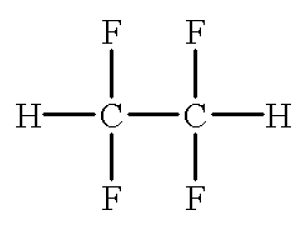
Structure of HFC
Properties of Hydrofluorocarbon
[Click Here for Sample Questions]
- Hydrofluorocarbon converts into solid very easily and is used for refrigerating purposes. The refrigerating items are mainly developed from fluid and used in refrigerators, air conditioners and many vehicles. A transformation of hydrofluorocarbon from gas to liquid and vice versa is very often and does not require any further composition.
- The chemical composition of this gas-only consists of carbon, hydrogen, chlorine, and fluorine atoms. These atoms are also found in the form of gas.
- While verifying the composition and the stability of this gas, inspecting the equipment regularly is vital. The composition of the gas changes regularly and the atom measurements also vary. If the equipment does not suit properly, it’ll fail identifying appropriate measurements.
- It does not have any chlorine component and does not provide input to ozone depletion. It is developed from human activities and therefore makes the environment a relatively safer place to live.
Replacing CFC with Hydrofluorocarbon
[Click Here for Sample Questions]
Most researchers have already identified that the CFCs can be replaced with hydrofluorocarbons while forming certain automobiles such as freezers, refrigerators, and also buildings. CFC does not wear out and the emission rate is negligent. Automobiles and other recharge systems release very minimal emissions and have a bad effect on the atmosphere which leads to ozone loss. Comparatively, if it is replaced with hydrofluorocarbon the emission rate will increase by 20% according to researchers in the United States. The Montreal protocol has also made certain changes wherein the incorporation of such gas has also been suggested. Only licensed people can use the CFC for their automobiles, otherwise, others are always suggested to use hydrofluorocarbon.
Environment & Hydrofluorocarbon
[Click Here for Sample Questions]
The New York declaration on the forest, 2016 has declared HFC as the best we out for global reduction. More than 197 countries met in the United States at the environment summit of October 2016 where they legally got a binding agreement to use hydrofluorocarbons instead of the other CFC gasses. In 2020, around 16 states met in the United States and banned the use of such gas.
Furthermore, in December 2020, during the global pandemic, all chemical manufacturers were instructed against the use of hydrofluorocarbon in their production process because the protection of the ozone layer is far more important. It has been further identified that hydrofluorocarbons can also result in climatic change and can also result in ozone depletion.
Things to Remember
- Hydrofluorocarbon is a greenhouse gas that consists of hydrogen, fluorine as carbon components.
- It is mainly used for refrigeration purposes.
- DuPont developed the chemical formula for Halocarbons.
- Hydrofluorocarbons can easily dissolve in the atmosphere when compared to CFCs.
- HFC contributes around 1% to the total global warming and can exceed up to 8.8 GT by 2050.
Sample Questions
Ques. State five important facts about the hydrofluorocarbons. (5 marks)
Ans.
- Hydrofluorocarbon is one such gas that increases at a rate of 15% annually and it is a man-made gas that can also lead to ozone depletion as per the current researchers.
- Previously it was stated that Only the CFC gasses led to ozone depletion and they can be replaced with the HFC gas. Therefore such gas was used for installation and refrigeration purposes. However, in 2020 it is seen that HSE gas is also harmful to the environment and therefore should be banned.
- Hfc contributes around 1% to the total global warming and can exceed up to 8.8 GT by 2050.
- This is one such strong greenhouse gas that has the capacity of consuming thousands of CO2 from the environment per unit of time.
- If the R22 is used as the chlorine composition of such gasses then it can become a safe option for the climate.
Ques. State three properties of hydrofluorocarbons. (3 marks)
Ans.
- The chemical composition of this gas-only consists of carbon, hydrogen, chlorine, and fluorine atoms.
- While verifying the composition and the stability of this gas it is very important to inspect the equipment regularly. The composition of the gas changes regularly and the atom measures also vary.
- It doesn’t have any chlorine component and does not provide input to ozone depletion.
Ques. How is HFC gas effective for the ozone? (2 marks)
Ans. HFC is part of greenhouse gasses that can affect the environment badly but on the other hand, it is also claimed that it can trap solar radiation. The HFC gas helps in absorbing only the radiant energy and converting the same on the earth's surface. However, it does add to global warming.
Ques. What can the synthesis of hydrofluorocarbons do? (2 marks)
Ans. The synthesis of hydrofluorocarbons can be done from trichloroethylene true hellion. When the isomers are split then the different reaction products are produced. The hydrogenases are formed through isomerization that is replaced by hydrogen and fluorine. Afterward, the same guests get released into the environment.
Ques. State why the United States and others banned HFC? (3 marks)
Ans. Many have banned the usage of HFC because the protection of ozone and the atmosphere has become significant in the course of time. It has been further identified that hydrofluorocarbons can also result in climatic change and can also result in ozone depletion. Therefore the Minnesota pollution control agency with the other governments concluded that along with the CFC gasses the HFC also has certain chemicals which can impact adversely on the global environment and therefore should be banned.
Ques. Explain radiative forces of Hydrofluorocarbons. (3 marks)
Ans. The contribution of Halocarbons towards the greenhouse gasses such as carbon dioxide, nitrous oxide, meeting, and others are almost 11% of the direct effects. CFC 11 has the maximum contribution of .06w/m2. CFC 12 on the other hand has .14 w/m2 and the other items have almost .08 w/m2. These carbon atoms are directly related and help in combining hydrochlorofluorocarbons (HCFC-22), and chlorofluorocarbons (CFC-113). These gasses have the positive atom combination and do not react with the negative ones that have an indirect effect on the greenhouse gas mixtures.
Ques. What is the composition of Hydrofluorocarbons? (2 marks)
Ans. As already mentioned, such gasses do not have any chlorine atomic content, which makes it better than HCFCs. When the depletion takes place in the stratosphere, gasses including CFC, helps in reducing ozone depletion. The formula of hydrofluorocarbons stands out to be CH2FCF3. It is composed of elements like hydrogen, fluorine and carbon.
For Latest Updates on Upcoming Board Exams, Click Here: https://t.me/class_10_12_board_updates
Also Check:



Comments