



Content Curator
Four spheres of Earth are Atmosphere, Biosphere, Geosphere, and Hydrosphere. The four spheres are the subsystems on Earth that include air, land, water, and living things. These systems or spheres of the Earth are used in the classification of various organic and inorganic materials found on the surface of the Earth. They work together to form our ecosystem. Humans can impact these spheres of Earth which in turn also affects their own lifestyle.
Also check: Potential Energy
| Table of Content |
Key Terms: Four Spheres of Earth, Atmosphere, Biosphere, Geosphere, Lithosphere and Interaction
What are the Four Spheres of Earth?
[Click Here for Sample Questions]
Earth as a whole works as a single system on which all things exist. This system is further sub-divided into various subsystems which constantly interact with one another to ensure our survival. The interaction between these various subsystems influences the environment around us, boosts various geological processes, and impacts our standards of living. The four spheres or subsystems of Earth are as follows:
Read More: Difference Between Equinox and Solstice
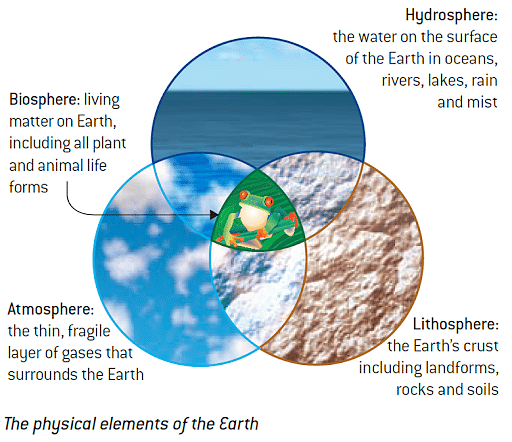
Four Spheres of Earth
The Atmosphere
Atmosphere refers to the gaseous component that is present above the surface of the Earth. The atmosphere of the Earth consists of all gases which are held together by the gravitational pull. Tiny water particles are also present in the atmosphere. The light and heat from the sun reach the Earth and the heat is reflected in the Earth’s atmosphere. This heat warms up the Earth’s surface and also facilitates the process of evaporation through which the atmosphere also gains moisture.
Also read:
The atmosphere is composed of different layers. These various zones or layers are as follows:
- Troposphere: Troposphere is the layer of atmosphere that is closest to the Earth. All the plants, animals, and even humans reside in this layer. Even airplanes and birds fly in this layer. The troposphere has about three-quarters of atmospheric mass.
- Stratosphere: Just above the troposphere lies the stratosphere layer. It is about 50 km from the Earth’s surface. As we move up from the troposphere, the atmospheric layers keep getting thinner.
- Mesosphere: The next layer above the stratosphere is known as the mesosphere and it lies over 85 km above the Earth’s surface.
- Thermosphere: This atmospheric layer lies 600 kilometers above the surface of our planet.
- Exosphere: Exosphere is the outermost layer of the Earth. Beyond this, only space exists.
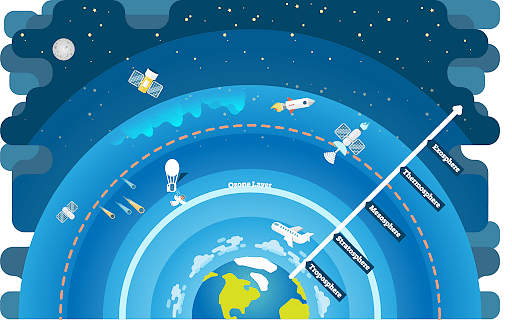
Various layers of the Atmosphere
| Frequently Asked Questions Ques. What are the different types of atmosphere? Ans. The layers of the atmosphere are categorized from lowest to highest. These are:
Ques. Why is the atmosphere important? Ans. Atmosphere contains the oxygen we need to live. It also protects the Earth from harmful ultraviolet solar radiation. Atmosphere creates a pressure without which liquid water couldn't exist on our planet's surface. |
The Biosphere
[Click Here for Sample Questions]
All the living components of the Earth from single-celled organisms to animals lie in the biosphere region. It consists of all the organic matter on the surface that has not decayed yet. It also has biomes which mainly refers to the community of plants and animals which are similar in nature and hence live together.
For example, coral reefs and deserts. The biosphere interacts with other spheres of life in an ecosystem. All the plants and animals present in the biosphere highly depend on all other spheres of Earth in the following manner:
Also check:
- Water and moisture are provided to the animals and plants through the hydrosphere.
- The heat of the sun reaches the living beings through the atmosphere which also protects us from harmful UV radiations.
- Heat is provided to animals and plants from below the Earth’s surface through the geosphere. The geosphere also provides us with the land where we can inhabit and reside.

Biosphere
| Frequently Asked Questions Ques. Give examples of Biospheres. Ans. Examples of Biosphere are:
Ques. What are the main components of the biosphere? Ans. The biosphere has three main components. These are:
|
The Geosphere
All the elements that form the core and crust of the Earth form the geosphere. It is also known as the lithosphere. Examples of geospheres include various particles of sand and rocks that range from drylands to the ocean’s bottom. Other examples are mountains, lava, molten magma, and minerals.
The geosphere of the Earth is formed of many minor and major plates. These tectonic plates constantly move and the friction due to their movement leads to earthquakes or the formation of volcanoes and mountains.

Geosphere or Lithosphere
The thickness of this region considerably varies and can lie in the range of 40 km to 280 km. The lithosphere ends where the minerals present in the Earth’s crust start to exhibit fluid and viscous behaviors. Other spheres are highly impacted and modified by the constant processes of the geosphere. One such process is the rock cycle.
Rock Cycle
In the rock cycle, the melted rock that is present below the crust of the Earth is blown out towards its surface through some vents in the form of lava. The movements of Earth erode the rock materials and the hardened lava through the process of weathering. For many years, the pressure in the surface keeps building up due to the eroded particles, after which the overlying weight exerts pressure leading to the burial of these rocks in the depth of the crust where they are melted due to the extreme heat present. Then, they are thrown out towards the surface of the other. This cycle of rock keeps on continuing and is impacted by the presence or absence of various factors of other spheres of Earth such as water, wind, and temperature.

| Frequently Asked Questions Ques. Give examples of the Geosphere. Ans. Examples of Geosphere are: Continents, Ocean floor, Rocks on the surface, and Sand in the deserts. Ques. Why is the Geosphere important? Ans. The geosphere controls distribution of rocks, minerals, and soils. It also controls the hazards of nature that form the land. The different Geospherical actions determine where to place mountains in the different landforms of the Earth. |
The Hydrosphere
[Click Here for Sample Questions]
All the water present on the planet composes the hydrosphere. The water present on the surface, water vapors, and water on the sub-surface is included in this hydrosphere. The water can be in any state be it solid, liquid or gas. Though a considerable part of our Earth is covered with water, still it just holds 0.023% of the mass of the Earth.
Various processes undergo in the hydrosphere daily. One of such processes that is also vital for our ecosystem is the water cycle.

Hydrosphere
Water Cycle
The energy of the sun is absorbed by the various water bodies such as the ocean which leads them to get warm. The process of evaporation of the surface water and transpiration through the trees takes place. The water vapor which is then present in the atmosphere undergoes condensation in order to form clouds that keep on accumulating water until they get very heavy and eventually pour down in the form of rain. This rain again falls back into the water bodies from where the whole cycle starts again. The water cycle also affects other spheres of Earth.

| Frequently Asked Questions Ques. Mention the important aspects of the Hydrosphere. Ans. Important aspects of the Hydrosphere are:
Ques. What would happen if there is no hydrosphere on Earth? Ans. Without the hydrosphere, there won’t be water on Earth to evaporate which will not create any clouds or rain. Without oceans and land, there would be no wind as winds are produced by differences in air temperature between the land and oceans. |
Interaction of the Four Spheres of Earth
[Click Here for Sample Questions]
The four spheres of Earth regularly interact with each other to ensure the working of these spheres and the Earth as a whole. The interaction between them takes place as:
- Between Atmosphere and the Hydrosphere
The evaporation process that takes place in the hydrosphere leads to the formation of clouds in the atmosphere. The atmosphere then returns back the water taken during evaporation to the water bodies in the form of rain.
- Between Atmosphere and Geosphere
The required heat for the erosion and the breakdown of the rocks in the geosphere is provided by the atmosphere. In return, the geosphere reflects the energy of the sun back into the atmosphere.
- Between Hydrosphere and Geosphere
Hydrosphere supplies the geosphere with the moisture that is needed for the process of weathering to erode the rocks. In turn, the geosphere allows for the water bodies to flow in a way that they eventually meet the ocean and it also helps in the melting of the ice.
- Between Biosphere and Atmosphere, Hydrosphere, and Geosphere
The atmosphere supplies the required gases and the light of the sun to the biosphere. The water is supplied by the hydrosphere while the geosphere provides a medium of living to the living beings.

Interaction between the four spheres of Earth
It is possible to see the working of all these four spheres of Earth at a single location. Let us take the example of soil. Soil has minerals that are supplied from the geosphere, the moisture in the soil is taken through the hydrosphere, and the plants and insects of the biosphere reside in the soil and the air pockets between the various pieces of soil. Hence, we can see that all these four spheres of Earth interact together to ensure the working of Earth as a whole.
Also check:
Things to Remember
- The four spheres of the Earth refer to the subsystems on Earth where every existing thing is placed such as air, land, water, and living things.
- The interaction between these various subsystems influences the environment around us, boosts various geological processes, and impacts our standards of living.
- Atmosphere refers to the gaseous component that is present above the surface of the Earth.
- All the living components of the Earth from single-celled organisms to animals lie in the biosphere region.
- All the elements that form the core and crust of the Earth form the geosphere, also known as the lithosphere.
- All the water present on the planet on the surface, water vapors, and on the sub-surface is included in this hydrosphere.
- The four spheres of Earth regularly interact with each other to ensure the working of these spheres and the Earth as a whole
Sample Questions
Ques. What are the four spheres of the Earth? What are they composed of? (5 marks)
Ans. The four spheres or subsystems of Earth are as follows:
- Atmosphere: The atmosphere refers to the air around us and is composed of all gases and water vapors.
- Biosphere: The biosphere includes all the living things on the planet Earth. From animals, single-celled organisms to even humans, all living beings together comprise the biosphere.
- Geosphere: The geosphere refers to the land. It is formed of various tectonic plates, the movement of which leads to the formation of volcanoes, mountains and even causes earthquakes.
- Hydrosphere: The hydrosphere refers to all the water present on the surface of the Earth. From water in the oceans, lakes, rivers, and aquifers, everything comprises the hydrosphere.
Ques. What are the various layers of the atmosphere? (5 marks)
Ans. The atmosphere is divided into various layers which are:
- Troposphere: Troposphere is the layer of atmosphere that is closest to the Earth.
- Stratosphere: The Stratosphere layer is about 50 km from the Earth’s surface. As we move up from the troposphere, the atmospheric layers keep getting thinner.
- Mesosphere: The next layer, the mesosphere, lies over 85 km above the Earth’s surface.
- Thermosphere: This atmospheric layer lies 600 kilometers above the surface of our planet.
Ques. How does the eruption of a volcano impact other spheres of Earth? (5 marks)
Ans. The eruption of a volcano leads to a release of a lot of rough material. These released materials help in the formation of water droplets. Hence, after the eruption of a volcano takes place, the amount of rainfall notices an increase. This increase in rainfall should ideally help in the rapid growth of plants.
However, when a volcano erupts, huge amounts of sulfur dioxide are released into the atmosphere. This mixes with the water to render various sulfurous and sulphuric acids. These acids then mix with rain and come down. When this rain reaches the plants, it has an adverse effect on their growth. The pH level of water is decreased which further impacts the growth of phytoplankton and zooplankton. The rate of photosynthesis gets impacted which leads to an increase in the carbon dioxide levels in the atmosphere causing global warming.
Ques. How do the four subsystems of the Earth impact one another? What will happen if this interaction stops? (5 marks)
Ans. The four spheres of the Earth which are atmosphere, biosphere, lithosphere, and hydrosphere constantly interact with one another. The interaction between them highly influences the environment around us, boosts various geological processes, and has significant effects on living beings.
If these spheres stopped interacting with each other, there would be various adverse effects such as with no water cycle, the weather would come to a halt. As a result of this, due to the absence of water, the growth of the trees and plants would cease. The animals and living beings will not be able to breathe due to the absence of oxygen and the surface current in the ocean will stop due to the absence of wind. Hence, the ecosystem will collapse in the absence of the interaction amongst these four spheres of the Earth.
Ques. How can human beings impact the spheres of Earth? (3 marks)
Ans. Human beings impact the Earth's spheres in the following way:
- When we dump waste in landfills, the geosphere gets affected.
- In a similar manner, the dumping of industrial waste in the oceans and other water bodies leads to water pollution that impacts the hydrosphere.
- The release of harmful chemicals in the air through air conditioners and pollution from vehicles causes air pollution impacting our atmosphere.
- Due to various human activities such as overfishing and the cutting of trees, even the diversity of living beings in the biosphere gets impacted adversely.
Ques. State the composition of our air. (3 marks)
Ans. The air around us is composed of:
- The majority of the air that is about 78% of the total volume is made up of Nitrogen.
- The next abundant gas in our atmosphere is oxygen which is 20% of the whole volume.
- The atmosphere is formed of 1% water vapor.
- 0.97% of inert gases are also present in the atmosphere which mainly comprises argon.
- Carbon Dioxide and other gases make up just 0.3% volume of the atmosphere.
Ques. Write a brief note on the lithosphere. (5 marks)
Ans. Lithosphere, also known as geosphere, refers to the subsystem of the Earth that mainly comprises all the rocks present on the surface. The mantle and the crust which are the two outermost layers of the planets are also included in the lithosphere. The thickness of this region considerably varies and can lie in the range of 40 km to 280 km.
The lithosphere ends where the minerals present in the Earth’s crust start to exhibit fluid and viscous behaviors. The exact specific depth of the geosphere depends on multiple factors such as the chemical composition of the Earth and also on the pressure and heat which acts on that particular material.
Majorly, the lithosphere is divided into 12 plates. It is also composed of many minor plates. The main tectonic plates of the lithosphere include Scotia, African Plates, Juan de Fuca, Eurasian, Philippine, Cocos, Antarctic, North American, South American, Pacific, Caribbean, and Indo-Australian plates.
These tectonic plates are not fixed in a specific motion, instead, they keep on moving in a gradual manner. The friction created by the movement of these tectonic plates as they push against one another causes earthquakes. This also leads to the formation of volcanoes, ocean trenches, and mountains.
Ques. Explain the water cycle in brief. (3 marks)
Ans. Various water bodies such as oceans absorb the energy of the sun and get warmer. The heat from the sun facilitates the process of evaporation wherein water is transformed into the form of vapors. The transpiration process also takes place. Once they are done, the water vapor in the atmosphere condenses to form clouds that keep getting heavier until they release in the form of rainfall. This rain again falls back into the water bodies from where the whole cycle starts again. The water cycle also affects other spheres of Earth.
Previous Year Questions
- Rachel Carson's famous book 'Silent Spring ' is related to… [NEET 2015]
- Sounds above what level are considered hazardous noise pollution… [NEET 1994]
- Dobson units are used to measure thickness of… [NEET 2021]
- Gas released during Bhopal tragedy was… [NEET 1990]
- Global agreement in specific control strategies to reduce the release of… [NEET 2009]
- Global warming can be controlled by… [NEET 2013]
- High value of BOD (Biochemical Oxygen Demand) indicates that… [NEET 2015]
- Kyoto Protocol was endorsed at… [NEET 2013]
- MAB stands for… [NEET 1997]
- Major aerosol pollutant in jet plane emission is… [NEET 1990]
- Snow blindness is caused due to… [KCET 2018]
- Which of the following is NOT a green house gas… [KCET 2020]
- The photochemical smog can be suppressed by… [KEAM]
- Biological Oxygen Demand (BOD) is a measure of…
- Eutrophication is the natural ageing of lake by...
Also check:



Comments