



Content Curator
Inertia can be defined as an object’s tendency to resist changes in its state of motion. The quantity of matter in a body is called its mass. Mass is determined by the inertia of the object. Mass can be inertial, active gravitational, or passive gravitational. Different objects resist change in different capacities, depending on their mass. A massive object will have more inertia than a smaller object. Momentum is the product of the mass and velocity of the object.
Read Also: Difference Between Density And Specific Gravity
| Table of Content |
Key Terms: Inertia, Mass, Momentum, Momentum Formula, Motion, Velocity
Introduction to Inertia and Law of Inertia
[Click Here for Sample Questions]
An object’s tendency to resist changes in its state of motion is called Inertia. The concept of Inertia was developed by Galileo. Law of Inertia is also known as Newton’s first law of motion. It states that "An object at rest stays at rest and an object in motion stays in motion with the same speed and in the same direction unless acted upon by an unbalanced force." These objects have a tendency to resist changes or exhibit inertia.

Law of Inertia
Read More: Difference Between Mass and Volume
Introduction to Mass
[Click Here for Sample Questions]
Mass can be defined as quantity of matter in a physical body. Standard unit of mass is the kilogram. Mass can be of three types:
- Inertial mass
- Active gravitational mass
- Passive gravitational mass
Relationship between Mass and Inertia
[Click Here for Sample Questions]
All the objects have a tendency to resist change. However, some objects resist changes more than others. This difference in objects to resist changes is due to its mass. Mass is determined by the inertia of the object. The more inertia an object exhibits, the more mass it will have. A massive object will resist changes in its state of motion more than a smaller object. So, a massive object has more inertia.
Also Read Further:
Momentum Formula
[Click Here for Sample Questions]
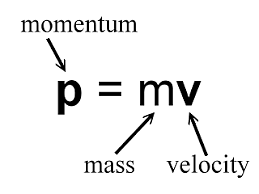
Momentum is the product of mass and velocity of the object.
- Momentum of the object is denoted by p.
- Mass of the object is denoted by m.
- Velocity of the object is denoted by v.
Momentum = Mass x Velocity
p = mv
How to Calculate Momentum?
Check Important Difference Between Gravitation and Gravity
Things to Remember
[Click Here for Sample Questions]
- An object’s tendency to resist changes in its state of motion is called Inertia.
- Mass can be defined as the quantity of matter in a physical body. The standard unit of mass is the kilogram.
- Momentum can be determined by the mass and velocity of the object. It is the product of mass and velocity.
- Momentum = mass x velocity (p = mv)
- All the objects resist change. However, some objects resist changes more than others. This difference in objects to resist changes is because of the mass of the object.
- More inertia an object exhibits, more mass the object has.
Also Read Further:
Sample Questions
Ques. What is Mass? What is Inertial Mass? (3 Marks)
Ans. Mass can be defined as the quantity of matter in a physical body. When force is applied to an object, the object will resist any acceleration. The measurement of this acceleration is known as inertial mass.
Inertial mass can be determined by calculating the acceleration of the object after a certain force is applied to it. A massive object will have more inertia than a smaller object. An object with a large inertial mass will accelerate less than an object with a small inertial mass.
Ques. What are the different types of Inertia? (3 Marks)
Ans.There are three different types of Inertia:
- Resting Inertia or Inertia of Rest: When an object is in a state of rest, it resists motion when an external force acts on it. This resistance is called resting inertia.
- Directional Inertia or Inertia of Direction: When an object is moving in a certain direction, it resists any change in the direction. This resistance is called directional inertia.
- Motion Inertia or Inertia of Motion: When an object is moving, it resists the state of rest. This resistance is called motion inertia.
Ques. Write a note on Conservation of Momentum. (3 Marks)
Ans. The law of conservation of momentum states that if no external forces are acting on the body, the momentum of the body remains constant. Though the law of conservation of momentum is based on Newton’s second law of motion, it is also incorporated in Newton’s first law of motion.
Conservation of momentum is inversely proportional to friction. When friction decreases, the momentum increases. The Law of conservation of momentum is largely employed during space travel.
Ques. If the mass of an object is 20 kg and the velocity of the object is 40 m/s, determine the momentum of the object. (3 Marks)
Ans. Mass of the object = 20 kg
Velocity of the object = 40 m/s
Momentum = mass x velocity
p = mv
p = 20 x 40
p = 800 kg m/s
So, the momentum of the object is 800 kg m/s.
Ques. If the mass of an object is 10 kg and the momentum of the object is 300 kg m/s, determine the velocity of the object. (3 Marks)
Ans. Mass of the object = 10 kg
Momentum of the object = 300 kg m/s
Momentum = mass x velocity
p = mv
v = p/m
v = 300/10
v = 30 m/s
So, the velocity of the object is 30 m/s.
Ques. If velocity of an object is 25 m/s and the momentum of the object is 200 kg m/s, determine the mass of the object. (3 Marks)
Ans. Velocity of the object = 25 m/s
Momentum of the object = 200 kg m/s
Momentum = mass x velocity
p = mv
m = p/v
m = 200/25
m = 8 kg
So, the mass of the object is 8 kg.
Ques. Explain Newton’s second law of Motion. (3 Marks)
Ans. Newton’s second law of motion states that “the acceleration of an object as produced by a net force is directly proportional to the magnitude of the net force, in the same direction as the net force, and inversely proportional to the mass of the object.”
According to this law, the mass of the object and the force acting on the object determine the acceleration of an object. The acceleration of the object and the net force acting upon it are directly proportional. The acceleration of the object and the mass of the object are inversely proportional.
Ques. Write a note on Newton’s third law of motion. (3 Marks)
Ans. Newton’s third law of motion states that “for every action, there is an equal and opposite reaction.” According to this law, there is a pair of forces acting when two objects come in contact with each other.
If object A is exerting force on object b, then object B will exert a force of equal magnitude in the opposite direction on object A. Everybody that exerts a force on another body will experience a force itself. Both the objects will exert equal force on each other but in opposite directions.
Science Related Links:



Comments