



Content Curator
Inverse variation formula shows a proportional relationship between two variables where if one quantity increases then the other quantity decreases and vice-versa. Raba is in a marathon. She walks to save her energy and all of a sudden, she starts running. Running doubles her speed and hence, it takes her less time to cover the track. As she increases her time to twice her original speed, the time taken by her to cover the track reduces by half. Here, what we can observe is that, as one quantity is increasing, the other quantity starts decreasing. This is an example of inverse variation.
| Table of Content |
Key Takeaways: Inverse variation formula, variation, proportional, quantity, variable
What is Inverse Variation?
[Click Here for Sample Questions]
There are two types of variations- direct variation and inverse variation. In direct variation, the proportional relationship between two quantities is direct, that is, if one quantity increases then the other quantity increases as well. On the other hand, in the case of inverse variation, the proportional relationship between the two quantities is indirect, that is, if one quantity increases then the other quantity decreases. For example, the more students help in decorating the class, the less time it will take to decorate the class.
Properties of Inverse Variation
- If one quantity increases, there is a decrease in the other quantity.
- If one quantity decreases, there is an increase in the other quantity.
- xy = K. This means that the ratio of the respective values of x and y will remain the same even if there is an increment or decrement in their values.
- From the above rule, we can say that if for the value of x at x1 the value of y is y1, and, for the value of x at x2 the value of y is y2, then x1 y1 = x2 y2= K. Here, K is the constant for proportionality.
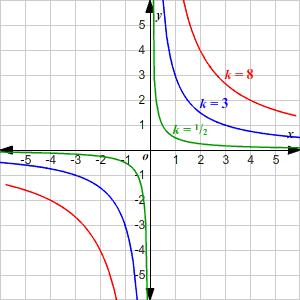
- The graph of inverse variation will be a rectangular hyperbola.
Graph of Inverse Variation
The graph for inverse variation is hence, a hyperbola.
Also Read:
Inverse Variation Table
Let’s take y = 1/x
Now, we will get different values of the second variable as we put values of the first variable.
| x | y = 1/x |
|---|---|
| 1 | y = 1 |
| 2 | y = 0.5 |
| 3 | y = 0.333... |
| 4 | y = 0.25 |
| 5 | y = 0.2 |
Formula of Inverse Variation
[Click Here for Sample Questions]
If x and y are two variables and, k is the constant of proportionality then,
| x ∝ 1/y or, y ∝ 1/x or, x = k/y or, xy = k |
Here, x ≠ 0 and y ≠ 0.
If the variables are (x1y1) and (x2y2) then,
| x 1 y1 = x2 y2 or, x1/x2 = y1/y2 |
Relation Between Two Quantities in Inverse Variation
[Click Here for Sample Questions]
Following is the product rule for inverse variation.
x ∝ 1/y
xy = k
Here, x and y are the values of two quantities.
k is a constant
If x1, y1 are initial values and x2, y2 are final values of quantities existing in inverse variation. They can be expressed as,
x1/x2 = y2/y1
Points to Remember
Following are some important points:
- If k = x / y or, x = ky, then x and y are in direct proportion or variation.
- If x = k/ y or, xy = k, then x and y are in inverse proportion or variation.
- Both the variables that follow an inverse variation should not be equal to 0.
- The product of the two variables is equal to a constant (constant of proportionality or k).
Sample Questions
Ques: Suppose that y varies inversely as x when x = 20 and y = 2. Find the value of x when y = 4. (3 Marks)
Ans: Given,
x = 20, y = 10
The inverse variation formula is:
y = k/x
xy = k
Therefore, k = (20) × (2) = 40
Since, we know that xy = k,
Thus,
x(4) = 40
x = 40/4= 10
Hence, the value of x is 10.
Ques: If y varies inversely with x and when y = 200, x = 50. What will be the value of y when x = 20? (3 Marks)
Ans: Given, y = 200 x = 50
The inverse variation formula is,
y = (k ⁄ x)
200 = (k ⁄ 50)
k = 200 × 50
k = 10000
Now, x = 20, k = 10000
y = (k ⁄ x)
y = (10000 ⁄ 20)
y = 500
Hence, the value of y is 500.
Ques: Suppose x and y are in an inverse proportion such that, when x = 25, then y = 2. What will be the value of y when x = 40? (3 Marks)
Ans: Given: x1 = 25, y1 = 2, x2 = 40, y2 = ?
Using inverse variation formula,
x1 y1 = x
⇒ 25 × 2 = 40 × y2
⇒ 50 = 40 × y2
⇒ y2= 5/4
Hence, the value of y is 5/4.
Ques: Suppose x and y are in an inverse proportion such that, when x = 30, then y = 10. What will be the value of y when x = 100? (3 Marks)
Ans: Given: x1 = 30, y1 = 10, x2 = 100, y2 = ?
Using inverse variation formula,
x1 y1 = x2 y2
⇒ 30 × 10 = 100 × y2
⇒ 300 = 100 × y2
⇒ y2= 3
Hence, the value of y is 3.
Ques: If 15 men are doing work in 30 minutes then how much time will it take for 30 men to do the same? Give the answer in hours. (3 Marks)
Ans: Since, the time is given in minutes,
Therefore, the time taken for 15 men to do the work will be:
30/60 = ½ hours
Let the time taken by 30 men be x hours.
| Number of workers ( men ) | 15 | 30 |
| Time Taken ( in hours ) | 1/2 | x |
Using inverse variation formula,
x1 y1 = x2 y2
⇒ 15 × 1/2 = 30 × X
⇒ 15/4 = 30 x X
⇒ x = ¼
Hence, the time taken will be ¼ hours.
Ques: State whether a/b is a constant when two quantities a and b are in inverse proportion. (2 Marks)
Ans: Yes, a/b is a constant when two quantities a and b are in inverse proportion. We can observe that the quantities given can be in inverse proportion which makes the product equal to the constant value of the given variables. Also, the value of one variable decreases when the other variable increases. Product of these variables also remains constant.
Ques: Give an example of inverse variation. (2 Marks)
Ans: Following is the example of inverse variation: When you want to reach a particular location, the time would decrease as the speed increases. But when you decrease your speed, the time to reach the location will increase. Hence, these quantities are inversely proportional.
Ques: There is a requirement of 7 pipes to fill a tank in 1 hour and 5 minutes. How long will this procedure take if there are only 3 pipes of the same type which are used? (3 Marks)
Ans: Since the time given here is in hours.
Therefore, time taken by 7 pipes to fill a tank = ( 60 + 5 ) minutes
Time taken by 7 pipes to fill a tank = 65 minutes
Let the time required to fill the tank by 3 pipes be x minutes.
| Number of pipes | 7 | 3 |
| Time ( in minutes ) | 65 | x |
Using inverse variation formula,
x1 y1 = x2 y2
65 × 7 = x × 3
65 x 7 x 1/3 = x
Or, x = 105
Thus, the time taken to fill the tank by 7 pipes is 105 minutes or 1 hour 45 minutes.
Ques: State the following two statements:
(A) Considering land to be uniform and fertile, the area and yield of land on it vary:
(B) Number of teeth and age of a person vary:
(2 Marks)
Ans: Following are the answers to the above statements:
(A) Directly with each other
(B) Sometimes directly and sometimes inversely with each other.
Ques: Look closely at the given table and figure out whether the variables ( x and y ) are in inverse variation. (3 Marks)
Ans:
| Price of each candy (in rupees) | 20 | 30 | 40 | 60 |
| Number of candies that can be bought | 60 | 40 | 30 | 20 |
Also, the product of the two variables in all the cases is equal.
20 x 60 = 30 x 40 = 40 x 30 = 60 x 20 = 1200 = constant
Therefore, this is a case of inverse variation.
Also Read:



Comments