



Content Writer
The multiplicative inverse is defined as the number that, when multiplied with another number, will equal the number one. It is also known as the reciprocal of the given value.
- The multiplicative inverse is always the identity of the value used for the computation of numbers.
- The word reciprocal is derived from the latin word reciprocus.
- It is used to simplify all the mathematical representations.
- When you multiply an original number with a reciprocal of a number, the original number must never be equal to 0.
- For instance, the multiplicative inverse of a number X is represented as X-1 or 1/X.
- It can be used for various mathematical domains and numbers.
- To calculate the multiplicative inverse of a real number then, divide the required number by 1.
Read More: Probability
Key Terms: Multiplicative inverse, Complex Numbers, Natural Numbers, Reciprocal, Modulo of multiplicative inverse, Domains, Real Numbers
What is Multiplicative Inverse?
[Click Here for Sample Questions]
A multiplicative inverse of a number is another number, which, when multiplied by 1, gives the original number itself. In simple words, the multiplicative inverse is 1/n for any number (n).
- A multiplicative inverse and the reciprocal of a number both are the same.
- It is a technique in mathematics that helps simplify complex mathematical problems.
- It is a pair of numbers that is when multiplied with another number is similar to 1.
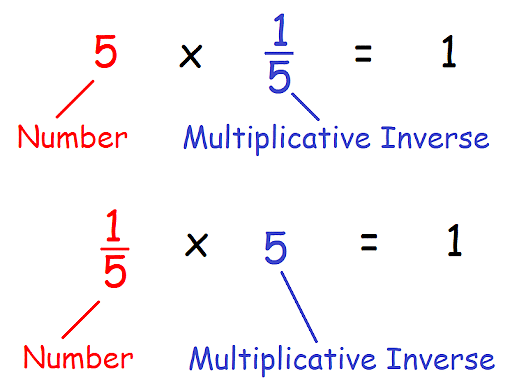
It can be more explained with the following example:
- If a number 8 is given so the multiplicative inverse of the number 8 is 1/8.
- It is because when you multiply 8 & 1/8 with each other the answer would be 1.
- So the meaning of a multiplicative inverse is a number that contradicts the consequence of a number for identifying 1.
The video below explains this:
Quadratic Equations Detailed Video Explanation:
Read More:
Multiplicative Inverse Examples
[Click Here for Sample Questions]
Various examples of multiplicative inverse are as follows:
Multiplicative Inverse of One
The multiplicative inverse of one is one. This is only because 1x1=1.
Multiplicative Inverse of Zero
The multiplicative inverse of zero does not exist because 0 x N=0 and 1/0 are undefined.
Multiplicative Inverse of a Natural Number
The multiplicative inverse of a natural number X is X-1 or 1/X. For instance, the multiplicative inverse of 237 is 1/237 because 237 x 1/237 = 1.
Multiplicative Inverse of a Negative Number
The multiplicative inverse of a negative number -Y is -Y-1 or 1/-X. For instance, the multiplicative inverse of -7 is 1/-7 because -7 x 1/-7 = 1.
Multiplicative Inverse of a Fraction
Here, if the fraction is a unit fraction, then its multiplicative inverse will be the value that is present in the denominator. For instance, the multiplicative inverse of 5/7 is 7/5, and the multiplicative inverse of 1/8 is 8.
Read More:
Properties of Multiplicative Inverse
[Click Here for Sample Questions]
The property of multiplicative inverse clarifies that if you multiply a number with its reciprocal or the multiplicative inverse, you will always get 1 as an answer.
- Consider a number p then P × 1 / P = 1.
For Examples:
- 4 × 1 / 4 =1
- 4 / 5 × 5 / 4 =1
Read More: Baye’s Theorem
How to Find the Multiplicative Inverse?
[Click Here for Sample Questions]
To calculate the multiplicative inverse of a number, try to solve some examples.
Unit fraction
If a fraction has a numerator 1, it will be called a unit fraction. It can be calculated as follows:
- Consider multiplication of 1/9 by 9, the product is 1.
- 1 / 9 × 9=1.
Mixed fraction
To calculate the multiplicative inverse of a mixed fraction, first, you need to convert the mixed one into a proper fraction and determine its reciprocal.
- For Examples: calculate the mixed fraction of 4 1/3
- First, we need to convert it into a proper fraction
- 4 × 3 + 1=13 / 3
- Now we need to find there reciprocal of 13 / 3
- So it will be 3 / 13.
and, multiplicative inverse of 4 1/3 is 3 1/3
Read More: Maxima and Minima
Natural numbers
The natural numbers are all the counting numbers that start from the number 1. The multiplicative inverse of the natural numbers is 1 / a.
- It can be found out as 1 / a × a=1
- For Examples: if we need to find out the multiplicative inverse of 7,9
- The multiplicative inverse of 1 / 7 × 7 = 1
- The multiplicative inverse of 1 / 9 × 9 = 1.
Thus, it is clear that the reciprocal of all the natural numbers is 1.
Complex numbers
The sum of an original & an imaginary saber is called a Complex number. It is expressed in a different form that is: a+ci. Where ‘a is an original number, on the other side, ‘ci’ is a complex number.
- So it is clear that a complex number is a combination of two numbers is a complex number.
- But one number should be original & the other one should be an imaginary one.
- Examples: z = 3 – 2i
- z=3+2i
- z2 =32+-2i2
- 9 + 4 =13
Read More: Trigonometry Values
Modulo of Multiplicative Inverse
[Click Here for Sample Questions]
A modular is a part of arithmetic; the modular of the multiplicative inverse of numbers is a number x such that the product bx is congruent to 1 concerning the modular m. This can be written as s: bx =1 mod m.
- It is the standard way of writing it, which shows that m evenly divides the quantity box-1.
- The modular multiplicative inverse is different from the other multiplicative inverses.
It can be understood by two different methods, which are as follows:
First method
- Consider two integers numbers' m'. Now, find out the modular multiplicative inverse of 'b' under the modulo 'm'.
- The Modular of an integer' x' such that
- ax=1mod m
Second method
- If b & m are coprime, then you can also find multiplicative inverse modulo with the help of The Extended Euclidean Algorithm.
- By the Extended Euclidean Algorithm, it takes numbers to say 'b' & 'a' find their gcd & also find 'x' & 'y'.
- Now, to find the Reciprocal of 'b' under 'm', we need to substitute b=m in the above formula. As we know, m & b are relatively prime, so the value of gcd would be taken as 1.
- ax + my =1
- And if we take modulo on both sides, All we get is
- ax + my = 1 mod m
Read More: Perimeter and Area of Circle
Solved Examples of Multiplicative Inverse
[Click Here for Sample Questions]
Example 1: What is the multiplicative inverse of -5?
Solution: As we know, the reciprocal of -5 is -1 / 5
- Number x Multiplicative inverse = 1
- (-5) x (-1/5) = 1
- 1 = 1
Therefore, the multiplicative inverse of -5 is -1 / 5.
Example 2: What is the reciprocal of 7 / 53?
Solution: Multiplicative inverse of 7/53 = (1 / 7) / (1 / 53)
- Required inverse is : 53 / 7
- Number x Multiplicative inverse = 1
- (7/53) x (53/7) = 1
Therefore, the solution is 53/7.
Example 3: Find the reciprocal of x2.
Solution: The reciprocal of x2 is 1 / x2 or x-2
- x2 × x-2 = 1
- 1 = 1
Read More:
Things to Remember
- The multiplicative inverse for number 1 is one, but for number 0, it can not be defined.
- Multiplicative inverse is also known as reciprocal inverse.
- To calculate the multiplicative inverse for a mixed fraction, you need to convert it into a proper fraction.
- Always remember when a number is multiplied by its multiplicative inverse, the result is always 1.
- The multiplicative inverse is also called a reciprocal number.
Sample Questions
Ques. Find out the reciprocal of 48. (1 mark)
Ans. Suppose, x=1
- Since 48×84=1
Therefore x -1= 84
Ques. Fiind out the reciprocal of the following: a) 4, b) 15, c) 17 & d) 28 (3 marks)
Ans. a) Value of x= 4
Reciprocal= 1 / x
Thus, the reciprocal of 4= 1/ 4
- Value of x = 15
Reciprocal= 1 / x
Thus, reciprocal of 15= 1/ 15
- Value of x = 17
Reciprocal= 1 / x
Thus, the reciprocal of 17= 1 / 17
- Value of x= 28
Reciprocal= 1 / x
Thus, the reciprocal of 28= 1 / 28
Ques. How to find the multiplicative inverse of a fraction? (2 marks)
Ans. To calculate the multiplicative inverse of a fraction you should understand with the following example;
- Because it will be easier to learn it with an example.
- For example, the Inverse of a fraction a/b is b/a
- Thus,
- The multiplicative inverse of 2 / 3 = 3 / 2
- The inverse of 1 / 6 = 6 / 1 = 1
Ques. Difference between multiplicative inverse and reciprocal. (2 marks)
Ans. There is no difference between the multiplication inverse and reciprocal of a number they both are the same on meaning. As per mathematics, if a product of 2 given numbers is 1 so it is said that both of the numbers are the multiplicative inverse of each other. The reciprocal of a number is nothing but another name of the multiplicative inverse of a number.
Ques. Define a complex number. (2 marks)
Ans. A number that consists of an original number and an imaginary number is called a complex number. These numbers are different from the real number. The reputation of these numbers is different from the other numbers.
- Because when you write a normal number you write is ait1,2,3,4 and so on.
- But when you write a complex number, you need to include 1 original & 1 imaginary number.
- Like, y+zi is a complex number.
Ques. Find out the reciprocal of c3. (2 marks)
Ans. It can be calculated as follows:
The reciprocal of c3 will be: 1 / c3
- 1 / c3 ×c3 =1
So, the reciprocal of c3 is 1.
Ques. Find out the reciprocal of 11 / 44. (2 marks)
Ans. Given, 11 / 44
- After simplifying the number we will get, 11 / 44 =1/4
- The reciprocal of 1 / 4 = 4
- Now, 1/ 4 × 4 =1
So the reciprocal of 11 / 44 is 1.
Ques. Find out the multiplicative inverse of -4 / 5. (2 marks)
Ans. Given in the question: -4 / 5
- Thus the reciprocal or multiplication inverse of -4 / 5 is
- -4 / 5 × -5 / 4=1
Thus, the multiplicative inverse or a reciprocal number of -4 / 5 is 1.
Ques. The total distance from Mark's home to school is 3 / 5 of a kilometer. He can ride his cycle 1 / 3 kilometer in a minute. In how many minutes will he reach his school from home. (3 marks)
Ans. Total distance from home to school = 3/5 km
- Distance covered in a minute = 1/3 km
- The time taken to cover the total distance = total distance / distance covered in a minute
- 3/5 ÷ 1/3
- The multiplicative inverse of 1/3 is 3.
- 3/5 × 3 = 9/5 = 1.80 minutes
Time taken to cover the total distance by Mark is 1.80 minutes.
Ques. Find the reciprocal of 7 / 8. (2 marks)
Ans. Let x = 7 / 8.
Since, 7 / 8 × 8 / 7 = 1
Therefore, x−1 = 8 / 7.
Ques. Simplify : (15 / c) / (3 / c2). (2 marks)
Ans. To solve this equation multiply the numerator by the reciprocal of the denominator.
- (15 / c) / (3 / c2) = (15 / c) ÷ (3 / c2) = (15 / c) × (c2 / 3)
- Solve the multiplication.
- (15 / c) × (c2 / 3) = (15 × c2) / (c × 3)
- (15 c2 ) / (3c)
Now we need to reduce the fraction to find our final answer.
- (3c x (5c)) / (3c) = 5c
Ques. A pizza is sliced into 8 pieces. Tom keeps 5 slices of the pizza at the counter and leaves the rest on the table for his 5 friends to share. What is the portion that each of his friends gets? Do we apply multiplicative inverse here? (3 marks)
Ans. Since Tom ate 5 slices out of 8, it implies he ate 5/8th part of the pizza.
- The pizza left out = 1 - 5/8 = 3/8
- 3/8 to be shared among 5 friends ⇒ 3/8 ÷ 5.
- We take the multiplicative inverse of the divisor to simplify the division.
- 3/8 ÷ 5/1
- 3/8 × 1/5
- 3/40
Each of Tom's friends will be getting a 3/40 portion of the left-over pizza.
Check-Out:



Comments