



Content Curator
The isotopic mass of an element is referred to as the most abundant isotope of an element. An atom is the smallest particle of an element and is composed of electrons, protons, neutrons. Atomic number is defined as the total number of electrons present in an atom. However, mass number is defined as the sum of the number of protons and neutrons. In any atom, the number of protons equals the total number of electrons, which in terms adds a neutral because of the equal and opposite charges of both electrons and protons.
| Table of Content |
Key Terms: Mass, Matter, isotopic, atom, atomic mass, neutrons, protons, isotopes
Read also: Properties of Matter
Expressing Atomic Mass
[Click Here for Sample Questions]
The atomic mass can be expressed using unified atomic mass units (u). While considering atoms there are few atoms which have the same number of protons but they actually differ in their mass number and the reason behind this is the number of neutrons, and these are called isotopes. For example, 3 hydrogens'>isotopes of hydrogen can be given as deuterium (D), hydrogen (H), tritium (T).
In the above example the atomic number remains the same, whereas the mass numbers are different, which are 1, 2, 3, respectively. In nature, isotopes are found in different percentages4. As an exception few isotopes are found in abundance in nature, while a few of them undergo the process of decay followed by radioactivity. For example, C-12 is known as the most abundant isotope of carbon, and, on the other hand, C-14 which is a radioactive isotope of carbon. The half-life cycle of these isotopes is of 5500 years.
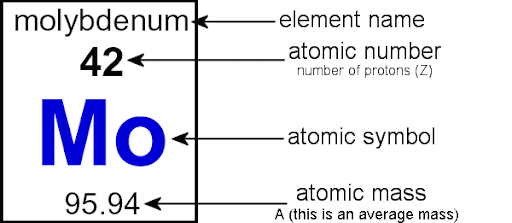
Expressing Atomic Mass
Read More: Energy Level Diagram
Isotopic Mass Definition
[Click Here for Sample Questions]
While considering the isotopes at the macroscopic level, measuring the mass of pure substance gives the mass of isotopic mixture. In other words we can say that mixtures are impure, but of all known mixtures, for instance the oxygen it is not necessary that the molecule's macroscopic mass equals the microscopic mass.
A certain isotopic distribution is indicated through the macroscopic mass. The macroscopic mass indicates the isotopic distribution whereas the microscopic mass is referred to the mass of the most common isotope of oxygen, O-16. Macroscopic mass is also known as either the atomic weight or molecular weight of an atom.
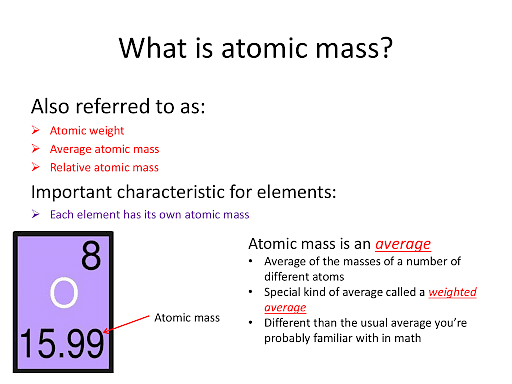
Atomic Mass
How to Find Isotopic Mass?
[Click Here for Sample Questions]
It is already known to us that isotopes are atoms that have the same atomic number but they differ in the number of neutrons. The mass number of an element aare expressed in terms of whole number, whereas the actual atomic mass of an atom is not a whole number. Carbon-12 is an exception.
For example, the atomic mass of Lithium is given as 6.941 Da. On the basis of the number of isotopes present the average atomic mass and the isotopic mass of an element can be calculated. The average mass of the element E is expressed as:
m(E)=n=1m(In) p(In)
For example, mass and the number of isotopes of Boron can be given as follows.
| S. No | Isotope In | Mass m (Da) | Isotopic Abundance p |
|---|---|---|---|
| 1 | 10B | 10.013 | 0.199 |
| 2 | 11B | 11.009 | 0.801 |
The average mass of Boron is calculated as follows.
m(B) = (10.013 0.199) + (11.009 0.801)
=(1.99) + (8.82)
= 10.81 Da
Relative Isotopic Masses
[Click Here for Sample Questions]
It is quite difficult to express the mass of an element since the relative isotopic masses is expressed as one of the best methods to express the known elements' mass. It is expressed as 'Ar';
Ar = m/mu
The relative isotopic mass of an element is defined as a unitless quantity while considering some standard mass quantity. The relative atomic mass of an element is defined as the atom's weighted mean mass of an element to that of the mass of 1/12 of the mass of an atom in the C-12 element.
In the similar manner the relative isotopic mass is referred to as the atom's mass of an isotope considering the mass of 1/12 of the mass of an atom in the C-12 element. The number of isotopes can be used to calculate the isotopic weights and average atomic weight.
Read More: Group 15 Elements
Average Isotopic Mass
[Click Here for Sample Questions]
The average isotopic mass can be calculated using the percentage of the isotopic mass. For example, two isotopes of Nitrogen are expressed as N-14, N-15, and the average isotopic mass of Nitrogen can be given as 14.007. The percentage abundance of both isotopes can be calculated as follows.
14.003074 x X + 15.000108 x 1 - X = 14.007
14 x X + 15 x 1 - X = 14.007
X = 15 - 14.007 = 0.993
1 - X = 0.007
Hence, 99.3 % will be the percentage abundance of N-14, whereas, for N-15, it would be 0.7%. In the same manner, the average isotopic mass of copper is given as 63.546, and the atomic mass of Cu-63 is given as 62.929 amu, and the Cu-65, as 64.927 amu. Hence, the resultant abundance percentage can be given as follows.
62.9296 x X + 64.9278 x 1 - X = 63.546
Therefore, x = 0.6915
Thus, 69.15 % would be the percentage abundance of Cu-63, whereas the rest will be Cu-65.
Read More: Group 16 Elements
Things to Remember
- Isotopic mass is referred to as the mass of the most abundant isotope of an element.
- The average isotopic mass can be calculated using the percentage of the isotopic mass.
- The relative isotopic mass is defined as a unitless quantity while considering some standard mass quantity.
- Isotopes of an element contain similar chemical properties.
- A chemical formula of a compound shows its constituent elements and the number of atoms of each combining element.
Sample Questions
Ques. Give Some Uses of Isotopes? [2 Marks]
Ans. A few of the uses of isotopes can be given as follows.
- The physical properties of isotopes are different and also depend on their masses.
- They contain a different number of neutrons, which affects both their mass number and mass.
Ques.Why Isotopes Hold Different Mass Numbers? [2 Marks]
Ans. Since different isotopes contain different numbers of neutrons, mass and weight are not the same. Different isotopes of the similar element contain a similar atomic number and the number of protons remains the same. The number of protons decides the atomic number.
Ques. Why Do Isotopes Contain Different Melting Points? [2 Marks]
Ans. The atomic mass of most elements is expressed in fractional value and they occur as a combination of isotopes of varying masses. As we know in nature most elements occur as an isotopic mixture of different masses. Hence resulting fractional atomic masses.
Average mass = Total mass of overall atoms/number of atoms
Ques. Why is the Isotopes' Atomic Mass Not a Whole Number? [2 Marks]
Ans. The atomic mass of an atom is given as the sum of the number of protons and neutrons present in the nucleus, which is always a whole number. On the other hand, atoms of a specific element do not always have a similar number of neutrons, so in a macroscopic sample elements will have atoms of different weights. Hence, resulting fraction can be expressed as the weighted average atomic mass, which happens naturally.
Ques.Define atomic mass unit. [2 Marks]
Ans: An atomic unit of mass is defined as accurately 1/12 the mass of a carbon-12 atom. The carbon-12 atom has six neutrons and six protons in its nucleus. The atomic unit mass is symbolized as AMU or amu.
Ques. Define atomicity. [2 Marks]
Ans: Atomicity is defined as the total number of atoms present in a molecule. Example: NH3 (Ammonia) has one nitrogen atom and three hydrogen atom. Hence, the atomicity is four.
Ques. What are polyatomic ions? Give examples. [2 Marks]
Ans: Polyatomic ions are the ions containing more than one atom.. For example, nitrate ion, NO3-, contains one nitrogen atom and three oxygen atoms. The atoms in a polyatomic ion are usually bonded covalently to one another, and therefore stay together as a single, charged unit.
Ques. Calculate the number of molecules of sulphur (S8 ) present in 16 g of solid sulphur. [2 Marks]
Ans: Moles of S8= 16/256
=1/16 mol
Number of molecules= NA/16
=6.023 x 1023
= 3.76*1022
Ques. Calculate the number of aluminium ions present in 0.051 g of aluminium oxide. [2 Marks]
Ans: n = N / N O.
Given mass of Aluminium ion (Al 2 O 3 )= m = 0.051g.
N = 6.022 x 10 23 x (0.051 / 102)
= 6.022 x 10 23 x (51 x 10 -3 ) / 102.
Thus, 6.022 x 10 20 Al 3+ ions are present in 0.051 molecules of Al2O3.
Ques. Write the chemical formulae of the following: [2 Marks]
(a) Magnesium chloride (b) Calcium oxide (c) Copper nitrate (d) Aluminium chloride (e) Calcium carbonate.
Ans: (a) Magnesium chloride
An inorganic compound consisting of one magnesium and two chloride ions. Magnesium chloride is used to treat or prevent magnesium deficiency (lack of natural magnesium in the body).
(b) Calcium oxide (CaO)
Calcium oxide (CaO), commonly known as quicklime or burnt lime, is a widely used chemical compound.
(c) Copper nitrate Cu (NO3)2
Cupric Nitrate is a bluish-green, odourless crystalline (sand-like) material.
(d) Aluminium chloride (AlCl3)
Aluminium chloride (AlCl3) is the main compound of aluminium and chlorine. It is used to treat excessive sweating, also called hyperhidrosis.
(e) Calcium carbonate (CaCO3)
Calcium carbonate also is used as an antacid to relieve heartburn, acid indigestion, and upset stomach.
Read More about:



Comments