



Education Journalist | Study Abroad Lead
Atomic mass is the total mass of an atom that comprises of its electrons, protons, and neutrons. It helps to determine an element's composition and significance. Atomic mass is the average mass of atoms of an element. It takes into account the abundance of isotopes.
- It is also known as atomic weight.
- Expressed in atomic mass units (amu), atomic mass is a fundamental concept in chemistry.
- It provides a way to quantify the mass of the atom of an element atoms relative to a standard reference.
Atomic Mass Definition
[Click Here for Sample Questions]
The atomic mass, defined as the total mass of one atom of an element, is the sum of protons and neutrons. Electrons have negligible mass and thus they are excluded from atomic mass calculations.
- Unified atomic mass is defined as the unit of the atomic mass of a given element.
- Moreover, Dalton is also considered to be the standard unit of the atomic mass of a given element.
- When the mass of an isotope of an element is compared to 1/12th of the mass of the carbon 12 isotope, it is called the atomic weight.
- It can also be called the relative isotopic mass.
Key Points
|
| Related Concepts | ||
|---|---|---|
| Oxides of Nitrogen | Oxides of Phosphorus | Phosphine |
| Periodic Classification of Elements | Electron Emission | First 20 Elements |
Methods to Find the Atomic Mass
[Click Here for Sample Questions]
There are various methods to determine the atomic mass of an element. The atomic mass, also known as atomic weight, is a weighted average. The value is calculated taking into account the relative abundance of different isotopes of the element. The three distinct methods to find the atomic mass of elements are as follows –
Method 1 – Sum of Protons and Neutrons
These steps involve calculating the sum of the total number of protons and the total number of neutrons. The atomic mass can be determined by adding the number of protons to the number of neutrons
| Atomic Mass = number of protons + number of neutrons |
Since the number of protons is also equal to the atomic number (Z) of a given element.
Therefore, Atomic Mass = Atomic Number + Number of Neutrons
| Example: Calculate the atomic mass of an oxygen atom. Total number of protons = 8 Total number of neutrons = 9 So, the atomic mass of Oxygen atom is = Protons + Neutrons = 8 + 9 = 17 The atomic mass of a given oxygen atom is 17 amu (atomic mass unit). |
Method 2: Atomic mass Through Periodic Table
The atomic mass of a sample can be determined with the help of the periodic table. The atomic mass of an element is usually given at the bottom of the symbol. To determine the atomic mass of a natural sample you must either know the symbol or name of the element or the atomic mass of a given element.
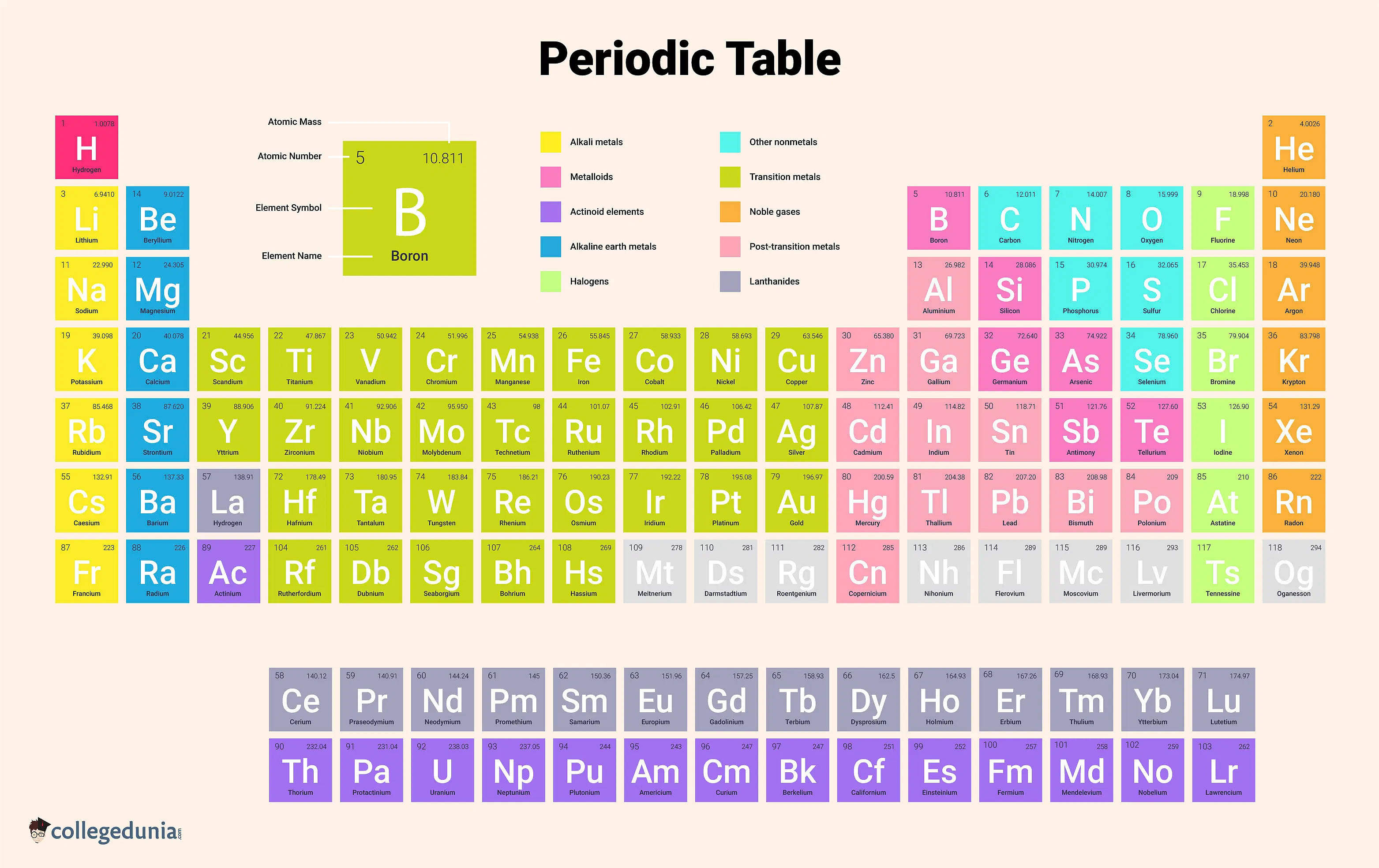
| Example: Determine the atomic mass of an element with the atomic number 27. Since we know the atomic number of this particular element, we check the periodic table for the same. The atomic mass of an element with atomic number 27 (i.e., Cobalt) is 58.9332 amu.
|

The periodic table typically provides atomic mass in atomic mass units (amu), although the preferred unit for calculations is grams per mole.
Method 3 – Average Atomic Mass of Isotopes
Elements may have isotopes with different numbers of neutrons. The different atoms with the same number of protons but different numbers of neutrons are called the isotopes of that particular element.
- The average atomic mass of an element is the average atomic mass of the different isotopes of that particular element.
- It is calculated by multiplying each isotope's mass by its abundance percentage, dividing by 100, and summing these values.
There are certain steps involved in calculating the average atomic mass of an element:
Step 1: Multiply the atomic mass of an element (i.e., its mass number) with the abundance percentage.
Step 2: Divide the obtained result by 100.
Step 3: Add the different values obtained from step 1 and step 2 of different isotopes.
| Example: Calculate the average atomic mass of a sample of boron with two isotopes: one is B-10 with an abundance of 19.9% and the other is B-11 with a natural abundance of 80.1%. Now, following the steps of the process, For the B-10 atom, the average atomic mass is (10* 19.9)/100 = 1.99amu For the B-11 atom, the average atomic mass is (10*80.1)/100 = 8.01amu So, the average atomic mass of the Boron atom is 1.99+8.01 = 10amu |
Ways of Finding Atomic Mass of an Element
[Click Here for Sample Questions]
The atomic mass of an element can be found in the following ways:
- Locate Isotopic Abundancies
Elements can exist in multiple isotopes, which are atoms with the same number of protons but different numbers of neutrons. Find the isotopic abundances of the different isotopes of the element.
- Convert Percent Abundances to Decimals
If the isotopic abundances are given in percentages, convert them to decimal form. For example, if an isotope has an abundance of 20%, convert it to 0.20.
- Multiply Isotopic Mass by Abundance
Multiply the mass of each isotope by its abundance. The mass of each isotope is usually given in atomic mass unit (amu). If you have percentages, this step is done by multiplying the decimal abundance by the mass of the isotope.
- Add up the products obtained from the multiplication step.
This sum represents the weighted average mass of the atoms.
The formula for calculating atomic mass Matomic is:
Matomic = (M1 x Abundance1) + (M2 x Abundance2) + …
where M1, M2, ... are the masses of the isotopes, and Abundance1, Abundance2, ... are their respective abundances.
| Example: Let's consider an element "X" with two isotopes: - Isotope X-10 has a mass of 10 amu and an abundance of 25% (0.25). Matomic = (10 x 0.25) + (11 x 0.75) Matomic = 2.5 + 8.25 Matomic = 10.75 amu So, the atomic mass of element X is 10.75 amu. |
Finding Atomic Mass – Real-Life Applications
[Click Here for Sample Questions]
Finding atomic mass has several real-life applications, especially in the fields of chemistry, physics, and industrial processes. Some practical applications are:
- Atomic mass is crucial in chemical reactions for stoichiometry.
- It enables chemists to determine precise proportions of reactants and products.
- Atomic mass is used to calculate the amounts of elements and compounds in drug formulation.
- It ensures specific drug properties in pharmaceuticals.
- Essential in environmental science, atomic mass identifies elements in soil, water, and air, evaluating their impact on ecosystems.
- Different atomic masses of isotopes aid fields like archaeology and forensics, in tracing the origin of materials.
- Precise atomic masses determine energy in nuclear reactions, playing a vital role in nuclear power generation.
- Atomic mass calculates material density, aiding engineers in designing materials with specific physical properties.
- In Mass Spectrometry, atomic mass identifies biomolecules, crucial in disease diagnosis and drug development.
- Carbon isotope atomic mass is used in radiocarbon dating, to estimate the age of organic materials.
Things to Remember
- Atomic mass is the sum total of the number of protons and neutrons.
- While calculating atomic mass, use the average atomic mass mentioned in the periodic table.
- The atomic mass in the periodic table is given in the atomic mass unit (u).
- For a particular element, the total number of neutrons may vary but the number of protons will remain the same.
- The atomic number of an element is equal to the number of protons or the number of electrons in a given atom.
- In chemistry, grams per mole (g/mol) unit for atomic mass is used for doing calculations instead of atomic mass unit(u).
Sample Questions
Ques 1. The average atomic mass of a hypothetical element A is 16.2u. Calculate the percentage of its isotopes \((A^{16}_{8})\) and \((A^{18}_{8})\). (4 marks)
Ans: The average atomic mass of element A (denoted as \((A^{16}_{8})\) and \((A^{18}_{8})\) is given by:
Average Atomic Mass = \(\frac{(16 \times \text{Abundance of } A^{16}_{8}) + (18 \times \text{Abundance of } A^{18}_{8})}{100} \)
Given that the average atomic mass is 16.2u, we can set up the equation:
16.2 = \(\frac{(16 \times x) + (18 \times (100 - x))}{100} \)
Solving for x:
1620 = 16x + 1800 - 18x
1620 = -2x + 1800
-2x = 1800 - 1620
-2x = 180
x = 90
Therefore, the abundance of \((A^{16}_{8})\) is 90%, and the abundance of \((A^{18}_{8})\) is 100 - x = 100 - 90 = 10%.
Ques 2. Calculate the average atomic mass of an element having one isotope with a natural abundance of 90.92% with an isotopic mass of 19.99 amu, second with the abundance of 8.82% and isotopic mass of 21.99 amu, and third with 0.26%, and isotopic mass 20.99amu. (2 marks)
Ans: The average atomic mass of the element = (90.92% * 19.99)/100 + (8.82 * 21.99)/100 + (0.26 * 20.99)/100
= 18.17 + 1.93 + 0.05
= 20.15 amu
So the average atomic mass of the element is 20.15amu.
The average atomic mass Am of an element can be calculated using the formula:
\([ A_m = \frac{(m_1 \times a_1) + (m_2 \times a_2) + (m_3 \times a_3)}{100}] \)
Where:
- \((m_1, m_2, m_3)\) are the isotopic masses,
- \((a_1, a_2, a_3)\) are the abundances as percentages.
Given the data:
\((m_1 = 19.99 \, \text{amu}\), \(a_1 = 90.92\%) \)
\((m_2 = 21.99 \, \text{amu}\), \(a_2 = 8.82\%) \)
\((m_3 = 20.99 \, \text{amu}\), \(a_3 = 0.26\%)\)
Plug these values into the formula:
\(A_m = \frac{(19.99 \times 90.92) + (21.99 \times 8.82) + (20.99 \times 0.26)}{100} \)
\([ A_m = \frac{1818.1908 + 194.3178 + 5.4474}{100}]\)
\([ A_m = 20.18956 \, \text{amu} ]\)
So, the average atomic mass of the element is 20.19 amu.
Ques 3. The IUPAC list of the average atomic masses is derived from the experimental basis. According to some earlier experiments, bromine consists of 2 isotopes, one with an isotopic mass of 78.9183 amu and 50.69% abundance and the other with an isotopic mass of 80.9163 amu and 49.31% abundance. Calculate the average atomic mass of Bromine. (2 marks)
Ans: The average atomic mass of Bromine = (78.9183 * 50.69)/100 + (80.9163 * 49.31)/100
= 40 + 39.89
= 79.89
So the average atomic mass of Bromine is 79.89 amu.
Ques 4. In some meteorites, the abundance ratio of 18O:16O is greater than that of the average atomic mass calculated on Earth. Compare the average atomic mass of an oxygen atom in these meteorites with that of the Earth. (3 marks)
Ans: The average atomic mass of an element on Earth is calculated based on the relative abundance of its isotopes. For oxygen, the isotopes include 16O, 17O, and 18O. The most abundant isotope on Earth is 16O, followed by 18O, and 17O is the least abundant.
The ratio of 18O to 16O in some meteorites is greater than what is typically found on Earth. This difference in isotopic composition can be attributed to the unique conditions in the early solar system.
To compare the average atomic mass of an oxygen atom in these meteorites with that of Earth, you would look at the weighted average of the isotopic masses. The higher abundance of 18O in meteorites would contribute more to the average atomic mass in those samples, making it slightly higher than the average atomic mass of oxygen on Earth.
Ques 5. Find out which one of these has the highest number of molecules: 1 mole of H2, O2, and F2 each. (1 mark)
Ans: 1 mole of a compound contains 6.022 x 10²³ molecules. Since, all these three H2, O2, and F2 are given one mole each, all have the same number of molecules i.e., 6.022 x 10²³ molecules.
Ques 6. Give the importance of 1 amu. (1 mark)
Ans: amu refers to the atomic mass unit. 1 amu = one-twelfth of the carbon-12 atom’s mass.
Ques 7. How to measure atomic weight? (1 mark)
Ans: In the case of any isotope the sum total of the nucleus’ neutrons and protons is known as the mass number. To get the atomic weight one can multiply the abundance of an isotope present in an element by the atomic mass and then by taking the result after adding them both.
Ques 8. State the three different methods to find out the atomic mass. (3 marks)
Ans: The three different methods to find out the atomic mass:
- Sum total of protons and neutrons of a single atom
- Atomic mass through the periodic table
- The average atomic mass of given isotopes of a particular element.
Ques 9. Describe a real-world application where the knowledge of atomic mass is essential. (3 marks)
Ans: In mass spectrometry, a technique used in various scientific fields, including chemistry and biochemistry, the precise measurement of atomic masses is crucial. Mass spectrometry analyzes the mass-to-charge ratio of ions, providing information about the composition of a sample. The accurate determination of atomic masses is vital for identifying and characterizing molecules, making it a fundamental aspect of this analytical method.
Ques 10. Explain the significance of the atomic mass unit (amu) in expressing atomic masses. (2 marks)
Ans: The atomic mass unit (amu) is a standard unit used to express atomic masses on a scale relative to the mass of a carbon-12 atom. Since atomic masses are extremely small, using grams would result in inconveniently small values. The amu provides a more convenient scale for expressing these masses, allowing for easier comparison of the masses of different atoms and isotopes.
For Latest Updates on Upcoming Board Exams, Click Here: https://t.me/class_10_12_board_updates



Comments