



Education Journalist | Study Abroad Lead
Lagrange points or Lagrangian points are the points in space at which the force that is exerted between any two given objects becomes equal. The objects at the Lagrangian point experience a neutral kind of force. The two-body systems such as Earth and the sun produce some enhanced regions of attraction as well as repulsion. It plays a very important role in astronomy and can be used by spacecraft to remain in their position without consuming much fuel. There are basically five Lagrange points wherein a body of a small mass can orbit in a pattern with any two larger masses. In this article, we will learn more about the Lagrangian points, their use, and mathematical representations.
| Table of Content |
Key Takeaways: Lagrangian points, Astronomy, Celestial Bodies, Earth, Sun, Satellite, Gravitation
What are Lagrangian Points?
[Click Here for Sample Questions]
Lagrangian Point or Lagrange Point can be understood as a point that is near two large celestial bodies moving in an orbit in a way that the smaller object is able to maintain its position in relation to the large bodies. Lagrangian points can also be called Lagrange points or Liberation Points, and are denoted by L.

Lagrangian Point
For every known combination of 2 large bodies, there exist up to 5 Lagrangian points from L1 to L5. Leonhard Euler discovered the first three Lagrangian points i.e. L1, L2, and L3. The remaining two points, L4 and L5, were later discovered by Joseph Louis.
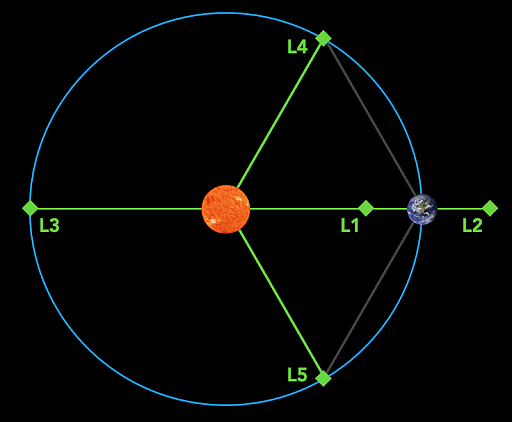
Lagrangian Point of a two-body system
Of all the five Lagrangian points, three of them are unstable while two are stable.
- L1, L2, and L3 are the three unstable Lagrange points that lie along the line that connects two of the large masses.
- L4 and L5 Lagrangian points however are stable points that form the apex of 2 equilateral triangles having large masses on their vertices.
In the system of Earth and sun, L1 and L2, the first two Lagrangian points exist at about 1,500,000 km or 900,000 miles from the Earth away and towards the sun. Satellites are located at the Lagrangian of the sun earth system.
Read More: Space Wave Propagation
Lagrange Points and Mathematical Details
[Click Here for Sample Questions]
There are 5 Lagrangian Points which are as follows:
Lagrange Point 1 (L1)
The point existing on the line between two large masses, known as M1 and M2 is the Lagrange Point 1. The gravitational attraction of a mass is partially canceled by the gravitational force of the other one. The mathematical representation of this point is:
\(\frac{M_1}{(R-r)^2}\)= \(\frac{M_2}{r^2}\)+\(\frac{M_1}{R^2}\)-\(\frac{r(M_1+M_2)}{R^3}\)
Here, r refers to the distance of an L1 point from the small object
R refers to the distance that exists between two main objects
M1 and M2 refer to the mass of the large and small object respectively
The L1 point of the Earth-sun system offers is currently home to SOHO (the Solar and Heliospheric Observatory Satellite). The point gives an uninterrupted view of the sun
Lagrange Point 2 (L2)
Lagrange Point 2 is the point that exists beyond the smaller of the two masses and on the line defined by them. The centrifugal effect on a body present at the L2 point is balanced by the gravitational force of both the large masses. The mathematical representation of this point is:
\(\frac{M_1}{(R+r)^2}\)+ \(\frac{M_2}{r^2}\)=\(\frac{M_1}{R^2}\)+\(\frac{r(M_1+M_2)}{R^3}\)
Here, r denotes the distance of the point L2 from the smaller of the two object
R denotes the distance between any two main objects
M1 and M2 denote the mass of the large and small objects respectively.
WMAP spacecraft was located at the L2 point of the Earth-sun system. It is a vital point in astronomy as the spacecraft is close enough to communicate with the Earth in a proper manner, can keep the Sun, moon, and Earth behind it, and with appropriate shielding can provide a clear view for our telescopes to explore the deep space.
Using a satellite at point L2, it was studied and observed that:
- 2.735 K was the average temperature that was recorded in space.
- Space is made up of 73% dark energy, 23% dark matter, and only 4% of the mass.
- Points lying outside the magnetic field of the Earth were also discovered.
- As there is no deflection observed in the position of the satellite at this point because it has no gravitational pull, the data recorded is accurate and reliable.
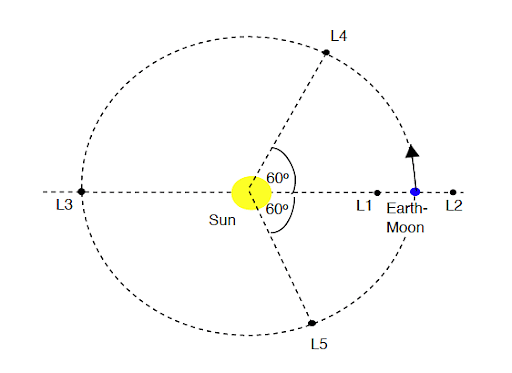
Lagrange Point 3 (L3)
The point that lies beyond the larger of the two masses and on the line defined by them is known as the Lagrange Point 3. The mathematical representation of this point is:
\(\frac{M_1}{(R-r)^2}\)+ \(\frac{M_2}{(2R-r)^2}\)=(\(\frac{M_2}{M_1+M_2}\)R+R-r)\(\frac{M_1+M_2}{R^3}\)
Here, r denotes the distance between the L3 and the smaller object
R denotes the distance between both the main objects
M1 and M2 denote the mass of the large and small objects respectively.
The point L3 remains hidden behind the sun at all points of time.
Read More: Difference Between Equinox and Solstice
Lagrange Point 4 (L4) and Lagrange Point 5 (L5)
L4 and L5 points exist on the line defined by the centers of both the masses in a way that they lie at the third corner of both the equilateral triangles. Using radial acceleration, the mathematical representation of this point is
a = \(\frac{-GM_1}{r^2}\)sgn(r) + \(\frac{GM_2}{(R-r)^2}\)sgn(R-r) + \(\frac{G((M_1+M_2)r-M_2R}{R^3}\)
Here, a refers to the radial acceleration
r refers to the distance from the larger body
sgn(x) is the sign function of x
L5 follows while L4 leads the orbit of the Earth. They are home to stable orbits as long as the mass ratio between both the masses is more than 24.96. Objects that orbit at the L4 and L5 points are known as Trojans.
Read More:
Applications of Lagrangian Point
[Click Here for Sample Questions]
Some applications related to spacecraft and Lagrangian points are:
- For the Earth-sun system, at Lagrangian points objects are never shadowed by either the moon or the Earth.
- For a solar telescope, it provides an uninterrupted view of the space weather and the sun at point L1.
- For the Earth-moon system, lunar orbits and Earth become easily accessible with negligible changes to velocity.
The easiest way to understand the system of Lagrange points is to think of a frame of reference that rotates with the entire system. The forces acting on a body at rest in this frame can be calculated using an effective potential in the same way that wind speeds can be calculated using a weather map. When the contours of the effective potential are close together, the forces are strongest, and when they are far apart, the forces are the weakest.
Things to Remember
- Lagrangian points are the points in space at which the force that is exerted between any two given objects becomes equal.
- The two-body systems such as Earth and the sun produce some enhanced regions of attraction as well as repulsion.
- For every known combination of 2 large bodies, there exist up to 5 Lagrangian points from L1 to L5.
- The point existing on the line between two large masses, known as M1 and M2 is the Lagrange Point 1.
- Lagrange Point 2 is the point that exists beyond the smaller of the two masses and on the line defined by them.
- The point that lies beyond the larger of the two masses and on the line defined by them is known as the Lagrange Point 3.
- L4 and L5 points exist on the line defined by the centers of both the masses in a way that they lie at the third corner of both the equilateral triangles.
Read More:
Sample Questions
Ques. How many Lagrangian points or Lagrange points are there? (3 marks)
Ans. There are basically 5 Lagrange Points for any two-body system. Of all the five Lagrangian points, three of them are unstable while two are stable.
- L1, L2, and L3 are the three unstable Lagrange point that lies on the line connecting two of the large masses.
- L4 and L5 Lagrangian points are stable points that form the apex of 2 equilateral triangles having large masses on their vertices.
Ques. Describe the structure of Lagrange points. (5 marks)
Ans. There mainly exist five Lagrangian points around major bodies such as a star or a planet. For the Earth-Sun system, these points are:
- The location of L1 is between the sun and the Earth. It exists at about a million miles from the Earth. An uninterrupted view of the sun is visible from this point.
- L2 point also exists about a million miles from Earth but in the entirely opposite direction from the sun. A spacecraft at this point has the Earth, moon, and the sun behind it and therefore gets a clear view of the deep space.
- L3, the third Lagrange point, is somewhere behind the sun, opposite to the orbit of the Earth. It has not been yet accessible to us.
- These L1, L2, and L3 points are highly unstable. If a spacecraft present at L3 drifts away or towards the Earth, it would eventually irreversibly fall towards the Earth or the sun. L4 and L5 points are however stable in nature.
- L4 and L5 lie along the orbit of the Earth at about 60 degrees behind or ahead of Earth. It forms the apex of the two equilateral triangles. These triangles have large masses such as the Earth and the sun on their vertices.
- As these points are stable, they eventually become home to asteroids and dust. Asteroids around the L4 and L5 points are known as Trojans. These points are relatively close to the Earth.
Ques. State some benefits of Lagrangian points. (3 marks)
Ans. A spacecraft located at Lagrange point can ideally be used for observation and research. It is an ideal location for the spacecraft as:
- An asteroid-hunting spacecraft located at the Lagrange point is very sensitive to tiny signals in the infrared range coming from the asteroids. This is because the point is located far from the interference of the light and heat of the sun.
- The spacecraft existing at this point can point towards many directions except the ones extremely close to the sun.
- As the location has a natural cooling system, the spacecraft would not even require a coolant.
- The communication speeds can also increase in these points.
- Spacecrafts can reduce their fuel consumption at these points.
Ques. How and why do satellites orbit Lagrange points? (3 marks)
Ans. Lagrange points refer to the locations around a two-body system. In this system, the gravitational forces of the two objects, let’s say Earth and moon, are equivalent to the centrifugal force. This helps a satellite stay in its place with almost no motion at one out of the five Lagrange locations. However, the gravitational forces for the first three Lagrangian points i.e. L1, L2, and L3 are balanced in just one radial direction. Therefore, these three points are unstable.
You can imagine this as keeping a ball on your head. The head will prevent the ball from directly falling down straight to the ground. However, the ball quickly rolls off to a side unless it is somehow balanced by moving it a bit around.
Similarly, for a satellite to stay at a Lagrange Point, it should have the appropriate velocity and location. It can also easily drift away perpendicular to an imaginary line connecting the Earth to the moon in a plane. If the satellite moves ahead of this Earth-moon line, the gravity of the moon pulls back the satellite and significantly slows it down. On the other hand, when the satellite falls behind the line, the moon’s gravity pulls it forward and accelerates it. Therefore, only slight adjustments are needed from the thrusters of the satellite to keep it in motion around a Lagrange point.
Ques. How can all the Lagrange points or Lagrangian points be represented mathematically? (5 marks)
Ans. The mathematical representation of the five Lagrangian points is as given below:
- Lagrangian Point 1:
\(\frac{M_1}{(R-r)^2}\)= \(\frac{M_2}{r^2}\)+\(\frac{M_1}{R^2}\)-\(\frac{r(M_1+M_2)}{R^3}\)
- Lagrangian Point 2:
\(\frac{M_1}{(R+r)^2}\)+ \(\frac{M_2}{r^2}\)=\(\frac{M_1}{R^2}\)+\(\frac{r(M_1+M_2)}{R^3}\)
- Lagrangian Point 3:
\(\frac{M_1}{(R-r)^2}\)+ \(\frac{M_2}{(2R-r)^2}\)=(\(\frac{M_2}{M_1+M_2}\)R+R-r)\(\frac{M_1+M_2}{R^3}\)
- Lagrangian Point 4 and 5:
a = \(\frac{-GM_1}{r^2}\)sgn(r) + \(\frac{GM_2}{(R-r)^2}\)sgn(R-r) + \(\frac{G((M_1+M_2)r-M_2R}{R^3}\)
Ques. Define the following terms: (5 marks)
Pressure
Thrust
Acceleration due to gravity
Relative Density
Freefall
Ans. The following terms can be defined as:
- Pressure: Pressure refers to the thrust per unit area.
- Thrust: The force that acts on an object perpendicular to the surface is known as thrust.
- Acceleration due to gravity: The acceleration with which a body falls towards the surface of the Earth due to the gravitational pull of the Earth is called the acceleration due to gravity.
- Relative Density: The ratio of density to the water is known as relative density.
- Freefall: When the objects fall towards the surface of the Earth under only the gravitational force, we can say that the objects are in a freefall.
Ques. State few characteristics of Lagrangian points. (5 marks)
Ans. Lagrange points or Lagrangian points have the following characteristics:
- These points are mainly positions in space where any objects that are sent to space can stay put in their positions.
- In order to stay in their position, the spacecraft does not even require much fuel in these locations.
- The L2 point is an ideal location from the astronomy perspective as at this position the spacecraft can communicate ideally with the Earth. As the sun, moon, and Earth are behind the spacecraft at this point, it offers an uninterrupted view of the deep space.
- The first 3 Lagrange points i.e. L1, L2, and L3 are unstable and they lie on the line that connects the two bigger masses of the two-mass system.
- L4 and L5 are the stable points that mainly form the apex of 2 equilateral triangles having huge masses at their vertices.
Also, Read:



Comments