



Exams Prep Master
Lateral surface area of a three dimensional figure is the area of non -base faces of that given figure only.The Lateral Surface of an object is all of the sides of the object, excluding its base and top (when they exist). The lateral surface area is the area of the lateral surface. This is to be distinguished from the total surface area which is the lateral surface area together with the areas of the base and top and when while adding the total surface area, the area of top face and bottom face is left that becomes the Lateral surface area of the given figure. Let’s learn more on lateral surface area and discuss some important questions.
| Table of Contents |
Key takeaways: Lateral surface area of cube, Lateral surface area of cuboid, Lateral surface area of cone, Lateral surface area of cylinder.
Lateral Surface area of a Cube
[Click Here for Sample Questions]
Lateral surface area of a cube would be the area of the four sides. If the edge of the cube has length a, the area of one square face Aface = a ⋅ a = a2. Thus the lateral surface of a cube will be the area of four faces: 4a2.Cube is a three dimensional figure with six faces and in figure 1.1 lateral surface of a cube is shown.
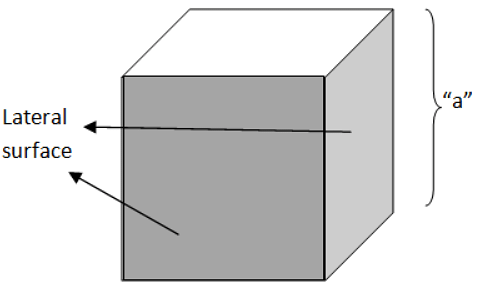
Lateral Surface area of a Cube
Lateral Surface area of Cuboid.
[Click Here for Sample Questions]
Lateral surface area of a cuboid is the area of four non-base faces of a cuboid . A cuboid has different length ,breadth and height .Lateral surface area of a cuboid =addition of area of four faces of the cuboid .

Lateral Surface area of Cuboid
This is a cuboid of height h .Lateral surface area of cuboid=area of side ABEF+area of side DAGE+area of CBHF+area of DGHC =2(bh) +2(lh) =2h(l+b)
Lateral surface area of the cuboid =2h(l+b).
Lateral Surface area of a Cone
[Click Here for Sample Questions]
The lateral surface area of a cone would be π r⋅l where r is the radius of the circle at the bottom of the cone and l is the lateral height (the length of a line segment from the apex of the cone along its side to its base) of the cone (given by the Pythagoras Theorem l=√r2 + h2 where h is the height of the cone.

Lateral Surface area of a Cone
In the given figure 1.3 l=slant height of the cone which is determined by pythagoras theorem ,л is 22/7 and r =radius of the circle in the bottom surface.
Lateral Surface area of Cylinder
[Click Here for Sample Questions]
Lateral surface area of a right circular cylinder of radius r and height h, the lateral area is the area of the side surface of the cylinder: A = 2πrh.. For a cylinder, the lateral surface area is the curved surface that connects the base and the top.

The height and radius of the cylinder
Things to Remember
- Lateral Surface area is determined for a three dimensional figure.
- Surface area of a three dimensional figure without its base and top area is called the lateral surface area of a figure .
- Lateral surface area of a cube is the surface area of four sides of the cube excluding its base and top part.
- Total surface area minus top and base area of the figure =lateral surface area.
- Lateral surface area of a sphere =Curved surface area of sphere.
- For a cylinder lateral surface area is the curved part of the cylinder connecting base and top.
Sample Questions
Ques: What is the lateral surface area (LSA) of a Rubik's cube of side length 4 inches? (2 marks)
Ans: The side length of the Rubik's cube is x = 4 inches.The LSA of the cube = 4x2 = 4 (42) = 64 square inches.Thus, the lateral surface area of the given Rubik's cube is 64 square inch.
Ques: The space diagonal of an ice cube is 5√3 units. Find its lateral area. (2 marks)
Ans: Let us assume that the edge length of the ice cube is x.
The space diagonal of the ice cube = 5√3 units. We know that the relationship between the side length (x) and the space diagonal (d) of a cube is expressed as, d = x √3. So we can write: x √3 = 5 √3 , x = 5 .The LSA of the cube = 4x2 = 4 (52) = 100 square units.
Method 2:The space diagonal of the ice cube, d = 5√3 units.The lateral surface area of cube in terms of space diagonal = 4d2 / 3 = 4 (5√3)2 / 3 = 300 / 3 = 100 square units.Therefore, the lateral area of the ice cube = 100 square inches.
Ques:Find the total surface area and the lateral surface area of a cuboid whose length = 6 inches, width = 4 inches, and height = 3 inches. (2 marks)
Ans: As we know, the total surface area of a cuboid = 2 (lw + wh + lh) and the lateral surface area of a cuboid is 2h(l + w).Here, length (l) = 6 inches, width (w) = 4 inches and height (h) = 3 inchesTotal surface area of cuboid = 2 (lw + wh + lh) = 2 [(6 × 4) + (4 × 3) + (6 × 3)] in2
⇒ Total surface area of cuboid = 108 in2
Lateral surface area of cuboid = 2h(l + w) = (2 × 3)(6 + 4) in2
⇒ Lateral surface area of cuboid = 60 in2 Therefore, the total surface area of the cuboid is 108 in2 and the lateral surface area of the cuboid is 60 in2.
Ques:The length, width and height of a cuboid are 12 cm, 13 cm and 15 cm respectively. Find the lateral surface area of a cuboid. (2 marks)
Ans: Lateral surface area of a cuboid is given by:
LSA = 2h (l + w)
By putting the values in the formula, LSA will be = 2 x 15 (12 + 13)
LSA = 750 cm2.
Ques: What is the lateral area of a cone that have a base radius of 4 units and slant height = 7 units? (2 marks)
Ans: Given r = 4 units and l = 7 units
As we know, lateral area of the cone = πrL⇒ Lateral area of cone = (22/7) × 4 × 7 = 88 units square.
Ques:Find the lateral area of a cone having base radius of 21 units and height of 20 units. (Use π = 22/7) (3 marks)
Ans: Given that r = 21 units and h = 20 units
Thus, slant height of the cone, l = √(r2 + h2) = √(212 + 202) = √(441 + 400) = √841 = 29 units
We know, the lateral area of the cone = πrL
⇒ Lateral area of a cone = (22/7) × 21 × 29 = 22 × 3 × 29 = 1914 units square.
Ques:Find the lateral area of a cone having height of 15 units and slant height of 17 units. (Use π = 3.14) (2 marks)
Ans: Given that h = 15 units and l = 17 units
Radius of the cone (r) = √(L2 - h2) = √(172 - 152) = √(289 - 225) = √64 = 8 units
Lateral area of cone = πrL
⇒ Lateral area of cone = 3.14 × 8 × 17 = 427.04 units square.
Ques:The radius of a cylinder is 5 inches and the height of the cylinder is 15 inches. Find the surface area of the cylinder. (Take the value of pi as 3.14) (3 marks)
Ans: Radius, r = 5 in
Height of the cylinder, h = 15 in
Surface Area of cylinder is: A = 2πr(r+h)
= 2π × 5 × (5 + 15)
= 2π × 5 × 20
= 2 × 3.14 × 5 × 20
= 628 ,Therefore, the surface area of the cylinder is 628 square inches
Ques: Samuel has a cylinder of surface area 1728π square units. Find the height of the cylinder if the radius of the base of the circle is 24 units. (3 marks)
Ans: The surface area of the cylinder, A = 1728π; radius (r) = 24; h = ?
Let us substitute the given values in the formula to find the height of the cylinder.
A = 2πr(r + h)
1728π = 2π × 24 × (24 + h)
⇒ 1728/48 = (24 + h)
⇒ 36 = (24 + h)
⇒ h = 12 ,Therefore, the height of the cylinder is 12 units.
Ques: Calculate the cost required to paint a container which is in the shape of a right circular cylinder having a base radius of 7 m and a height of 13 m. If the painting cost of the container is INR 2.5/m2. (Take π = 22/7) (2 marks)
Ans: Total surface area of aquarium = 2πr (h + r)= 2 × (22/7) × 7 × 20 = 880 m2
Total cost of painting the container = 2.5 × 880 = Rs. 2200.
Also Read:
Also Read:
| Mathematics Study Guides | ||
|---|---|---|
| NCERT Solutions for Class 12 Maths | Difference between in Maths | Mathematics Notes |
| Math Formula | Math MCQs | Maths Study Material |



Comments