



Content Curator
The Surface Area of Cylinder can be divided into two categories: The Curved Surface Area (CSA) and the Total Surface Area (TSA). The area of any shape in geometry is the area it covers in a plane. A cylinder has two sorts of surfaces: one with a curved surface and another with two circular bases. Both circular bases have the same area.
| Table of Content |
Read Also: Pythagoras Theorem
Surface Area of Cylinder
The total area covered by a cylinder in three-dimensional space is called the surface area of the cylinder.
- The area of a cylinder is equal to the sum of the areas of two circular bases and the area of a curved surface.
- The two circular bases of the right cylinders are perfectly aligned, and the axis line forms a right angle to the base.
- The oblique cylinder is formed when one of the circular bases is moved and the axis does not generate a right angle to the base.
- The lateral surface is another name for this curved surface.
- Radius, height, axis, base, and side are some of the characteristics needed to compute the cylinder area.
- The radius of the cylinder is equal to the radius of the circular base.
- The height of the cylinder is determined by measuring the perpendicular distance between two circular bases, and the axis is the line that connects the base's center.

The video below explains this:
Surface Area and Volume Detailed Video Explanation:
Formula of Surface Area of Cylinder
The surface area of a cylinder is equal to the sum of the curved surface and the area of the cylinder's two circular bases.
Surface Area of Cylinder = Curved Surface + Area of Circular bases
Surface Area of Cylinder= 2πr (h + r) sq. unit
Where,
π (Pi) = 3.142 or = 22/7
r is the radius of the cylinder
h height of the cylinder.
Also Read:
Curved Surface Area of Cylinder
The curved surface area of a cylinder, or the area obtained by omitting the area of its two circular bases, is called the curved surface area. It is also referred to as the lateral surface area (LSA).
The CSA of a cylinder with a base radius of ‘r' and a height of ‘h' is calculated as follows:
Curved surface area (CSA) of cylinder = 2πrh sq. units.

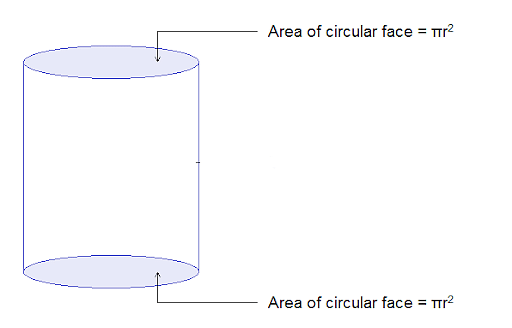
Base Area of Cylinder
The base area of the cylinder has a round form. As a result, we can conclude from the formula for the area of a circle that-
Area of the circular bases of cylinder = 2 (πr2) (because the cylinder has two circular bases)
Total Surface Area of Cylinder
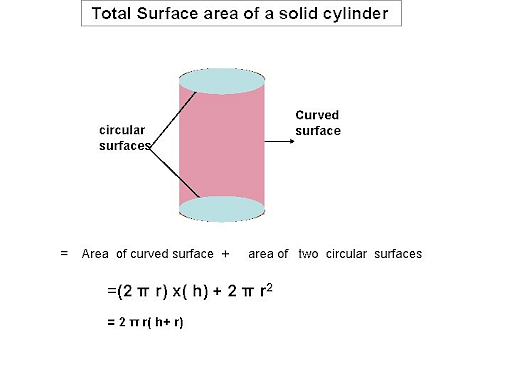
The total surface area of a cylinder is equal to the sum of its faces. The sum of the curved and circular areas of the cylinder equals the total surface area with radius ‘r' and height ‘h'.
Total surface area (TSA) = 2π × r × h + 2πr2 = 2πr (h + r) sq. units
Things to Remember Based on Surface Area of a Cylinder
- Surface Area of Cylinder (in terms of π) = 2πr (h + r) sq. unit
- Curved surface area (CSA) of cylinder = 2πrh sq. units.
- Area of the circular bases of cylinder = 2 (πr2)
- Total surface area (TSA) = 2π × r × h + 2πr2= 2πr (h + r) sq. units
Also Check:
Important Questions Based on Surface Area of a Cylinder
Ques: What is the formula of curved surface area and base area of a cylinder? (1 Mark)
Ans: The formula of the curved surface area of the cylinder is 2πrh sq. units.
The formula for the base area of the cylinder is 2 (πr2) sq. units.
Ques: What is a cylinder and how is its total surface area calculated? (1 Mark)
Ans: A cylinder is a three-dimensional solid and one of the most fundamental curvilinear geometric shapes. The formula to calculate its total surface area is 2πr (h + r) sq. units
Ques: Calculate the cost required to paint a container that is in the shape of a right circular cylinder. Given a base radius of 14 m and a height of 25 m, the painting cost is INR 6/m2. (Take π = 22/7) (2 Marks)
Ans: Total surface area = 2πr (h + r)
Total surface area = 2 x 22/7 x 14 (25+14)
Total surface area = 2 x 22/7 x 14 x 39
Total surface area = 3432 sq. m
Total cost of painting the container = 6 x 3432= Rs. 20592.
Also Read:
Ques: Given the height of the cylinder- 9 m; diameter- 8m; painting cost is INR 5/m2. (Take π = 22/7). Calculate the total cost and total surface area of the cylinder. (2 Marks)
Ans: Total Surface Area= 2πr (h + r)
r= 8/2 = 4m.
Total Surface Area= 2πr (h + r)
Total Surface Area= 2 x 22/7 x 4 x (9 + 4)
Total Surface Area= 2 x 22/7 x 4x 13
Total Surface Area = 326.85 sq. m
Total Cost = 5 x 326.85 = INR 1634.25
Ques: Given, the surface area of the cylinder is 345π sq. m; radius- 5m. Find the height of the cylinder. (2 Marks)
Ans: Surface area of the cylinder = Area of the cylinder
345π = 2πr (h + r)
345 x 3.14 = 2x3.14x5 (h + 5)
1083.3= 31.4 (h+5)
(h + 5)= 34.5
h= 34.5 – 5
h= 29.5m
Mathematics Related Links:



Comments