



Content Curator
Lead II Chloride Formula is PbCl2. Under ambient conditions, lead (ll) chloride is a white solid compound; otherwise, it is a crystalline colorless and odorless chemical that is also a very essential lead-based reagent. Cotunnite is a naturally occurring inorganic compound that is found in the form of mineral ore. It is a natural mineral form of lead (ll) chloride. It is insoluble in water but readily soluble in chloride-containing solutions. Since lead belongs to group 4, all elements in that group have two oxidation states: +4 and +2. Lead chloride is more stable than lead tetrachloride. The stability of the +4 oxidation state decreases as we proceed down the group, while the stability of the +2 oxidation state increases. PbCl4 is far less stable than CCl4 or SiCl4 and easily decomposes at ambient temperature to generate the much more stable PbCl2.
| Table of Content |
Key Terms: Cations, Anions, Covalent Bond, ionic Bond, Oxidation
What is Lead II Chloride?
[Click Here for Sample Questions]
The inorganic compound lead II chloride has the appearance of a white solid in ambient circumstances. In water, this chemical has a low solubility. Lead II chloride is a major reagent containing lead. It is found in the form of the mineral cotunnite in nature. The main precursor for numerous organometallic derivatives of lead, such as plumbocenes, is lead II chloride. Lead II oxide is formed when lead II chloride combines with molten sodium nitrite.
Properties Of Lead (II) chloride
[Click Here for Sample Questions]
| Property Name | Value |
|---|---|
| Molar mass | 278.10 g / mol |
| The chemical formula of lead chloride | PbCl2 |
| Appearance | White odorless solid |
| Hardness | 1.5 - 2mohs scale |
| Density | 5.85 g /cm3 |
| Boiling point | 950 oC or 1740 oF or 1220 K |
| Melting point | 501 oC or 934 oF or 774 K |
| Crystal structure | orthorhombic, oP12 |
| Space group | Pnma No. 62 |
| Solubility in water | 0.99 g in 1L of water at 20 oC |
| Solubility product (Ksp) | 1.7 x 10⁻⁵ at 20 oC |
| Solubility | Slightly soluble in HCl and ammonia, insoluble in alcohol, soluble in hot water as well as in presence of alkali hydroxide, and also soluble in concentrated HCl (>6M) |
| Magnetic susceptibility | -73.8 x 10⁻⁶ cm3 / mol |
| Refractive index | 2.199 |
| Std. molar entropy | 135.98 J K-1 mol-1 |
| Std. enthalpy of formation | -359.4 KJ / mol |
Lead (II) Chloride Structure
[Click Here for Sample Questions]
PbCl2 is the chemical formula for lead chloride, which is also known as lead chloride. The IUPAC name for lead chloride is lead (ll) chloride. Covalent bonding with a bond angle of 98 degrees connects the chlorine atoms to the central lead atom, and the isotopic bond distance between each chlorine atom and the central lead atom is 2.44. The electronic arrangement of the molecules and their atoms must now be considered to explain the nature of the bond.
With an atomic number of 82, the electronic configuration of the lead atom will be Pb 6s2 4f14 5d10 6p2. As a result, lead has two electrons to donate or share in its outer shell. Chlorine, on the other hand, has an atomic number of 17, which indicates that it has an electronic configuration of 1s2 2s2 2p6 3s2 3p5, indicating that the shell is unstable due to an unpaired electron in the 3p orbital, and it requires an electron to complete its function.
To complete the octane, the two chlorine atoms share each of the two pair electrons of lead present in the 6s shell, resulting in a stable molecule. The twisted structure of the molecule lead (ll) chloride. As a result, the structural formula for lead II chloride molecules is as follows.

Lead (II) Chloride Structure
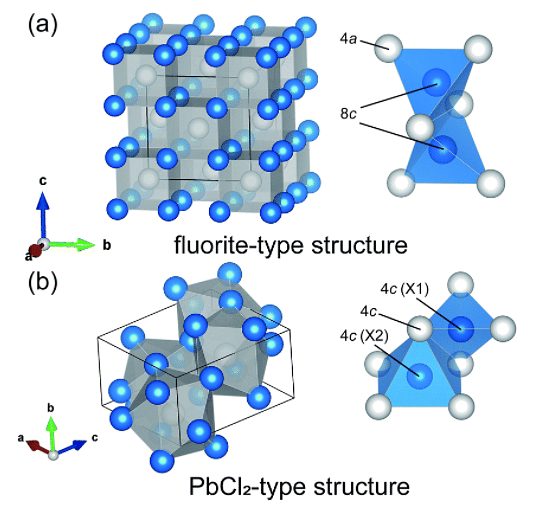
As a result, le's structural formula Each lead atom in lead (ll) chloride is surrounded by nine chloride ions, similar to a tricapped triangular prism molecular geometry in which nine atoms or groups of atoms or ligands are arranged around the central atom in such a way that a triangle is formed with one atom attached on each of the three faces of the triangle.
Six chloride ions are present in the vertices of the triangle prism with lead as the center atom, and three beyond the surfaces of each rectangular prism face in solid lead chloride molecules. As a result, the chloride ions are not evenly spaced around the center lead atom.
Seven of the nine chlorine atoms are between 280 and 309 pm, whereas the other two are between 270 and 280 pm. As a result, PbCl2 forms an orthorhombic needle structure, also known as an orthorhombic dipyramidal, with a point group of 2m / 2m / 2m. The coordination number of each lead atom is 9. As a result, the structural formula of lead chloride is shown below in terms of its coordinate geometry. The following diagram depicts ad chloride molecules.
Synthesis of Lead II Chloride
[Click Here for Sample Questions]
Lead (ll) chloride is formed when an aqueous solution of chloride compounds such as HCl, NaCl, or KCl is introduced to any lead (ll) compound. The twofold displacement or metathesis reaction is the name given to this phenomenon. The following are some examples of such reactions.
With Soluble Lead Compound
- Lead (ll) Nitrate : Pb(NO3)2 + 2NaCl (aq) → PbCl2 (s) + NaNO3 (aq)
- Lead (ll) Acetate : Pb(CH3COO)2 (aq) + HCl (aq) → PbCl2 (s) + 2CH3COOH
With Insoluble Lead Compound
- Lead (ll) Carbonate : PbCO3 + 2 HCl (aq) → PbCl2 (s) + CO2 (g) + H2O (aq)
- Lead (ll) Dioxide : PbO2 (s) + 4 HCl (aq) → PbCl2 (s) + Cl2 (g) + 2 H2O (aq)
- Lead (ll) Oxide : PbO (s) + 2 HCl (aq) → PbCl2 (s) + H2O (aq)
A direct reduction reaction occurs when copper (ll) chloride is reduced in the presence of lead metal to produce lead (ll) chloride. The following is the reaction:
Pb (s) + CuCl2 → PbCl2 (s) + Cu (s)
Direct chlorination of lead metal by chlorine gas produces lead (ll) chloride as well. The following is the reaction:
Pb (s) + Cl2 (g) → PbCl2 (s)
Uses of Lead II Chloride
[Click Here for Sample Questions]
- In the manufacturing of infrared transmitting glass, experts employ lead II chloride. This chemical is also used in aurene glass, an attractive glass, according to specialists. The iridescent surface of Aurene glass is created by spraying it with lead II chloride and then warming it under regulated conditions.
- Bismuth (Bi) ore is refined using lead II chloride as an intermediary. To remove traces of acidic elements, the ore containing Bi, Pb, and Zn is first treated with molten caustic soda. Following that, the Parkes desilverization process is used to remove any remaining silver and gold.
- Bi, Pb, and Zn are currently present in the ore. Experts use Cl2 gas at a temperature of 500°C to treat it. ZnCl2 is formed first, and then it is removed. After that, PbCl2 develops and is eliminated, leaving only pure Bi. BiCl3 would be the last to form.
Things To Remember
[Click Here for Sample Questions]
- Lead titanate and barium lead titanate, which are widely used in the ceramic industry, are manufactured via a cation replacement reaction of lead (ll) chloride in molten state.X PbCl2 + BaTiO3 (s) → Ba1-xPbxTiO3 + x BaCl2
- PbCl2 is also used by foreigners in the production of transmission glasses and aurene glass, which is decorative glass. When this beautiful glass is sprayed with PbCl2 under controlled conditions, an iridescent surface emerges.
- Even though PbCl2 is poorly soluble in HCl, it is utilized in service with HCl as an addition of anatomy (Sb) to improve corrosion resistance.
- Pb(OH)2 is a kind of white lead that is used in automotive paints. Pattinson's white lead has the formula PbCl2. White lead, on the other hand, is now outlawed in many nations due to its severe health risk.
Sample Questions
Ques. Is Lead (ll) Chloride Cation? (2 Marks)
Ans. Although lead (ll) chloride is not always a cation, the lead atom in the molecule can lose its two electrons in the 6s shell to create a cation, but each of the chlorine atoms in the 3p shell can receive an electron to complete its octane and therefore operate as a cation.
Ques. Is lead II chloride soluble in water? (2 Marks)
Ans. PbCl2 (lead(II) chloride) is an inorganic compound that is a white solid at room temperature. It has low water solubility. One of the most significant lead-based reagents is lead(II) chloride. It can also be found in nature as the mineral cotunnite. Because the ionic connections that hold the Pb2+ to the CL- are stronger than the hydration forces between the ions and water molecules, it is insoluble in cold water.
Ques. Is lead chloride toxic? (3 Marks)
Ans. In humans, lead chloride is a PROBABLE CARCINOGEN. Inorganic Lead compounds have been demonstrated to induce kidney cancer in animals and have been linked to lung, brain, stomach, and kidney cancer in people.
A carcinogen is a substance that causes cancer. Lead chloride ingestion Nausea, vomiting, and diarrhea are symptoms of gastrointestinal inflammation. Lead compounds can be hazardous to the blood-forming organs, kidneys, and central nervous system if consumed. Inhalation: May irritate the respiratory tract. The effects may be similar to those stated for ingestion.
Ques. What is lead II chloride used for? (2 Marks)
Ans. Lead(II) chloride is used to make lead titanate and barium lead titanate ceramics; it's also utilized to make infrared transmission glass and decorative glass (aurene glass), and it's used as an electrode in geophysical applications and solar cells. The iridescent surface of Aurene glass is created by spraying it with PbCl2 and then warming it under regulated circumstances.
Ques. Is lead II chloride a strong or weak electrolyte? (2 Marks)
Ans. Electrolytes are compounds that, when dissolved in water, separate into cations (positively charged ions) and anions (negatively charged ions) (minus-charged ions). We call it ionization. Two chlorine atoms are covalently bonded to a central lead atom in lead(II) chloride, an inorganic chloride. It's an inorganic chloride and a lead coordination substance. Although PbI2 is an ionic compound and so a strong electrolyte, it is insoluble and thus not recorded as distinct ions.
Ques. How many moles of lead (II) chloride will be formed from a reaction between 6.5 g PbO and 3.2 g HCl? (3 Marks)
Ans. Given as:
n PbO = 6.5/223
=0.029 (atomic mass pf PbO=223)
n HCl = 3.2/36.5
=0.0877 (atomic mass of HCl=36.5)
The reaction is,
PbO+2HCl→PbCl2 +H2O
PbO will be the limiting reagent in this reaction since it is entirely consumed and produces 0.029 mol of PbCl2.
Ques. What is the Ksp expression for lead (II) chloride? (3 Marks)
Ans. PbCl2=1.7×10⁻⁵
Between the solid lead(II) chloride and the dissolved ions, an equilibrium will be achieved regulated by the solubility, product constant, Ksp. At 298 K, the solubility product constant, Ksp, of lead (II) chloride was determined to be 1.59 10–5 6.00 10–7.
Ksp = [Pb2+][Cl–]2
Ques. What kind of bond is lead chloride? (2 Marks)
Ans. Covalent bonding with a bond angle of 98o connects the chlorine atoms to the central lead atom, and the isotopic bond distance between each chlorine atom and the central lead atom is 2.44. In PbCl4, the lead is in the Pb4 state, and Cl has a significant, but not very large, charge density, allowing it to be easily polarized, and the high charge density on lead polarises the anion much more efficiently, causing the electron density to be shifted and partially shared, resulting in a much covalent compound.
Ques. How lead chloride is formed? (2 Marks)
Ans. The reaction of sodium chloride or hydrochloric acid with lead nitrate produces lead(II) chloride. It's also possible to make it by combining lead(IV) oxide with hydrochloric acid. Chlorine and lead can also be combined to make it. To deliver the chloride ions, you could use sodium chloride solution, but it's typically quicker to just add some weak hydrochloric acid.
Also read:



Comments