



Education Journalist | Study Abroad Lead
Ideal Gas Law helps us understand the behaviour of different types of gases in thermodynamics in different conditions. It uses a mathematical equation to describe the behaviour of hypothetical gases by combining certain physical constants and empirical factors. It is a mathematical formula which is termed an equation of generic gas.
- The equation of Ideal Gas is formed by various other laws which include Charles’s law, Boyle's law, Gay Lussac’s law, and Avogadro's law.
- These laws provide the foundation for understanding how gases react and change in different situations.
- The Ideal Gas Law helps us make predictions and calculations about gases in a simple and unified way.
| Table of Content |
Key Terms: Charle's law, Boyle's law, Gay law, Lussac's, Avogadro's law, Equilibrium, IUPAC, Universal Gas Constant, temperature, pressure
What is an Ideal Gas?
[Click Here for Sample Questions]
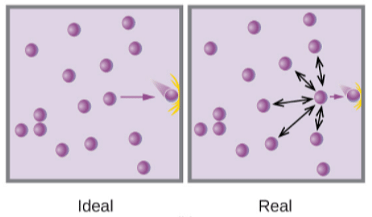
An ideal gas is a hypothetical gas made up of a collection of randomly moving point particles that only interact through elastic collisions.
- In an ideal gas, gas molecules move freely in all directions, and collisions between them are entirely elastic, meaning no kinetic energy is lost as a result of the collision.
- Although there is no such thing as an ideal gas, all real gases tend to resemble it when their density is low enough.
- As the gas molecules are so far away, they don't interact with one another.
Ideal Gas Laws
[Click Here for Sample Questions]
The study of gas behaviour has resulted in some generalisations. These broad generalisations are referred to as "gas laws." The term "ideal gas laws" refers to laws that apply to ideal gases. Ideal Gas Law is an equation which satisfies various states of different Ideal Gases. Despite its flaws, it provides a reasonable approximation of the behaviour of many gases under a variety of situations. These laws establish measurable relationships between two variables while keeping the others constant. Let's look at the different gas laws.
Boyle’s Law (Pressure-Volume Relationship)
By varying the pressure of a specific amount of gas at a constant temperature, Robert Boyle explored changes in the volume of a gas. He collected some air in the tube's tip and used the difference in mercury height between the tube's two arms to compute the pressure exerted by the gas. The pressure of the gas is increased while the volume of the gas is reduced by adding more mercury to the tube.
It can be expressed as P α 1/V
PV=nRT
where n and T are constant.
Charles’s Law (Volume-Temperature Relationship)
In 1787, Jacques Charles looked into the effect of temperature on gas volume under constant pressure. In 1802, Gay Loussac expanded on the findings. Charles’s law is a generalisation of what has been seen in the relationship between the pressure and volume of a gas.
It can be expressed as follows:
V∝T where n and P are constants
Gay Loussac’s Law
The link between pressure and temperature, known as Gay Loussac’s law, was established by Joseph Gay Loussac. It means that the pressure of a fixed amount of gas changes directly with the change in temperature for constant volume.
It can be expressed as:
P α T
P = k3T
(Where k3 is a constant of proportionality)
P/T = k3
Avogadro’s Law
Amadeo Avogadro established a formula for determining a gas's volume based on the number of molecules present under constant temperature and pressure in 1811. This is known as the Avogadro law. At constant temperature and pressure, this equation states that the volume of a gas is precisely proportional to the amount of gas.
It can be expressed as:
V α n
where T and P are constant
Also Read:
| Related Articles | ||
|---|---|---|
| Bond Energy | Unsaturated Hydrocarbons | Laws of Chemical Combinations |
| Significant Figures | Atomic Mass Formula | Avogadro’s Law |
Ideal Gas Equation
[Click Here for Sample Questions]
The ideal gas equation is written as follows:
PV = nRT
In this equation, P = the ideal gas's pressure
- V = ideal gas's volume,
- n = total amount of ideal gas measured in moles
- R = the universal gas constant
- T = temperature
Derivation of the Ideal Gas Equation
[Click Here for Sample Questions]
Assume that the gas exerts a pressure of 'P.' The volume of the gas is 'V.' The temperature is 'T.' The number of moles of gas is 'n.'
At constant n and T, Boyle's Law states that the volume of a gas is inversely proportional to the pressure it exerts.
V ∝ 1/P.................(1)
When P and n are constant, the volume is directly proportional to the temperature, according to Charles’ Law.
V ∝ T ...................(2)
When P and T are constant, it is already stated by Avogadro’s Law that the Volume of any gas is directly proportional to the molecule number of that gas.
V ∝ n........................(3)
Then all three equations are combined, we get,
V ∝ nT/P
PV ∝ nT
PV = nRT
where R is the Universal gas constant, which is 8.314 J/mol-K.
Also Read:
Things to Remember
- The Ideal Gas Law is a fundamental principle in gas physics that relates the properties of gases under various conditions.
- Gas particles move randomly and follow Newton's laws of motion.
- The volume occupied by individual gas molecules is negligible compared to the overall volume.
- Intermolecular forces between gas molecules are insignificant.
- Collisions between gas molecules are perfectly elastic.
- The average kinetic energy of gas molecules is directly proportional to temperature.
Sample Questions
Ques: What is the significance of the ideal gas equation, PV = nRT, in describing the behaviour of gases, under ideal conditions?(3 Marks)
Ans: In this equation, the product of one mole's pressure and volume equals the product of its temperature and the gas constant. The equation is precise for an ideal gas, and it is a good approximation for real gases at low pressures. PV = nRT is the formula for the ideal gas equation. In this equation, P denotes the ideal gas's pressure, V denotes the ideal gas's volume, n is the total amount of ideal gas measured in moles, R denotes the universal gas constant, and T denotes the temperature.
Ques: Which gases are considered examples of ideal gases? (2 Marks)
Ans: There are various examples of Ideal Gas which include oxygen, nitrogen, and hydrogen. Ideal Gas includes noble gases also. There are some heavier ideal gases which include mixtures like air and carbon dioxide also. All these gases are considered Ideal Gases due to their limits of pressure and temperature. These are the gases that are assumed to be ideal in a particular condition but there is no ideal gas.
Ques: What is the temperature, measured in Kelvin, when one mole of CH4 gas occupying 20.0L is subjected to a pressure of 1.00 atm? (3 Marks)
Ans: The ideal gas equation is:
PV=nRT
T=PV/nR………(1)
Given 1.00 atm pressure, so P=1.00 atm. one mole of CH4 gas, so n=1mol, the CH gas occupies 20.0L, so V=20.0L. The gas constant is R=0.082.
On substituting these value sin equations (1).
T = (1.00atm)(20.0L)/(1mol)(0.082)
T = 244K
Ques: When a gas at standard temperature and pressure undergoes a modification that decreases its pressure by half, what is the resulting change in the gas's volume? (4 Marks)
Ans: The ideal gas equation is:
PV=nRT
The given gas undergoes a transformation in which its pressure is half. Therefore:
P′=P/2
The ideal gas equation can also be written as,
V=nRT/P
and
V′=nRT/P′ ...............................(1)
On substituting the value of P’ in equation (1).
V’=(nRT)/(P/2)
V’=2(nRT/P)
V’=2V
As a result, we can observe that the new volume is twice the original volume.
Ques: What are the ideal gas conditions? (3 Marks)
Ans: The following are the fundamental assumptions that must be met for a gas to be ideal:
- The gas particles have a very small volume.
- There are no intermolecular forces (attraction or repulsion) between the gas particles because they are all the same size.
- Between the gas particles, perfectly elastic collisions occur with no energy loss.
Ques: What is R in the ideal gas equation? (2 Marks)
Ans: The gas constant is denoted by the letter R. Emil Clapeyron first identified this gas constant in the mid-1830s. The ideal gas law was named after this discovery. R is often referred to as the universal constant. This is due to the fact that this constant can be found in a variety of non-gas-related contexts. As a result, the value of R can take many various units and shapes depending on the units used.
Ques: What are the fundamental assumptions underlying the ideal gas law? (5 Marks)
Ans: The ideal gas law is derived from the kinetic theory of gases and is based on the following assumptions.
- The gas is made up of a vast number of molecules moving at random and adhering to Newton's laws of motion.
- When compared to the volume occupied by the gas, the molecules have a negligible volume.
- Intermolecular forces in gases are insignificant.
- Collisions between gases are entirely elastic.
- The average kinetic energy of a gas is related to its absolute temperature.
Ques: Why are monatomic gases at low pressure and high-temperature ideal for adhering to the Ideal Gas Law? (2 Marks)
Ans: Monatomic gases at low pressure and high temperature are the greatest candidates for the Ideal Gas Law. There are four controlling assumptions for a gas to be "ideal": The volume of the gas particles is insignificant. The gas particles are all the same size and there are no intermolecular forces (attraction or repulsion) between them. According to Newton's Laws of Motion, the gas particles travel at random. Because the average distance between molecules is substantially higher than the molecular size, lower pressure is ideal.
For Latest Updates on Upcoming Board Exams, Click Here: https://t.me/class_10_12_board_updates
Do Check Out:



Comments