



Education Journalist | Study Abroad Lead
The leaf apex refers to the tip or end of a leaf. It is the terminal point of the leaf blade, opposite to the leaf base.
- They are classified as acuminate, acute, obtuse, rounded, emarginate, mucronate, and cuspidate, etc.
- The leaf apex is the site of active growth where new cells divide and elongate, causing the leaf to expand and reach its full size.
- The apex often houses specialized cells that sense environmental factors like light and humidity, contributing to the overall development and responses of the leaf.
- In some plants, the leaf apex may have protective structures like hairs, spines, or waxy coatings to deter herbivores or minimize water loss.
Download PDF: Leaf Apex Frequently Asked Questions with Answers
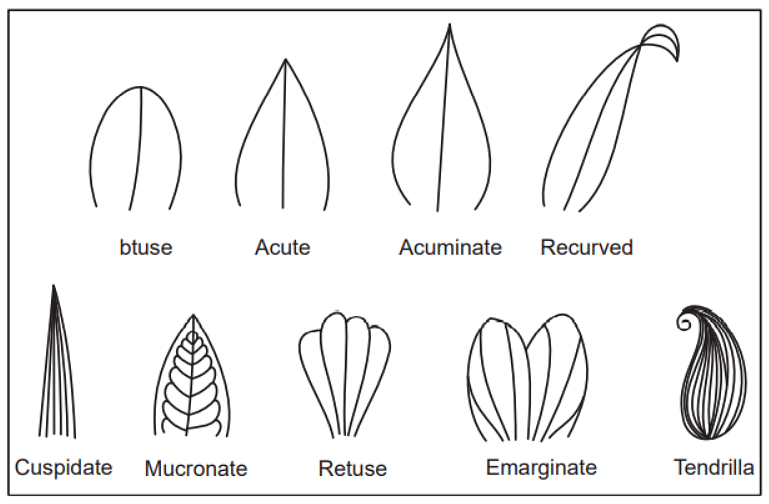
Leaf Apex
Types of Leaf Apex
The shape and structure of the leaf apex can vary greatly among different plant species:
| Leaf Apex | Description | Example |
|---|---|---|
| Rounded | The leaf apex forms a smooth, curved end without any sharp points or angles. | Water Lily |
| Obtuse | The leaf apex has a blunt or rounded end that is wider than it is tall, forming an angle greater than 90 degrees. | Common Bean |
| Acute | The leaf apex tapers to a pointed end with an angle of less than 90 degrees. | Mango |
| Acuminate | The leaf apex narrows gradually to a slender and pointed tip, often with concave sides. | Tulsi |
| Elliptical | The leaf apex is shaped like an ellipse, with gently curved sides and rounded ends. | Rose |
| Hooked | The leaf apex ends in a sharp, curved point resembling a hook. | Blackthorn |
| Mucronate | The leaf apex has a small, abrupt, and sharp point extending beyond the leaf margin. | Fir |
| Truncate | The leaf apex appears as if it has been abruptly cut off, forming a straight edge across the tip. | Cucumber |

Types of Leaf Apex
Importance of Leaf Apex
Leaf apex is important in plants as -
- Leaf apex helps in regulating water loss through transpiration.
- It shields the inner parts of the leaf from physical damage and pests.
- It aids in capturing sunlight for photosynthesis by providing a surface area.
- The shape of the leaf apex can be an adaptation to environmental conditions.
- Leaf apex morphology helps in plant identification and classification.
- Certain leaf apex shapes may attract specific pollinators, aiding in reproduction.
- Leaf apex assists in absorbing nutrients from the environment.
- It plays a role in controlling the growth pattern of the leaf and plant.
Shape of Leaf ApicesThe shape of the leaf apex can be influenced by various factors like:
|
Things to Remember
- The leaf apex refers to the tip or end portion of a leaf blade.
- It maximizes the leaf's surface area exposed to sunlight and optimizes photosynthesis.
- Leaf apex can vary in shape and structure, including pointed, rounded, acute, obtuse, acuminate, and mucronate, each serving different purposes.
- The apex helps shield the leaf from physical damage and pests, preserving its integrity.
- Different types of leaf apex may be adaptations to specific environmental conditions, such as drought or heavy rainfall.
- Certain shapes of leaf apex may attract specific pollinators, contributing to plant reproduction.
- The apex plays a role in controlling the growth pattern of the leaf and the plant structure.
Sample Questions
Ques. How does the leaf apex contribute to plant adaptation? (5 marks)
Ans. The leaf apex contributes to plant adaptation in several ways:
- In arid environments, plants may have leaf apices that are pointed or acuminate, reducing surface area and minimizing water loss through transpiration.
- Different shapes of leaf apices can affect the leaf's exposure to sunlight and heat.
- Certain shapes of leaf apices attract specific pollinators, contributing to plant reproduction and adaptation to local pollinator populations.
- In regions with heavy snowfall, plants may have pointed or acuminate leaf apices, allowing snow to slide off more easily and preventing damage to the leaf tissue.
- The shape and orientation of the leaf apex can influence light capture and photosynthetic efficiency, helping the plant maximize its energy production in varying light conditions.
Ques. Do all leaves have an apex? (2 marks)
Ans. Yes, all vascular plants (plants with a well-developed transport system) have leaf apices as they are the point of growth and development for the leaf blade.
Ques. What is the difference between the leaf apex and the leaf margin? (1 mark)
Ans. The leaf apex is the tip of the leaf blade, while the leaf margin is the edge of the leaf blade that runs along its sides.
Ques. What are some specialized structures found at the leaf apex in some plants? (3 marks)
Ans. The specialized structures at the leaf apex in some plants are -
- Trichomes: Hair-like structures that may secrete various substances like oils, resins, or even digestive enzymes to deter herbivores or regulate temperature.
- Hydathodes: Water pores that facilitate the process of guttation, where excess water droplets exude from the leaf tip.
- Meristematic tissue: Actively dividing cells at the apex responsible for the continuous growth of the leaf.
Ques. How does the leaf apex contribute to water management in plants? (2 marks)
Ans. The shape of the apex can influence water drainage.
- Pointed or elongated apices may promote faster water runoff, while broader or waxy apices might encourage water retention.
- Some plants have specialized structures like waxy coatings or grooves on the apex to channel water droplets efficiently.
Ques. How does the leaf apex differ in different plant groups? (3 marks)
Ans. The structure of the leaf apex can vary significantly across different plant groups:
- Gymnosperms (cone-bearing plants): Often have pointed or needle-like apices, adapted to cold climates and efficient water management.
- Angiosperms (flowering plants): Exhibit a wider diversity in apex shapes, with variations like rounded, lobed, or even tendrils depending on the species and function.
- Ferns and fern allies: Typically have rolled or fiddlehead-shaped apices when young, which unroll as the leaf matures.
Ques. Are there any adaptations in plants to protect the leaf apex? (3 marks)
Ans. Various adaptations can be seen in plants to safeguard the vulnerable leaf apex:
- Trichomes, spines, or thorns: These physical structures can deter herbivores or physical damage.
- Waxy coatings: Can shield the apex from harsh weather conditions or water loss.
- Folding or coiling: Some young leaves temporarily fold or coil their apices for protection during early development.
Ques. Can damage to the leaf apex affect the plant? (3 marks)
Ans. Yes, damage to the leaf apex can impact the plant in several ways:
- Disrupted growth: The apex is the primary site of growth, so damage can hinder the leaf's ability to reach its full size and develop properly.
- Altered function: Depending on the extent of the damage, the ability of the apex to sense environmental cues or perform its protective functions might be compromised.
- Increased susceptibility to stress: Damaged apices may make the plant more vulnerable to pests, diseases, or environmental stressors.
Check-Out:
| Biology Study Guides | ||
|---|---|---|
| Biology MCQs | Comparison Topics in Biology | Biology Study Notes |



Comments