



Content Curator
In order to overcome the limitations of Rutherford’s atomic model and to explain the line spectrum of hydrogen, Niel Bohr, a Danish physicist proposed an atomic model. The model proposed by Neil Bohr was based upon Planck's quantum theory of radiation. The model proved to work as a remedy for the stability problem in previous Rutherford model of the atom. This atomic model is popularly known as Bohr’s Atomic Model.
Read Also: Electrostatic Potential Capacitance
Bohr’s Atomic Model
[Click Here for Sample Questions]
According to Bohr’s Atomic Model, an atom consists of a small, positively charged nucleus which is surrounded by electrons that travel in circular orbits around the nucleus with attraction provided by electrostatic forces.

Read More: Wave Nature of Electromagnetic Radiation
Postulates of Bohr’s Atomic Model:
[Click Here for Sample Questions]
The main postulates of Bohr’s Atomic Model are as follows:
- The electrons move around the nucleus in certain permitted circular paths known as orbits.
- Each orbit is associated with a definite amount of energy and therefore, these are known as energy levels or energy states. The energy levels are numbered as 1,2,3,4……. etc. or designated as K, L, M, N……. etc. shells. The energy level closest to the nucleus is numbered 1 or designated as K shell.

- While moving in a particular energy level or energy state an electron neither loses nor gains energy. The energy of an electron in a particular energy state always remains fixed or stationary. This state is called normal or ground state.
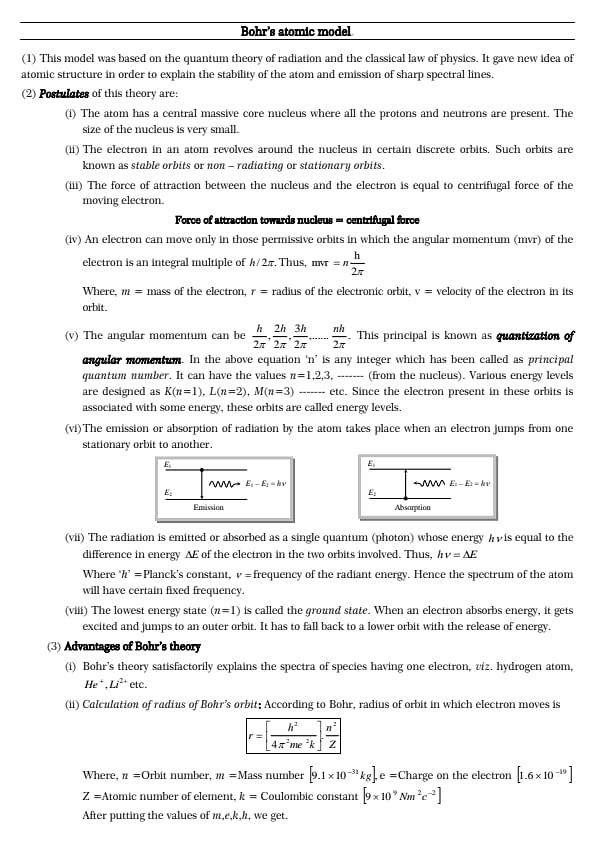
- An electron emits or absorbs energy when it jumps from one orbit or energy level to another. When it jumps from a higher energy level to lower energy level it emits energy while it absorbs energy when it jumps from a lower energy level to a higher energy level.
- The energy absorbed or emitted is equal to the difference between the energies of the two energy levels (E1, E2) and is determined by Plank’s equation.
ΔE = E2-E1 = hv
Where,
E2 and E1 are the energies of electrons in the higher and lower energy levels respectively
ΔE is the difference in energies of two levels.
V is the frequency of electromagnetic radiation emitted or absorbed

Transition of Electron from lower to higher and higher to lower energy levels
- Like energy, the angular momentum of an electron in an atom can have certain definite or discrete values and not any values of its own. The only possible values of angular momentum are given by the expression,
mvr= nh/2π
i.e., h/2π will be an integral multiple of angular momentum of the electron.
Here, m= mass of electron, ν= tangential velocity of revolving electron, r= radius of the orbit, h= Planck’s constant and n= integer 1,2,3………
Also Read:
Achievements of Bohr’s Atomic Model:
[Click Here for Sample Questions]
-
Bohr’s atomic model explains the stability of an atom: - According to Bohr’s theory, the electron does not lose energy as long as it revolves in a particular orbit. Also, it cannot jump from the first orbit to the lower orbit as there is no orbit less than one. Thus, gradual loss of energy by the electron is not possible. Hence, the atom is stable. Thus, it removes the limitation of the Rutherford model of atoms.
- Bohr’s theory has helped in calculating the energy of electrons in hydrogen atom and hydrogen like compounds: - On the basis of various postulates of Bohr’s model, it is possible to calculate the energy of an electron in nth orbit of hydrogen like compound. For example, He+, Li+2, etc.
- Bohr’s theory has explained the atomic spectra of hydrogen atoms: - According to Bohr’s model of atoms, electrons in an atom can have only certain definite energy levels. When the electron is present in the lowest possible energy level, it is said to be in ground state. When the energy is supplied from some external source, the electron may absorb energy and jump to a higher energy level.
The electron in that state is said to be in an excited state. The excited state is unstable and, therefore the electron has a tendency to come back to the ground state.
When the electron jumps back to the lower energy levels, it loses energy in the form of a quantum.
If E1 and E2 are the energies of lower and higher energy levels respectively, then frequency (v) of the radiation emitted is given by the following relation:
E2-E1= hv
Where,
h= Planck’s constant
- Explanation for the simultaneous appearance of many spectral lines in the hydrogen spectrum: - Although hydrogen atom has only one electron (which can be excited to one higher orbit at a time) yet hydrogen spectrum consists of several spectral lines in different series of hydrogen spectrum such as Lyman, Balmer, Paschen, Brackett and Pfund series.

This can also be explained with the help of Bohr’s theory. A given sample of hydrogen contains a large number of atoms. When electric discharge is passed through hydrogen gas, solitary electrons in different hydrogen atoms absorb energy and thus get excited to different energy levels.

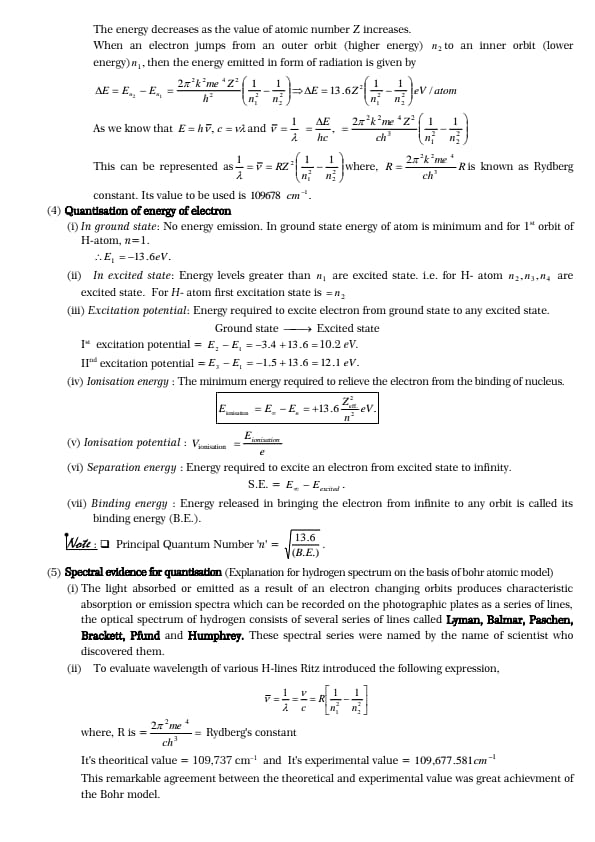
Electron moving from n=4 to n=1
Click Here To Download Questions on Bohr Model Of Atom



Read Also: Planck Quantum Theory and Black Body Radiation
Limitations in Bohr’s Atomic Model
[Click Here for Sample Questions]
The Limitations of Bohr’s atomic model are as follows:
- It could not explain the atomic spectra of elements having more than one electron.
- It could not explain the Zeeman effect when the spectral lines are split into closely spaced lines under the influence of magnetic field.
- It failed to explain the Stark effect when the spectral lines get split into fine lines under the influence of an electric field.
- According to Bohr, the circular orbits of electrons are planar. But modern research reveals that an electron moves around the nucleus in three-dimensional space. This is based on de Broglie’s suggestion that electrons of light have a dual character.
- It does not obey Heisenberg’s uncertainty principle. According to this principle, it is impossible to determine simultaneously the exact position and momentum of a small moving particle like an electron with absolute certainty. However, according to Bohr, electrons move in a well-defined circular orbit.
- Bohr’s model could not explain shapes and geometry molecules. It failed to make correct predictions of large-sized atoms and provided sufficient information only for smaller atoms.
Also Check:
Important Questions Based on Limitations of Bohr’s Model
Ques: What are the shortcomings of Bohr’s atomic model? (3 Marks)
Answer: The shortcomings of Bohr’s Atomic Model are as follows:
- It couldn’t explain the atomic spectra of elements having multi-electron atoms.
- It fails to explain the Zeeman effect and Stark effect of splitting of spectral lines when subjected to the magnetic fields and electrostatic fields respectively.
- It does not account for the fine splitting of spectral lines.
- It explains a two-dimensional picture of the revolution of electrons while the electron revolves around the nucleus in three dimensions.
- It could not explain the shapes and geometry of molecules.
- It does not obey Heisenberg’s uncertainty principle.
Ques: What are the main achievements of Bohr’s theory of the atom? (3 Marks)
Answer: The main achievements of Bohr’s theory of atom are:
- It explains the stability of the atom.
- Bohr’s theory of Atoms successfully explains the line spectrum of hydrogen.
- It explains the line spectra of single-electron ions like He+ and Li2+.
- Bohr’s theory helped in calculating the energy of electrons in hydrogen atoms and hydrogen like compounds.
Ques: Calculate the velocity of electrons in the first Bohr orbit of the hydrogen atom. Given that Bohr’s radius = 0.529 A. Planck’s constant h = 6.626 × 10⁻³⁴ Js mass of electron = 9.11 × 10⁻³¹ kg and 1 J = 1 kg m2 s-1. (3 Marks)
Answer: Given that:
r= 0.529 A = 0.529 x 10⁻¹⁰ m
h= 6.626 × 10⁻³⁴ Js
m= 9.11 × 10⁻³¹ kg
We have to find v,

Ques: Why was a change in the Bohr Model of atom required? Due to which important development (s), the concept of movement of an electron in an orbit was replaced by the concept of probability of finding an electron in an orbital? What is the name given to the changed model of atom? (3 Marks)
Answer: Bohr’s Model of Atom required changes due to the several shortcomings of the Bohr's model. Two important development which contributed significantly in the formulation of such a model were:
(i) Dual behaviour of matter,
(ii) Heisenberg uncertainty principle.
Werner Heisenberg, a German physicist in 1972, stated the uncertainty principle which is the consequence of dual behaviour of matter and radiation. One of the important implications of the Heisenberg Uncertainty Principle is that it rules our existence of definite paths or trajectories of electrons and other similar particles.
The name given to the changed model of atom is Quantum Mechanical Model of atom.
Ques: Explain the stability of the atom with the help of Bohr’s theory. (2 Marks)
Answer: According to Bohr’s theory, an electron revolves around the nucleus only in a definite orbit and cannot lose energy continuously. The electron loses energy if it jumps from a higher orbit to a lower orbit. This can only be possible if the electron has already absorbed a certain amount of energy and acquired a higher energy level. If no lower level is available, the electron cannot lose energy at all. This simply means an atom can not collapse. In other words, an atom is quite stable.
Chemistry Related Links:



Comments