



Exams Prep Master
Energy levels, also known as electron shells, are fixed distances from the nucleus of an atom where the electrons can be found. Electrons are the negatively charged particles in an atom that move around the positive nucleus at the center. Here, we will discuss the topic in detail along with some important questions.
| Table of Content |
Key Terms: Bohr atomic model, energy level, bohr's theory, hunds rule, aufbau principle, atom, Electron, Nucleus, Electron shell
Energy Level
[Click Here for Sample Questions]
Electrons spinning around a nucleus make up an atom. They are unable to move freely in any direction. Their rotation is limited in specific orbits based on their energy levels. The set distances between electrons and an atom's nucleus are referred to as energy levels. Electron shells are another name for energy levels. An electron can go from one energy level to another, but it cannot move back and forth between them.
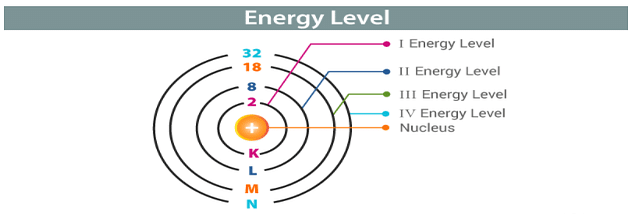
- The energy level rises by a predetermined amount. If electrons absorb this fixed energy, they can move from a lower to a higher energy level.
- An electron, on the other hand, emits energy when it jumps from a higher to a lower level. The majority of this energy is emitted in the form of light.
- Emission or absorption of energy occurs when electrons move from one energy level to another.
- The lowest energy level is referred to as the ground state, while the higher energy levels are referred to as excited states.
Also Read:
| Related Articles | ||
|---|---|---|
| LASER LIGHT | Avogadro's Number | Laser |
| Alpha Particle Mass | Magnetic Quantum Number | Modern Physics |
Bohr’s Atomic Model
[Click Here for Sample Questions]
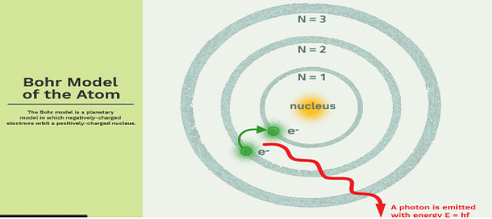
- The atomic models of Thomson and Rutherford failed to answer any problems about an atom's energy or stability. Niels Bohr presented an atomic model in 1913, characterizing an atom as a small, positively charged nucleus surrounded by electrons that orbit the positively charged nucleus in circular orbits, comparable to planets orbiting the sun in our solar system, with attraction provided by electrostatic forces.
- The Bohr model of an atom is a popular name for this model. An atomic model of a hydrogen atom was proposed by Bohr.
- The stability of electrons revolving in orbits was explained properly by Bohr's model. These orbits were given the term "energy shells" by him.
Postulates in Bohr’s Atomic Model
[Click Here for Sample Questions]
- Around the nucleus, electrons revolve in a fixed circular pattern.
- The orbits remain stationary at all times.
- A certain amount of energy will be contained in each stationary orbit. Orbital shells are another name for these orbits. The electrons won't be able to radiate energy until they continue in their orbits around the nucleus.
- The various energy levels and orbits are represented either numerically (1, 2, 3,...) or alphabetically (K, L, M, N...).
- Integers are used to represent all energy levels, such as n=1, n=2, n=3, and so on. These numbers are quantum numbers. The quantum number's range can vary from the lowest energy level to the highest energy level.
- The first energy level (K) has two electrons, the second has eight, and so on.
Bohr’s Explanation for Energy Level
[Click Here for Sample Questions]
- For an electron, these stationary states/energy levels (different orbit levels) are numbered n = 1, 2, 3,........... The principal quantum numbers are sometimes known as these integers.
- The orbital energy in which an electron is placed is given by: En = − Rh 1/ n2
Where, RH is called the Rydberg constant whose value is 2.18 × 10⁻¹⁸ J.
- When an electron is far from the nucleus' impact, its energy is assumed to be zero. The principal quantum number of an electron in such a stationary condition is denoted by n =. An ionized hydrogen atom is one of several types of hydrogen atoms. The following equation has a negative sign because the stationary state energy is expelled when an electron transitions from one orbit to another, lowering energy.
- An electron is said to be in the ground state when it is placed in the lowest stationary state/energy level conceivable. Electrons at this energy level rotate around the smallest possible orbit. This state has an energy of –13.6 eV.
Aufbau Principle
[Click Here for Sample Questions]
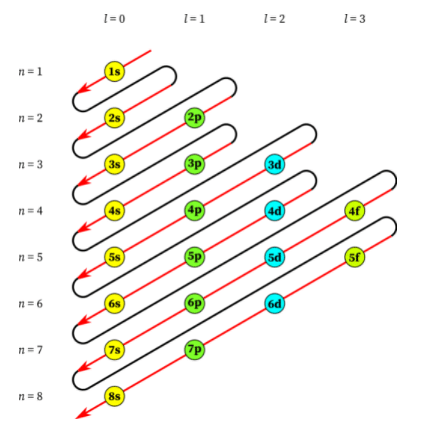
- According to the principle, the orbitals are filled based on their increasing energies in the ground state.
- Electrons first occupy the position in lower energy, then jump to higher energy levels only when lower levels are filled.
Pauli’s Exclusion Principle
[Click Here for Sample Questions]
- Based on the principle, an orbital can take place a maximum of two electrons having an opposite spin.
Hund’s Rule of Maximum Multiciplity
[Click Here for Sample Questions]
- Hund's rule considers the placement of electrons into decadent orbitals of the same subshells (s, p, d).
- Bonding in s, p, d subshells can not take place until and unless each orbital is engaged by one electron.
- The electrons repel each other as they are negatively charged. The repulsion can be lessened by moving them apart and placing indifferent degenerate subshells.
- All the subshells that have a single electron will spin in the same direction, either clockwise or anticlockwise.
Things to Remember
- Electrons spinning around a nucleus make up an atom. They are unable to move freely in any direction.
- The Bohr model of an atom is a popular name for this model. An atomic model of a hydrogen atom was proposed by Bohr.
- The stability of electrons revolving in orbits was explained properly by Bohr's model. These orbits were given the term "energy shells" by him.
- One of the postulates of this model is that the various energy levels and orbits are represented either numerically (1, 2, 3,...) or alphabetically (K, L, M, N...).
- According to the Aufbau principle, the orbitals are filled based on their increasing energies in the ground state.
- Based on Pauli’s exclusion principle, an orbital can take place a maximum of two electrons having an opposite spin.
- Hund's rule considers the placement of electrons into decadent orbitals of the same subshells (s, p, d).
Also Read:
Sample Questions
Ques. What is the energy level in an atom? (1 mark)
a) The number of protons in the nucleus
b) The amount of energy that an electron has in the orbital that it is in.
c) The number of electrons in the atom
d) The number of orbitals in the atom
Ans: The correct answer is (b) The amount of energy that an electron has in the orbital that it is in.
Ques. To excite an electron to a higher energy state, there needs to be: (1 mark)
a) Absorption of energy
b) Emission of energy
c) Movement of electrons
d) Protons
Ans: The correct option is (a) Absorption of energy
Ques. When an electron transitions from a higher level to a lower level, (1 mark)
a) The electron collapses to the nucleus
b) The electron loses all its energy
c) Light is emitted
d) Light is absorbed by the photons
Ans: The correct option is (b) The electron loses all its energy
Ques. How many electrons can the third shell accommodate? (3 marks)
Ans: The third orbit can hold up to 18 electrons in its maximum potential. Each shell can only hold a certain amount of electrons: the first shell can hold up to two electrons, the second shell can hold up to eight (2 + 6) electrons, the third shell can hold up to 18 (2 + 6 + 10) electrons, and so on. In theory, the nth shell can hold up to 2(n2) electrons, according to the general formula.
Ques. In which of the following Bohr’s stationary states, the electron will be at maximum distance from the nucleus? ( 2 marks)
a) IInd
b) Ist
c) Vth
d) IIIrd
Ans: The correct answer is (c) Vth
Ques. The same orbital electrons can be distinguished by: (1 mark)
a) Principal quantum number
b) Azimuthal quantum number
c) Spin quantum number
d) Magnetic quantum number
Ans: The correct answer is (c) Spin quantum number
Ques. What will be the sum of all possible values of l and m for n = 5? (1 mark)
a) 12
b) 13
c) 4
d) 9
Ans. The correct answer is (b) 13
Ques. State Aufbau principle? (2 marks)
Ans:
- According to the principle, the orbitals are filled based on their increasing energies in the ground state.
- Electrons first occupy the position in lower energy, then jump to higher energy levels only when lower levels are filled.
Ques. What is Bohr’s Atomic Model? (4 marks)
Ans:
- The atomic models of Thomson and Rutherford failed to answer any problems about an atom's energy or stability. Niels Bohr presented an atomic model in 1913, characterizing an atom as a small, positively charged nucleus surrounded by electrons that orbit the positively charged nucleus in circular orbits, comparable to planets orbiting the sun in our solar system, with attraction provided by electrostatic forces.
- The Bohr model of an atom is a popular name for this model. An atomic model of a hydrogen atom was proposed by Bohr.
- The stability of electrons revolving in orbits was explained properly by Bohr's model. These orbits were given the term "energy shells" by him.
Ques. What are the postulates found in Bohr’s atomic model? (5 marks)
Ans: The postulates of Bohr’s atomic model are:
- Around the nucleus, electrons revolve in a fixed circular pattern.
- The orbits remain stationary at all times.
- A certain amount of energy will be contained in each stationary orbit. Orbital shells are another name for these orbits. The electrons won't be able to radiate energy until they continue in their orbits around the nucleus.
- The various energy levels and orbits are represented either numerically (1, 2, 3,...) or alphabetically (K, L, M, N...).
- Integers are used to represent all energy levels, such as n=1, n=2, n=3, and so on. These numbers are quantum numbers. The quantum number's range can vary from the lowest energy level to the highest energy level.
- The first energy level (K) has two electrons, the second has eight, and so on.
For Latest Updates on Upcoming Board Exams, Click Here: https://t.me/class_10_12_board_updates
Check-Out:



Comments