



Content Curator
Magnesium oxide, commonly known as 'Magnesia,' is an ionic compound generated by the transfer of electrons between the metal Magnesium and the non-metal Oxygen. Magnesium oxide has the Chemical Reactions Formula MgO. It exists as a white hygroscopic solid found in nature as 'periclase,' a magnesium mineral found in metamorphic rocks as the "oxide of Magnesium."
| Table of Content |
Key Takeaways: Magnesium Oxide, MgO, Oxide, Magnesium, Oxygen
Read More: Number of Moles Formula
Magnesium Oxide's Chemical Formula and Structure
[Click Here for Sample Questions]
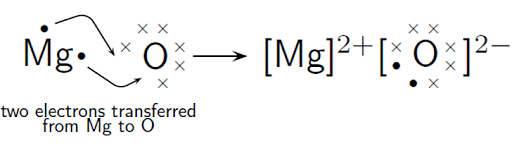
Magnesium oxide (MgO) is an ionic molecule generated by the transfer of both Magnesium and Oxygen valence electrons during the displacement reaction. As a result, the cation (Mg2+) and anion (O2– ) form an ionic bond in MgO due to a high covalent bond.
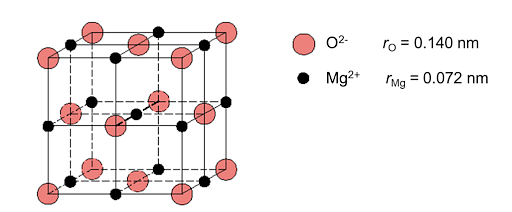
Magnesium oxide's crystal lattice has an octahedral geometry and is shaped like 'Halite,' with a lattice constant of "a=4.212Ao." The Mg2+ and O2– ions are firmly linked, resulting in a high melting point.
Various Types of Chemical Formulas
A Chemical Formula can be expressed in a number of different ways, including
- Empirical Formula: The empirical formula represents the ratio of the elements contained in specific chemical composition.
- Molecular Formula: The molecular formula can be used to calculate the number of components in a particular molecule.
- Structural Formula: The structural formula of a specific chemical compound provides insight into the configuration of the atoms in the given molecule.
Experiment to Demonstrate Magnesium Ribbon Burning Equation
[Click Here for Sample Questions]
When a piece of magnesium ribbon is lit, light and heat are produced.
Aim: This is a simple demonstration that illustrates the magnesium oxide symbol as well as the concept of an exothermic and light-producing process.
Materials Needed:
- Sanded 6-8 cm magnesium ribbon to remove the oxide layer
- Bunsen burner, charcoal grill lighter, or other similar device
- Tongs

Procedure: After lighting the burner, adjust the flame to a light blue. While holding one end of the magnesium ribbon with tongs, place the other end in the flame. It is best to keep the blazing ribbon at arm's length. Magnesium burns brightly and produces a great amount of heat.
2Mg + O2 = 2MgO (magnesium ribbon formula)
Magnesium oxidation or combustion in air has long been used as a source of brilliant light in photography and other photochemical activities. As indicated in the magnesium oxide balanced equation, the energy released in this combustion is due to the reaction of magnesium with oxygen in the air.
Read More: Physical and Chemical Classification of Matter
How to Balance a Magnesium Oxide Equation
[Click Here for Sample Questions]
Consider the chemical interaction between magnesium and oxygen to understand the processes required in balancing a chemical equation.
Step 1: Let us begin by constructing the word equation for the reaction.
MAGNESIUM + OXYGEN → MAGNESIUM OXIDE
Step 2: Now we shall construct the equation for the above word equation.
Mg + O2 → MgO
Step 3: Count the number of times each element appears on both the left and right sides of this equation.
| COMPONENT | REACTANT | PRODUCT |
|---|---|---|
| MAGNESIUM | 1 | 1 |
| OXYGEN | 2 | 1 |
Here we can see that there is only one magnesium atom and two oxygen atoms on the reactant side of the equation. So, we now multiply the magnesium atom on the left-hand side by two.
| COMPONENT | REACTANT | PRODUCT |
|---|---|---|
| MAGNESIUM | 1 x 2 = 2 | 1 |
| OXYGEN | 2 | 1 |
Step 4: Since we have multiplied the left-hand side of the magnesium atom by two, we will also have to multiply the right-hand side of the equation containing Mg by 2.
| COMPONENT | REACTANT | PRODUCT |
|---|---|---|
| MAGNESIUM | 1 x 2 = 2 | 1 x 2 = 2 |
| OXYGEN | 2 | 1 x 2 = 2 |
Step 5: We now have a balanced equation.
2Mg + O2 → 2MgO
Therefore, now we can see that the number of magnesium and oxygen atoms on the reactant side of the equation is equal to the number of atoms of magnesium and oxygen on the product side of the equation.
Magnesium Oxide Physical Properties
[Click Here for Sample Questions]
| Chemical formula | MgO |
| Common Name | Magnesia |
| Molar Mass | 40.304gmol−1 |
| Melting Point | 2852oC |
| Boiling Point | 3600oC |
| Density | 3.6gcm−3 |
| Crystal Structure | Halite (Cubic) |
Points to Remember
Following are some important points:
- Magnesium oxide, commonly known as 'Magnesia,' is an ionic compound generated by the transfer of electrons between the metal (Magnesium) and the non-metal (Oxygen).
- Magnesium oxide has the chemical formula MgO. It exists as a white hygroscopic solid.
- It is mostly generated by calcining magnesite or magnesium carbonate (MgCO3).
- Its melting point is 2852°C and boiling point is 3600°C.
- Magnesium oxide (MgO) is found in abundance on Earth in the form of Dolomite, silicate, and magnesite rocks.
Read More: Law of Multiple Proportions
Sample Questions
Ques: What exactly is magnesium oxide? (2 Marks)
Ans: Magnesium oxide is an ionic substance generated by the combination of magnesium and oxygen. It is available as a white, odourless powder. Because it is a metal oxide, it is basic in nature. It is used as an antacid to alleviate indigestion, among other things.
Ques: Why is magnesium oxide's formula, MgO? (2 Marks)
Ans: Magnesium oxide is an ionic compound generated by valence electron transfer. Because oxygen is more electronegative, it attracts valence electrons to itself, whereas magnesium donates its two valence electrons to create its stable electronic configuration. As a result, the cation (Mg2+) and anion (O2–) are held together by a strong electrostatic force of attraction to form an ionic bond in MgO. As a result, the formula for magnesium oxide is MgO.
Ques: Is magnesium oxide stable? (2 Marks)
Ans: It is unreactive at elevated temperatures, such as 1500 – 2000oC, and mildly reactive and reactive at lower temperatures. Its melting point is 350 degrees Celsius. Solid Magnesium Hydroxide experiences an endothermic breakdown when exposed to extremely high temperatures, which means it absorbs heat from the surrounding environment.
Ques: Why does magnesium burn in a bright white colour? (2 Marks)
Ans: Magnesium reacts with oxygen to create a bright light that temporarily blinds you. Magnesium burns brightly because the reaction generates a lot of heat. In an exothermic reaction, magnesium donates two electrons to oxygen, resulting in powdered magnesium oxide (MgO). That is why Magnesium burns so brightly.
Ques: What distinguishes magnesium oxide from magnesium? (2 Marks)
Ans: Magnesium oxide, abbreviated MgO, is a combination of magnesium and oxygen, whereas magnesium is a pure element. It is a metal with the atomic number 12 and the symbol Mg. MgO is formed when Mg burns in the air.
Ques: Mention any four applications of Magnesium oxide? (2 Marks)
Ans: Magnesium oxides have a variety of applications in industry, health, and everyday life. Some of them are as follows:
- Refractory materials are commonly employed as furnace linings for high-temperature applications. Magnesium oxide is widely utilised in the manufacture of crucibles.
- Magnesium oxide supplements are sometimes utilised as a short-term laxative to alleviate gastrointestinal symptoms.
- Magnesium is required by our bodies for optimal muscle, neuron, and cell function.
- As a result, magnesium oxide is also used as a magnesium supplement to assist treat low Mg levels in the body.
Ques: How can one produce magnesium oxide? (2 Marks)
Ans: The various methods to produce magnesium oxide are:
- Magnesium Hydroxide Calcination: Calcination of magnesium hydroxide includes heating a filter cake comprising 50–72 solid magnesium hydroxide solids to roughly 350 degrees Celsius.
- By Using Magnesite Calcination: Magnesite or magnesium carbonate (MgCO3) calcination is the most popular method for producing magnesium oxide. For magnesite calcination, a variable temperature kiln is taken, where it decomposes into magnesium oxide and carbon dioxide gas is emitted.
- Deduced from Dolomite: Magnesium oxide is recovered from Dolomite powder by treating it with sulfuric acid, which converts the lime to insoluble and the magnesia or Magnesium oxide to soluble. The product was separated by filtering, and is transformed to or and subsequently calcined to using the same technique.
Ques: Is Magnesium Oxide a Laxative or an Antacid? (2 Marks)
Ans: Magnesium oxide is a supplement that aids in the maintenance of magnesium levels in the body. Magnesium oxide can also be used as an antacid or a laxative to alleviate constipation. Magnesium offers a plethora of other beneficial characteristics.
Ques: What exactly is Magnesium Hydroxide? (2 Marks)
Ans: Magnesium Hydroxide is a non-harmful naturally occurring inorganic base. The aqueous solution is known as milk of magnesia, and it is widely used as an antacid. Mg(OH)2 is the chemical formula for magnesium hydroxide. Furthermore, the molar mass of the same is said to be 58.32 g/mol. The core Mg is connected by the two hydroxyl groups. Because it is ionic, the molecule is found mostly as Mg2+ and OH- ions. Magnesium Hydroxide is a white, odourless solid form of magnesium. It has a density of 2.34 g/mL and a weight of 2.34 g/mL.
Ques: Write the procedure and result of the Magnesium Ribbon reaction? (2 Marks)
Ans: Adjust the flame to a light blue after lighting the burner. The flaming ribbon should be kept at arm's length at all times. Magnesium emits a lot of heat and burns brilliantly.
2Mg + O2 = 2MgO
Magnesium oxidation or combustion in the air has long been utilised in photography and other photochemical processes as a source of dazzling light. The energy released in this combustion comes from the reaction of magnesium with oxygen in the air, as illustrated in the magnesium oxide balanced equation.
Magnesium oxide is produced at a temperature of -601.83 kJ/mol. When magnesium burns, around 10% of the energy is converted to light, a percentage that is unrivalled among known energy transformations employed in the production of light.
Also Read:



Comments