



Education Journalist | Study Abroad Lead
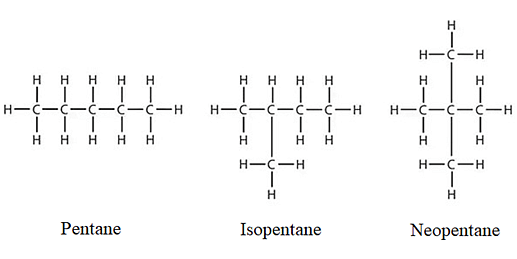
Pentane, the organic compound, has the formula C5H12, which means it's a five-carbon alkane. The name can refer to any of three structural isomers, or a combination of them; however, in IUPAC nomenclature, pentane only refers to the n-pentane isomer; the other two are known as isopentane and neopentane respectively Because cyclopentane only contains 10 hydrogen atoms whereas pentane has 12, it is not an isomer of pentane. Pentanes are used as specialty solvents in the laboratory and are found in some fuels. Qualities induced in them have an affinity towards hexanes & butanes. In this article, we will look at the formula of Pentane, its Isomers, and its properties.
Read Also:- Classification of Organic Compounds
| Table of Contents |
Keyterms: Organic compound, Carbon, Alkane, Isomer, Hydrogen, Atom, Cyclopentane, Hexanes, Butanes, Isopentane
What is Pentane?
[Click Here for Sample Questions]
Pentane is a colorless, flammable liquid that is lighter than water, and it’s the first liquid member of the alkanes. At 900 parts per million, it has a nice odor, while at 5000 parts per million, it has a moderate odor strength. Isopentane [(CH3)2CHCH2CH3] and neopentane [C(CH3)4] are two more isomers of it. Isopentane (2-methyl butane) resembles straight-chain pentane in terms of physical and physiological properties. Physically and physiologically, neopentane (2,2-dimethylpropane) is identical to butane. C-5 pentane is comparable to 3 mg m3 in the air at one part per million.
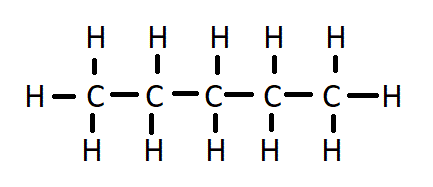
Pentane
Pentane is an aliphatic hydrocarbon that is mostly generated from crude oil. It's a colorless, volatile petroleum distillate that's rather water-soluble and makes up a big part of gasoline. It would have a tendency to travel to the atmosphere following an environmental release due to its volatility, and would not pose a threat to the food chain. Humans can be exposed by skin contact or inhalation.;
The poisoning mechanism is most likely nonspecific narcosis (similar to volatile anesthetic compounds). Acute exposure of people and/or animals to relatively high levels might result in this narcotic kind of poisoning, although persistent exposures to lower levels appear to be inconsequential. Pentane is non-neurotoxic, non-mutagenic, and non-cancerous. Following exposure, clinical care would entail getting the person away from the source and into the fresh air (e.g., outdoors). Occupational exposure to pentane has regulatory requirements, while the branched isomers do not. Pentane's toxicity to the environment is expected to be negligible.
Read more:- Isotopes and Isobars
Properties of Pentane
[Click Here for Sample Questions]
The properties of pentane are as given below:
- C5H12 is a colorless, transparent liquid with a petroleum-like odor. It is found in crude oils and condensates and belongs to the organic class alkanes. It is a component of certain fuels and is used in laboratories as a specialty solvent.
- The vapors are heavier than air and have a boiling point of 36°C/97°F. The liquid and vapor are both combustible.
- At normal temperatures, pentane is a liquid. When heated over 36°C/97°F, it turns into a gas, and when cooled, it turns into a solid.;
- The phase diagram for pentane depicts how the phase behaves as temperature and pressure change. The pentane boiling point is shown as a curve between the critical point and the triple point as pressure varies. It also depicts variations in saturation pressure as a function of temperature.
- When pressure is increased or heat is applied to the critical point, the state does not change.
The properties of pentane in the tabulated form are as given below:
| IUPAC Name | Pentane |
| Molecular formula | C5H12 |
| Molecular mass | 72.151 g/mol |
| Melting point | -130.5 to -129.1ºC |
| Boiling point | 35.9 to 36.3ºC |
| Density | 0.626 g/mL |
| Appearance | Colorless liquid |
| Refractive index | 1.358 |
| Viscosity | 0.240 mPa.s at 20ºC |
Isomers of Pentane
[Click Here for Sample Questions]
Pentane has three structural isomers, which are as follows:
- The first isomer, n-pentane, is a straight-chain with a conventional pentane structure.
- The second isomer, 2-methyl butane, has a branched-chain structure with one carbon atom bonded to three other carbon atoms.
- The third isomer, 2,2-dimethylpropane, has a branched-chain structure with the core carbon atom bonded to four additional carbon atoms.
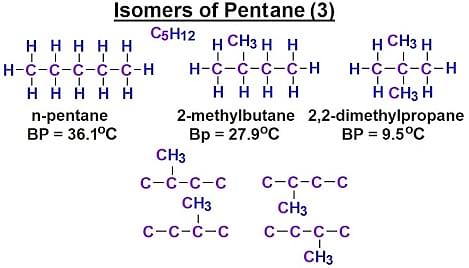
Isomers of Pentane
Uses of Pentane
[Click Here for Sample Questions]
Pentane has multiple applications such as:
- Pentane has a variety of industrial applications in addition to being a component of natural gas.
- Pentane is primarily used to make a blowing agent, which is subsequently used to make polystyrene foam. Insulation materials for refrigerators and heating pipes are made of polystyrene.
- Pentane is also employed as a binary fluid in geothermal power plants due to its low boiling point (36ºC).
- It's a component in polystyrene foam manufacture.
- High-octane fuels are made from isopentane, which is created by acid-catalyzed isomerization.
- It is utilized as a working medium in the Rankine cycle in geothermal power plants.
- Liquid chromatography makes use of it as well.
- Pentanes are volatile liquid that is cheap at ambient temperature. They're employed in laboratories as a solvent.
- Pentane is a commodity chemical since it is an unfunctionalized hydrocarbon. It is mostly utilized as a fuel and a solvent, although it may also be used to produce hydrogen by steam reforming.
Also Read:
Structure and Formula of Pentane
[Click Here for Sample Questions]
Pentane has a straight-chain structure with 5 carbon atoms. Any of the three structural isomers with the chemical formula C5H12 are referred to as pentane. However, in IUPAC nomenclature, the name pentane refers only to the unbranched isomer of the group, n-pentane. Pentane, often known as n-pentane, has the chemical formula C5H12.
Structure and Formula of Pentane
Structural formula = CH3CH2CH2CH2CH3
Condensed structural formula = CH2CH23CH3
Things to Remember
- Pentane isomers have boiling temperatures ranging from 9 to 36°C. As with other alkanes, the boiling temperatures of the extensively branched isomers are lower.
- Alkane isomers have comparable melting values, with isopentane having a lower melting point than n-pentane (by 30 degrees Celsius).;
- The melting point of neopentane, which is the most branched of the three, is 100 degrees Celsius higher than that of isopentane.
- The tetrahedral molecules cluster closer together in solid form, resulting in a relatively high melting point for neopentane.;
- The fact that neopentane has a lower density than the other two isomers refutes this theory, and the high melting point is due to neopentane's much lower fusion entropy.
- The branched isomers are more stable than n-pentane (they have lower formation and combustion heat). Isopentane has a difference of 1.8 kcal/mol, while neopentane has a difference of 5 kcal/mol.
- Four distinct conformations result from rotating n-pentane around two core single C-C bonds.
Sample Questions
Ques. What is the use of pentane in everyday life? (5 marks)
Ans. Pentane has a variety of industrial applications in addition to being a component of natural gas. Pentane is primarily used to make a blowing agent, which is then used to make polystyrene foam. Insulation materials for refrigerators and heating pipes are made of polystyrene.
Iso-Pentane is nearly insoluble in water, but it has excellent solubility or unrestricted miscibility in a wide range of organic solvents, including paraffin, ethers, esters, aromatics, and chlorinated hydrocarbons. As a result, the product can be used in a variety of situations:
- Shaving foam and shower gel are examples of personal care items.
- In geothermal plants, it serves as the working medium.
- The solvent is non-polar and has high volatility.
- Polyethylene (PE, LLDPE) and polypropylene (PP) processing medium (PP)
Ques. Describe the structure of pentane? (5 marks)
Ans. All pentanes have five carbon atoms and are saturated hydrocarbons. n-Pentane and iso-Pentane are produced as a by-product of natural gas production and are found naturally in crude oil. The ring-shaped molecule cyclopentane, which is highly sought after in the industry, is found more in naphtha (crude petrol), which is created in refineries through so-called cracking procedures.
Pentanes are present in various proportions in naphtha, depending on the crude oil's origin, refinery structure, and process management. At room temperature, they are the first hydrocarbons to be liquid.
Pentane is a colorless, flammable liquid that is lighter than water (the first liquid member of the alkanes).
Ques. Is pentane gas poisonous? (3 marks)
Ans. Pentane can irritate the nose and throat when inhaled. If a person is exposed to pentane it can cause lightheadedness, severe headaches, immense dizziness, etc. It can also cause pulmonary edema, which is a medical emergency.
Normal pentane leads to VOC and tropospheric ozone generation, both of which are hazardous to green plants, animals, and people.
Ques. Is pentane a type of LPG? (3 marks)
Ans. Pentane is a colorless, highly volatile liquid with a gasoline-like odor. Pentane has a variety of industrial applications in addition to being a component of natural gas. Pentane is primarily used to make a blowing agent, which is subsequently used to make polystyrene foam.
Because natural gas contains heavier components (such as pentane, hexane, and heptane), LPG is separated from the overall liquid through distillation, and the remaining liquid is known as Natural Gasoline Liquid. Pentane and Special Boiling Point Solvent are made from this NGL after it has been treated further.
Ques. What is the explosive power of pentane? (5 marks)
Ans. Pentane is a highly flammable gas. It has a flashpoint of -50 degrees Celsius and a boiling point of 36 degrees Celsius. Because it is heavier than air, the vapor emitted can concentrate in low-lying locations or containers, creating a persistent flammable environment that can trigger a flash fire if ignited.
It is critical that flammable gas storage spaces be adequately ventilated. Consider the specific gravity of the real gas while constructing ventilation systems. When there is a leak, the gas mixture is not homogenous, and lighter gases concentrate near the ceiling. Gases that are heavier than air condenses along the floor.
Natural or mechanical ventilation must be enough to keep the concentration of flammable gases or vapors below 25% of their "Lower Explosive or Flammable Limit" (LEL/LFL).
Ques. Where can you find pentane? (5 marks)
Ans. n-Pentane and iso-Pentane are produced as a by-product of natural gas production and are found naturally in crude oil. The ring-shaped molecule cyclopentane, which is highly sought after in the industry, is found more in naphtha (crude petrol), which is created in refineries through so-called cracking procedures.
At 29 degrees Celsius, iso-Pentane has the lowest boiling point, followed by n (35 degrees Celsius) and Cyclopentane (49 degrees Celsius). Pentane's three isomers may be easily distinguished from one another due to their low boiling temperatures and significant intervals between them.
Pentanes are present in varying amounts in naphtha, depending on the crude oil's origin, refinery construction, and process management. At room temperature, they are the first hydrocarbons to be liquid.
Ques. What are the properties of pentane? (3 marks)
Ans. Pentane is a colorless liquid with a very unpleasant odor. It has a melting point of -129.8 degrees Celsius and a boiling point of 36.1 degrees Celsius. Because of its low boiling point, pentane may quickly evaporate into a vapor at ambient temperature. A highly flammable substance that can be explosive when mixed with air as a vapor.
For Latest Updates on Upcoming Board Exams, Click Here: https://t.me/class_10_12_board_updates
Check-Out:



Comments