



.png?h=18&w=18&mode=stretch)
The MCAT test carries 230 multiple-choice questions across 4 sections, with a total seating time of 7 hours 30 minutes and 6 hours 15 minutes of actual content testing time. The MCAT exam is administered by the Association of American Medical Colleges (AAMC), scored on a scaled 472–528 range with zero negative marking.
- The MCAT subjects span 10 academic disciplines across its 4 sections — General Chemistry, Organic Chemistry, Biochemistry, Physics, Biology, Psychology, Sociology, and Critical Reading.
- Roughly 76% of the MCAT paper is passage-based, built around data-analysis charts, experimental methodology descriptions, and text-heavy excerpts.
- Highest-Weightage Sections: Chemical & Physical Foundations, Biological & Biochemical Foundations, and Psychological/Social/Biological Foundations each have 59 questions, while CARS has 53 questions.
- Time Allocation: The three 59-question sections get 95 minutes each, while CARS has 90 minutes.
- MCAT exam is for Indian students targeting medical schools in the US, Canada, or the Caribbean. MCAT is not used for domestic MBBS admissions in India, where NEET remains the sole gateway.
Related Links:
- MCAT Exam 2027: Registration, Test Dates, Syllabus, Free Sample Papers
- MCAT Score: Release Date, Score Percentile, and Accepted Universities
Key Summary
- The MCAT exam consists of 230 questions across 4 sections, with content testing time of 6 hours 15 minutes and total seating time of 7 hours 30 minutes including breaks.
- The MCAT exam syllabus has no negative marking, unlike NEET's strict penalty matrix, an MCAT wrong answer costs nothing, so there's no reason to leave a bubble blank.
- MCAT scoring uses a scaled 472–528 range (midpoint 500) rather than a simple correct-minus-incorrect raw score, because the AAMC equates scores across different test dates and difficulty levels.
- MCAT exam in India is not conducted for domestic medical admissions; it's relevant specifically to Indian students applying to medical schools abroad.
MCAT Exam Pattern 2027: Overview
The MCAT is a computer-based test administered exclusively at Pearson VUE testing centres, run multiple times a year with a scaled scoring system rather than a raw marks total.
- A total of 230 questions are asked in the MCAT exam for a total of 472-528 marks.
- Total seating time of the MCAT exam is 7 hours 30 minutes, which is longer than the actual content testing time of 6 hours 15 minutes. This is because the exam includes an optional tutorial, three built-in breaks, and an end-of-day survey.
- MCAT does not have one fixed pass/fail score. Instead, scores range from 472 to 528, with 500 as the midpoint. A higher score means stronger performance, so your score is understood based on where it falls on this scale.
| Aspect | Details |
|---|---|
| Full Name | Medical College Admission Test (MCAT) |
| Conducted by | Association of American Medical Colleges (AAMC) |
| Test Delivery Partner | Pearson VUE (in-person computer-based testing centres) |
| Exam Mode | Computer-based (in-person only) |
| Frequency | Multiple dates per year (typically January–September) |
| Number of Sections | 4 |
| Total Questions | 230 (includes some unscored field-test questions) |
| Content Testing Time | 6 hours 15 minutes |
| Total Seated Time | Approximately 7 hours 30 minutes (includes breaks & administrative time) |
| Score Scale (per section) | 118–132 (midpoint 125) |
| Total Score Range | 472–528 (midpoint 500) |
| Marking Scheme | No negative marking; scaled scores based on correct answers |
| Void Option | Available at the end of the exam (choose to score or void the entire attempt) |
Ques. What is MCAT exam?
Ans. MCAT stands for Medical College Admission Test, a computer-based entrance exam administered by the AAMC for admission into medical schools primarily in the US and Canada.
Ques. What is the MCAT test duration?
Ans. Total seating time is approximately 7 hours 30 minutes, of which 6 hours 15 minutes is actual content testing time across 4 sections.
MCAT Sample Papers 2026
| Download Free MCAT Practice Papers PDF 2026 | |
|---|---|
| MCAT CPBS Sample Paper 1 | MCAT CPBS Sample Paper 2 |
| MCAT BBLS Sample Paper 1 | MCAT BBLS Sample Paper 2 |
| MCAT PSBB Sample Paper 1 | MCAT PSBB Sample Paper 2 |
| MCAT CARS Sample Paper 1 | MCAT CARS Sample Paper 2 |
MCAT Exam Pattern 2027: Section-wise Breakdown
The MCAT splits into 4 sections of near-equal length, with three sections built around 10 passage sets, having 15 discrete questions each, and one section entirely passage-based with no standalone questions.
- Marks are not given on a per-question basis. For the number of questions attempted in a given section, there is a score associated, based on the difficulty of the section.
- The score of each section ranges between 118 and 132. Chem/Phys, Bio/Biochem, and Psych/Soc sections each run 95 minutes for 59 questions.
- CARS section runs shorter at 90 minutes for 53 questions; it's built entirely from 9 passage sets with zero standalone questions, making it the only section where every single question depends on reading comprehension rather than any recalled fact.
| Order | Section | Questions | Time | Notes |
|---|---|---|---|---|
| 1 | Chemical and Physical Foundations of Biological Systems | 59 | 95 min | 10 passage sets (4–6 Qs each) + 15 discrete questions |
| 2 | Critical Analysis and Reasoning Skills (CARS) | 53 | 90 min | 9 passage sets (5–7 Qs each); no discrete questions |
| 3 | Biological and Biochemical Foundations of Living Systems | 59 | 95 min | 10 passage sets (4–6 Qs each) + 15 discrete questions |
| 4 | Psychological, Social, and Biological Foundations of Behavior | 59 | 95 min | 10 passage sets (4–6 Qs each) + 15 discrete questions |
Ques. How many sections are there in the MCAT exam?
Ans. Four sections: Chemical and Physical Foundations, Critical Analysis and Reasoning Skills (CARS), Biological and Biochemical Foundations, and Psychological, Social, and Biological Foundations of Behavior.
Also Check: MCAT Test Dates 2026: Check Exam Dates for 2026 Testing Year
MCAT Exam Pattern: Past Year Analysis
The biggest change in the MCAT exam pattern was made in 2015 and the pattern is still continued for the current cycle:
- The 2015 redesign nearly doubled the testing time, from 3 hours 20 minutes to 6 hours 15 minutes, while adding an entirely new section (Psych/Soc).
- The exam dropped the old Writing Sample essay, and introducing Biochemistry as a core pillar for the first time in 2015.
- Total question count increased from 144 MCQs in the 2007–2014 era to 230 currently, alongside scoring-scale changes.
- A temporary 2020 pandemic-shortening decreased the science-section questions from 59 down to 48 and removed tutorials to allow multiple testing cohorts per day. However, this change was temporary and the original structure was reverted from 2021.
| Feature | 2007–2014 Era | 2015–Present Era (Current) |
|---|---|---|
| Exam Format | Computer-based | Computer-based |
| Total Seating Time | 5 hours | 7 hours 30 minutes |
| Actual Testing Time | 3 hours 20 minutes | 6 hours 15 minutes |
| Total Question Count | 144 MCQs | 230 MCQs |
| Core Sections | Physical Sciences; Biological Sciences; Verbal Reasoning | Chem/Phys; CARS; Bio/Biochem; Psych/Soc |
| Scoring Scale | 1–15 per section (Max 45) | 118–132 per section (Max 528) |
Ques. When was the MCAT exam pattern last overhauled?
Ans. The most significant redesign happened in April 2015, adding the Psych/Soc section, nearly doubling testing time, and replacing the old scoring scale with today's 118–132 system.
MCAT Exam Pattern: Marking Scheme 2027
Unlike NEET's literal correct-minus-incorrect formula, the MCAT converts raw correct-answer counts into a scaled score through a process called Equating, and there is zero penalty for guessing.
Equating means adjusting scores from different versions of a test so that they are comparable, even if one version was slightly easier or harder than another.
- Because every MCAT test form varies slightly in difficulty, the AAMC's equating process ensures a scaled score of 130 on a harder test date represents the same skill level as a 130 on an easier one.
- The MCAT question papers include some unscored "field-test" questions mixed in among the 230 total, meaning test-takers cannot identify which questions count toward their score and must treat every question as if it does.
| Feature | MCAT (2027) |
|---|---|
| Total Marks | 472–528 (Scaled Score) |
| Correct Answer | Adds to the raw score (scaled later) |
| Incorrect Answer | 0 points (no negative marking) |
| Unattempted | 0 points |
| Score Calculation | Raw scores converted via AAMC equating to a 118–132 sectional scale |
Ques. Is there negative marking in the MCAT exam?
Ans. No. The MCAT marking scheme has zero penalty for incorrect answers, so unlike NEET, there's no strategic reason to leave a question unattempted.
MCAT Sections and Subject Weightage 2027
Each MCAT section comes from a different mix of MCAT subjects. These 4 sections are:
- Chem/Phys
- CARS
- Bio/Biochem
- Psych/Soc
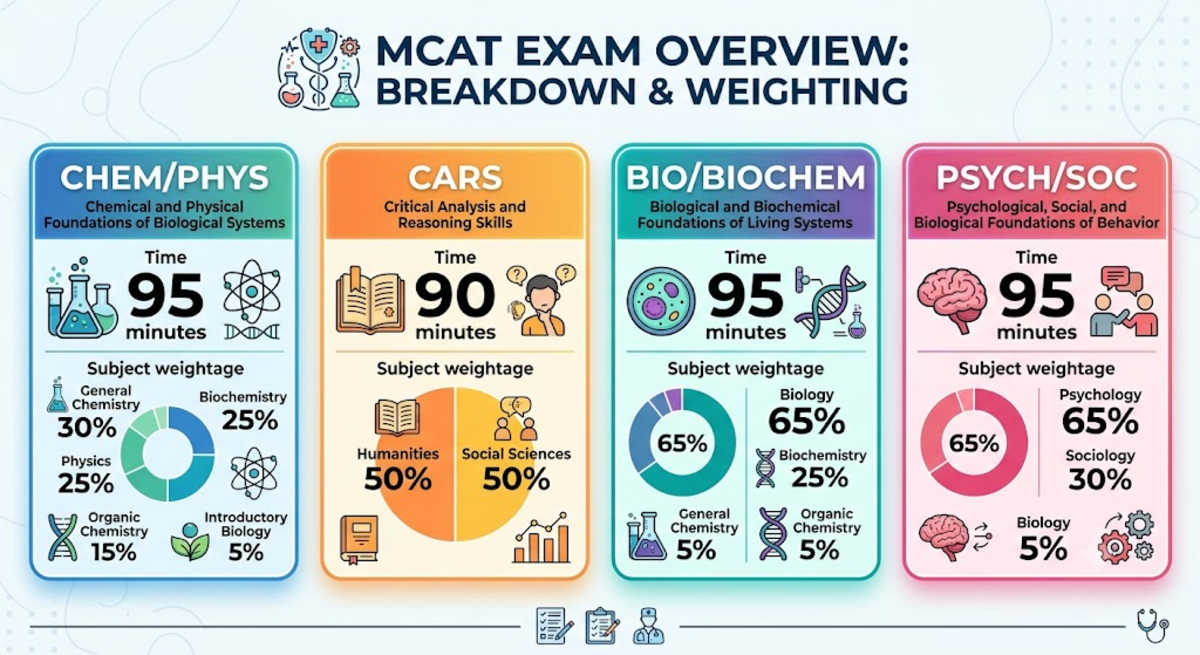
The section-wise weightage varies as follows in the MCAT exam:
- Chem/Phys splits fairly broadly across General Chemistry (30%), Biochemistry (25%), Physics (25%), and Organic Chemistry (15%), while Bio/Biochem concentrates much more heavily in Biology alone (65%).
- Psych/Soc: Most questions come from Psychology (65%), followed by Sociology (30%), while only 5% are from Biology.
- CARS: Unlike the other MCAT sections, CARS does not test science. Half of the questions are based on Humanities passages and half on Social Sciences passages, mainly testing reading and reasoning skills.
| Section | Time | Subject Weightage |
|---|---|---|
| Chem/Phys | 95 min |
|
| CARS | 90 min |
|
| Bio/Biochem | 95 min |
|
| Psych/Soc | 95 min |
|
Ques. What subjects does the MCAT test?
Ans. The MCAT syllabus spans General Chemistry, Organic Chemistry, Biochemistry, Physics, Biology, Psychology, Sociology, and reading comprehension through the CARS section — 10 academic disciplines in total across its 4 sections.
MCAT Practice Papers: Download Free PDFs
| MCAT Test Papers for Chemical and Physical Foundations of Biological Systems | |
|---|---|
| Sample paper 1 | Sample paper 2 |
| Sample paper 3 | Sample paper 4 |
| Sample Paper 5 | Sample Paper 6 |
| Sample Paper 7 | Sample Paper 8 |
| MCAT Test Papers for Biological and Biochemical Foundations of Living Systems | |
|---|---|
| Sample Paper 1 | Sample Paper 2 |
| Sample Paper 3 | Sample Paper 4 |
| Sample Paper 5 | Sample Paper 6 |
| Sample Paper 7 | Sample Paper 8 |
| MCAT Test Papers for Psychological, Social, and Biological Foundations of Behavior | |
|---|---|
| Sample Paper 1 | Sample Paper 2 |
| Sample Paper 3 | Sample Paper 4 |
| Sample Paper 5 | Sample Paper 6 |
| Sample Paper 7 | Sample Paper 8 |
| MCAT Test Papers for Critical Analysis and Reasoning Skills | |
|---|---|
| Sample Paper 1 | Sample Paper 2 |
| Sample Paper 3 | Sample Paper 4 |
| Sample Paper 5 | Sample Paper 6 |
| Sample Paper 7 | Sample Paper 8 |
MCAT Syllabus: High-Weightage Topics 2027
As MCAT is an undergraduate entry test into medical school, the MCAT exam syllabus prioritises concepts that bridge foundational science with human physiology.
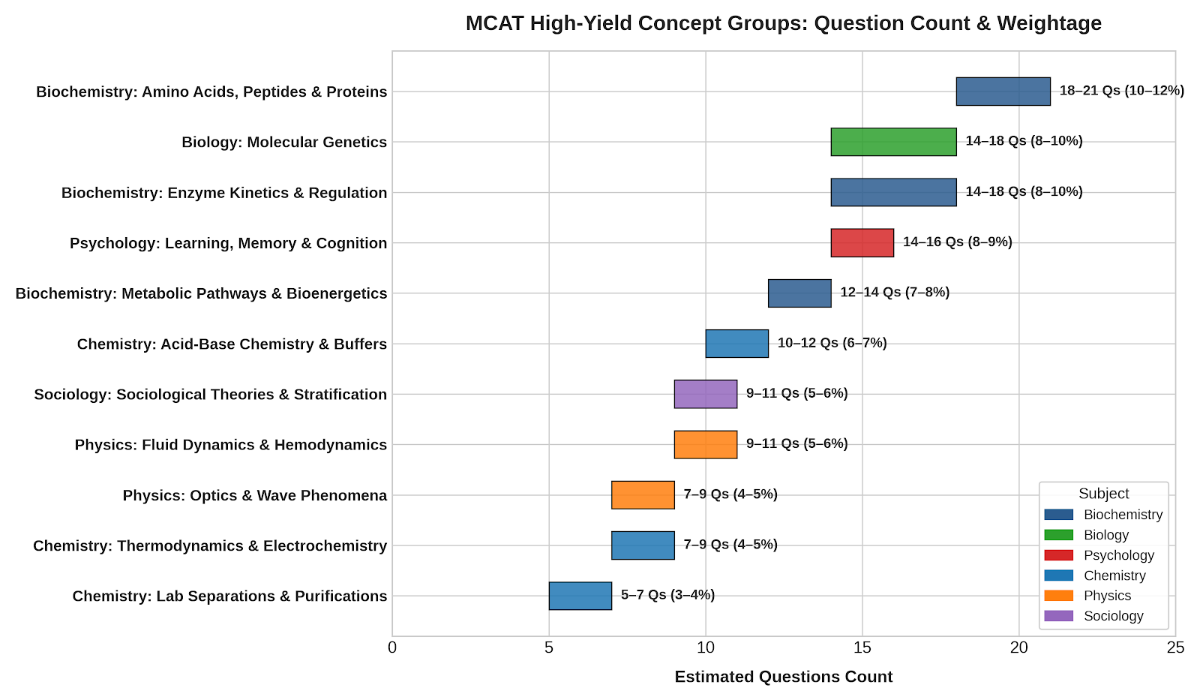
- Amino Acids, Peptides, and Proteins is the single highest-yield topic on the entire MCAT, candidates need to know structures, one- and three-letter codes, and physiological pH properties cold, since it alone accounts for 10–12% of all science questions.
- Enzyme Kinetics (Michaelis-Menten, Km, Vmax, and the four inhibition types) is the second-highest-yield Biochemistry topic, closely followed by Metabolic Pathways & Bioenergetics, together these three topics make up roughly a quarter of every science section combined.
- CARS carries no topic list; instead, its weighting splits across three reasoning skills: Foundations of Comprehension (30%), Reasoning Within the Text (30%), and Reasoning Beyond the Text (40%).
| Subject | High-Yield Concept Group | Expected % of Science Questions | Estimated Questions |
|---|---|---|---|
| Biochemistry | Amino Acids, Peptides & Proteins | 10–12% | 18–21 |
| Enzyme Kinetics & Regulation | 8–10% | 14–18 | |
| Metabolic Pathways & Bioenergetics | 7–8% | 12–14 | |
| Biology | Molecular Genetics | 8–10% | 14–18 |
| Psychology | Learning, Memory & Cognition | 8–9% | 14–16 |
| Chemistry | Acid-Base Chemistry & Buffers | 6–7% | 10–12 |
| Thermodynamics & Electrochemistry | 4–5% | 7–9 | |
| Lab Separations & Purifications | 3–4% | 5–7 | |
| Physics | Fluid Dynamics & Hemodynamics | 5–6% | 9–11 |
| Optics & Wave Phenomena | 4–5% | 7–9 | |
| Sociology | Sociological Theories & Stratification | 5–6% | 9–11 |
Ques. What is the syllabus for MCAT?
Ans. It spans molecular biology, biochemistry, general and organic chemistry, physics, psychology, and sociology, applied through a clinical and physiological lens rather than tested as isolated facts — plus reading comprehension in CARS, which has no science content at all.
How Is the MCAT Exam Conducted?
The MCAT runs as a single, tightly scheduled day at a Pearson VUE testing centre, with fixed break points built into the sequence rather than flexible timing.
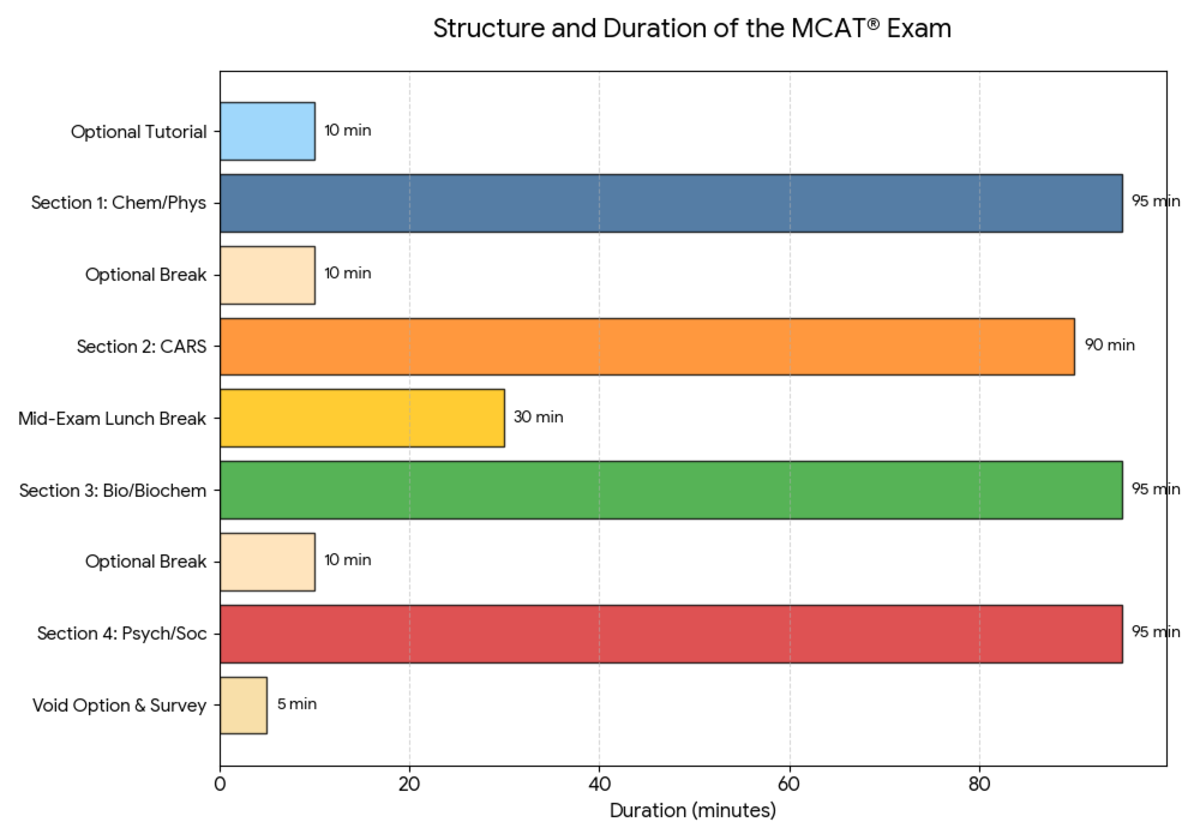
- The exam starts with a 4-minute certification step, followed by an optional 10-minute tutorial.
- Three breaks are provided between the four sections: 10 minutes, 30 minutes (lunch), and 10 minutes.
- The 30-minute lunch break comes after CARS (Section 2), giving students a longer break before the final two science sections.
| Test Component | Duration | Questions |
|---|---|---|
| Optional Tutorial | 10 minutes | |
| Section 1: Chem/Phys | 95 minutes | 59 Qs |
| Optional Break | 10 minutes | |
| Section 2: CARS | 90 minutes | 53 Qs |
| Mid-Exam Lunch Break | 30 minutes | |
| Section 3: Bio/Biochem | 95 minutes | 59 Qs |
| Optional Break | 10 minutes | |
| Section 4: Psych/Soc | 95 minutes | 59 Qs |
| Void Option & Survey | 5 minutes | |
Ques. What is the MCAT exam day structure?
Ans. It runs as one continuous sequence at a Pearson VUE centre — a certification step, an optional tutorial, four sections totalling 6 hours 15 minutes, and three built-in breaks, ending with a void-or-score decision.
What Types of Questions Are Asked in the MCAT Exam?
MCAT sample questions fall into two categories, passage-based and independent, and roughly three-quarters of the entire paper is passage-based.
- Most MCAT questions are passage-based, about 76% of the exam.
- Passages may include charts, graphs, experiments, or academic-style text.
- Data-analysis passages test your ability to understand graphs, tables, and study results.
- Independent questions make up about 24% and test direct knowledge or calculations without a passage.
- These independent questions appear in all sections except CARS.
- All questions have 4 answer choices with 1 correct answer. There are no essays, numerical-entry questions, or negative marking.
Ques. What kind of MCAT sample questions should I expect?
Ans. Roughly three-quarters of questions come with a supporting passage — data charts, lab methodology descriptions, or dense text excerpts — while the rest are standalone questions testing direct recall or calculation.
What Is the Difficulty Level of MCAT?
The MCAT's difficulty comes less from any single hard topic and more from sustaining accuracy and focus across a 7.5-hour testing day spanning 10 academic disciplines.
- The average score across all test-takers sits at roughly 501, but the average score among applicants who actually matriculate into US medical schools is higher, at 511–512.
- Reaching a 511+ generally requires answering roughly 75–80% of questions correctly across the entire exam, a bar that demands consistency across all four sections rather than excelling in just one or two.
- CARS is uniquely difficult to prepare for since it has no syllabus at all and it tests pure reading comprehension and argument analysis on dense philosophy, history, and art-related passages, which can't be studied the way a fact-based section can.
Ques. What is a good MCAT score?
Ans. The overall average is around 501, but candidates who successfully matriculate into US medical schools average 511–512, roughly the 82nd to 85th percentile.
MCAT Exam Pattern vs NEET Exam Pattern 2027
MCAT focuses more on passages, reasoning, and endurance, while NEET focuses more on quick problem-solving, memory, and accuracy with negative marking.
- Time & marking: NEET gives about 67 seconds per question and has −1 negative marking, so speed and careful guessing are important. MCAT gives about 98 seconds per question with no negative marking.
- Subjects: NEET focuses only on Physics, Chemistry, and Biology. MCAT also includes Psychology, Sociology, and reading/reasoning through CARS.
- Exam duration: NEET is completed in about 3 hours 20 minutes, while MCAT takes around 7.5 hours including breaks, so it requires much more stamina and concentration.
| Feature | MCAT (2027) | NEET-UG (2027) |
|---|---|---|
| Target Academic Level | Post-Undergraduate | Post-High School (Class 12) |
| Exam Mode | Computer-Based Test at testing centres | Pen-and-Paper (OMR-based) |
| Total Seating Time | 7 hours 30 minutes | 3 hours 20 minutes |
| Actual Testing Time | 6 hours 15 minutes (excluding breaks) | 3 hours 20 minutes |
| Total Question Count | 230 MCQs | 200 questions (180 to attempt) |
| Pacing Per Question | ~98 seconds | ~66.6 seconds |
| Marking Formula | No negative marking; scaled score (472–528) | +4 correct, -1 incorrect; raw score (max 720) |
| Question Style | Passage-based data analysis & clinical scenarios | Direct, standalone, knowledge-recall questions |
| Core Subjects | Biology, Biochem, Gen Chem, Org Chem, Physics, Psychology, Sociology, CARS | Biology (Botany & Zoology), Chemistry, Physics |
Ques. Is MCAT harder than NEET?
Ans. They're difficult in different ways — NEET demands rapid, penalty-aware speed across pure STEM content, while MCAT demands sustained accuracy and reading-comprehension depth across a much longer, multidisciplinary exam with no negative marking.
MCAT 2027 Preparation Tips
Cracking the MCAT exam pattern comes down to treating content mastery, active recall, and full-length practice as parallel tracks rather than sequential phases.
- Build a strong content foundation first. Cover the entire MCAT syllabus while prioritising high-yield areas, using a structured prep course or comprehensive review books to learn and reinforce concepts.
- Use active recall daily. Dedicate consistent time, roughly 1.5 hours a day over several months, to a spaced-repetition flashcard system for definitions, equations, and terminology.
- Practice extensively, not just review. Work through a large volume of practice questions to convert content knowledge into exam-solving ability, focusing on reading dense passages and locating relevant information quickly.
- Analyse every mistake. Review incorrect questions to understand exactly why they were missed, and turn recurring knowledge gaps into dedicated flashcards.
- Take weekly full-length practice tests during intensive preparation, spending the following day reviewing every mistake in depth.
- Build mental resilience deliberately. Treat slow progress or a poor practice score as feedback rather than a judgment of ability, since consistency over months matters more than any single practice result.
The video explains how a structured MCAT preparation strategy combining content mastery, active recall, extensive practice, mistake analysis, test-taking techniques, and consistent discipline can help students significantly improve their scores.
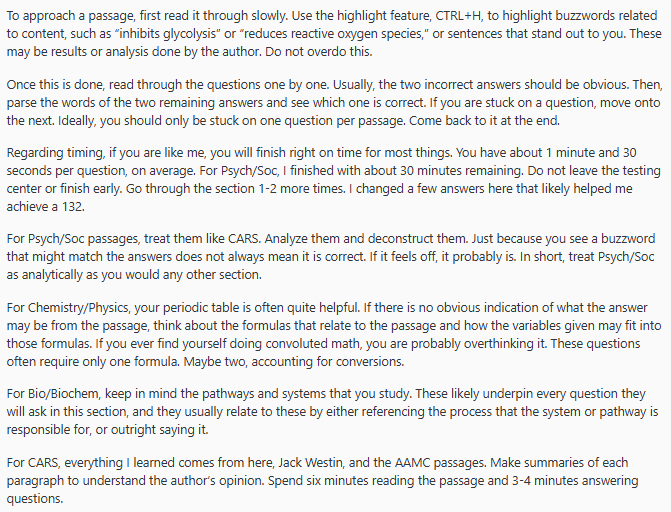
Students on Reddit, consistently emphasize daily consistency and active recall over passive review, treating content mastery and question practice as inseparable rather than sequential steps.
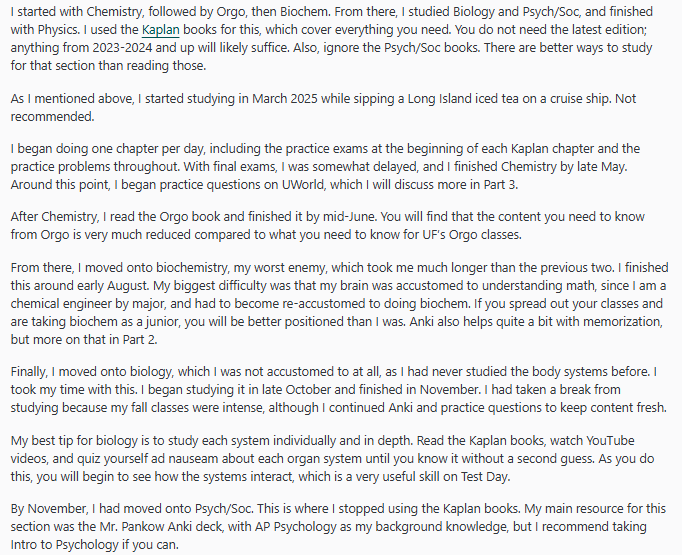
- Study consistently: Cover around one chapter per day, including practice questions and chapter tests.
- Use active recall: Reinforce concepts with Anki, quizzes and UWorld practice questions, especially for memorisation-heavy subjects.
- Study Biology deeply: Learn one organ system at a time, using books, videos and self-quizzing until you can recall concepts without guessing.
Source: Reddit
MCAT Exam Pattern FAQs
Ques. What is MCAT test?
Ans. MCAT (Medical College Admission Test) is a standardized, computer-based entrance exam administered by the AAMC for admission into medical schools, primarily in the US and Canada.
Ques. What is MCAT exam syllabus?
Ans. It spans Biology, Biochemistry, General and Organic Chemistry, Physics, Psychology, and Sociology, tested through passage-based clinical and research scenarios, plus a reading-comprehension-only CARS section with no science content.
Ques. Is MCAT exam in India conducted for domestic medical admissions?
Ans. No. MCAT is not used for MBBS admissions within India, that's done through NEET. MCAT matters specifically for Indian students applying to medical schools abroad, mainly in the US, Canada, or the Caribbean.
Ques. What is the MCAT syllabus for Indian students planning to study medicine abroad?
Ans. The syllabus itself doesn't change by nationality, it's the same MCAT subjects and weighting for every test-taker, but Indian students should specifically account for the CARS section's humanities/social-science reading component, since it has no equivalent in Indian board or entrance-exam curricula.
Ques. How many MCAT questions are there in total?
Ans. 230 questions across 4 sections; 59 each in Chem/Phys, Bio/Biochem, and Psych/Soc, and 53 in CARS.
Ques. Where can I find MCAT sample questions?
Ans. The AAMC publishes official MCAT practice materials and sample question sets; using official practice questions is generally more reliable than third-party question banks for matching the real exam's style and difficulty.
*The article might have information for the previous academic years, which will be updated soon subject to the notification issued by the University/College.



Comments