



Education Journalist | Study Abroad Lead
Moment can be defined as a very short interval of time. Moment in Physics is an expression that accounts for how a physical quantity is positioned or ordered by combining the product of a distance and a physical quantity. Moments are normally described in terms of a specific reference point, and they deal with physical quantities that are placed at a certain distance from that point. The product of a force on an object and the distance between the object is what we define as the moment of force. The measure of the turning effect is defined as torque and the force which acts on the body of the torque is known as the moment of force.
| Table of Content |
Key Terms: Moment, Force, Moment of Force, Turning Effect, Distance, Displacement, Torque, Clockwise Rotation, Anticlockwise Rotation, Unbalanced Force
What is Moment?
[Click Here for Sample Questions]
The term "moment" refers to a brief interval of time. If we consider a see-saw, we can put weights on both sides and get it to balance. The see-saw becomes unbalanced if we add more or less weight to one side. As a result, this is referred to as the imbalanced moment. Torque is the term used to describe this measure of turning effect.
Turning forces can be present in a variety of common scenarios and are required for the proper operation of machinery. These rotating forces are used by levers and gears to create an advantage. An object can rotate around a pivot if it is subjected to a force. The moment of the force is the turning effect of a force. Moments rotate clockwise or counterclockwise around a pivot.
Also Read: Difference between Torque and Moment
Moment Formula
[Click Here for Sample Questions]
The moment of force is determined using a simple formula and is one of the most straightforward approaches because it only requires two parameters: the applied force and the distance from the fixed axis. The moment of force is calculated by multiplying the applied force by the distance from the axis. The moment of force may be calculated for both balanced and unbalanced forces. The newton metre is the SI unit for moment and force.
The moment formula is as follows:
Moment of force (M)= F x d
Where
- The applied force is denoted by the letter F.
- The distance from the fixed axis is denoted by d.
- Newton metre is a unit of measurement for the moment of force (Nm).
- For both balanced and unbalanced forces, the moment of force formula can be used to compute the moment of force.
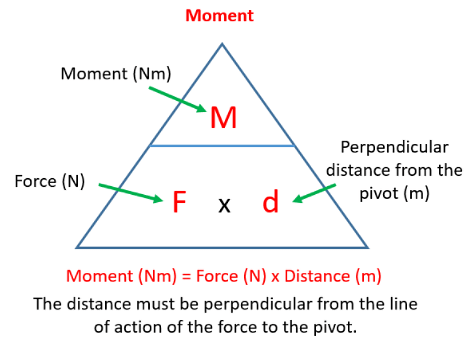
Moment Formula
Also Read: Moment of Inertia
Principle of Moment
[Click Here for Sample Questions]
If the body is in equilibrium under the operation of a number of parallel forces, the total of the anti-clockwise moments about the same point is equal to the sum of the clockwise moments, according to the principle of moments.
- The clockwise moment occurs when the body moves in a clockwise direction due to the action of force.
- An anti-clockwise moment occurs when the body moves in an anti-clockwise direction due to the influence of force.
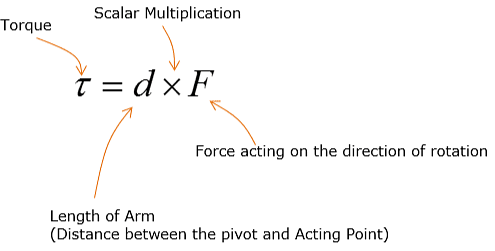
Torque
Things to Remember
[Click Here for Sample Questions]
- Moment is the term for a force's turning effect. A moment can be defined as a very short interval of time.
- The Newton-metre is the SI unit for a force's moment (Nm). It's a quantity with a vector. The right-hand grip rule, which is perpendicular to the plane of the force and has a pivot point parallel to the axis of rotation, determines its orientation.
- Torque is the term used to describe this measure of turning effect.
- The exact point about which the force induces rotation could be the Center of Moments. It could also be a reference point or axis around which the force is thought to be rotating.
- A rotation about a point or axis is caused by a moment. If a moment is to be taken about a point due to a force F, the line of action cannot travel through that point in order for a moment to form.
Solved Questions
Ques. How can you define the moment of force? (3 Marks)
Ans. Moment of force can be defined as the measure of the force that may spin a body about a specific axis or point is known as the. The moment arm is a significant factor that refers to the distance between the force and the rotational axis. The lever, gear, pulley, and other simple machines all need the concept of the moment arm to function. If the system is in equilibrium, the sum of clockwise and anticlockwise moments is equal, according to the principle of the moment.
Ques. What method can we use to compute the time? (3 Marks)
Ans. The moment of force is determined using a simple formula and is one of the most straightforward approaches because it only requires two parameters: the applied force and the distance from the fixed axis. Moment of force can be computed by the product of the applied force and the distance from the axis. The moment of force may be calculated for both balanced and unbalanced forces. The SI unit for moment and force is the newton metre.
Ques. What is the Moment of Force Dimensional Formula? (3 Marks)
Ans. The tendency to cause rotation of an item on its axis is described as the moment of force.
Moment of force is defined as Force x Distance in mathematics.
- M1L1T-2 is the Dimensional Formula of Force
- M0L1T0 is the dimensional formula for Distance
Ques. If the moment of force of 10 N about a point is given as 3 Nm, what will be the distance of the point of application of the force from the point? (2 Marks)
Ans. We know that
Moment of force = force × distance
3 Nm = 10 N×r
r = 0.3 m
Ques. A metre rule has a length of 200 cm and is set in the middle. A weight of 10N is removed from the metre rule's 30cm point, and a weight of 20N is removed from the 60 cm mark. Then, using the moment formula, determine if the metre rule is balanced or not. (5 Marks)
Ans. We need to verify the concept of momentum to see if the metre rule is balanced. As a result, the total anticlockwise moments are equal to the total clockwise moments, according to the momentum principle. In such cases, we must compute both sides' momentum and then compare their results. The distance for total anticlockwise seconds is (50 - 30), which is equivalent to 20 cm or 0.20 m.
Because the applied force is 10N, the anticlockwise moment will be the product of 10N and 0.20 m, or 2Nm. The entire clockwise moment distance will be 60 - 50, or 10 cm or 0.10 m, and the force exerted will be 20N in this case. As a result, the clockwise moment will be 2 Nm, which is the product of 20N and 0.10 m. Because the anticlockwise and clockwise moments are the same, the metre scale will be in a condition of rotational balance, according to the principle of moments.
Ques. What is a real-life example of a force moment? (3 Marks)
Ans. A see-saw that we swing in a park is the finest example of a moment of force in our daily lives. When we place weight on both sides of a see-saw to balance the moment, the swing stays in a balanced position, but if we add more weight to one side of the see-saw, the swing does not stay in a balanced position. As a result, this is referred to as an imbalanced moment. There are much more examples of the notion of the moment of force in our daily lives.
Ques. If a 10N force acts at a perpendicular distance of 0.50m from the turning point, calculate what will be the moment of the force? (2 Marks)
Ans. As we know that,
Moment = Fd
= 10 x 0.50
= 5.0 Nm
Ques. How can I determine the weight that needs to be added at the 80cm mark of a 500cm metre rule to maintain it balanced if a weight of 2N is adjusted from the 20cm mark of the same rule using the moment formula? (5 Marks)
Ans. The sum of anticlockwise moments and the total of clockwise moments should be equal in order for an item to be in rotational equilibrium, according to the principle of moments. As a result, if the 500m rule is to be in rotational equilibrium, the force applied on the 80cm mark must impose a moment equivalent to the moment exerted on the 20cm mark by a 2N weight.
The length of the lever arm for the anticlockwise moment will be 50 - 20, which is equivalent to 30cm or 0.30m, and the force exerted will be 2N. As a result, the anticlockwise moment will be 0.6Nm, which is the product of 0.30m and 2N. As a result, the clockwise moment must likewise be 0.6Nm. The lever arm's length will be determined as 80 - 50, or 30cm or 0.30m. As a result, the force necessary to be hanged at the 80cm point is 0.6 divided by 0.30, or 2N.
Ques. At the pivot point (40 cm point), a 200-cm-long meter-rule is pivoted. If a 10 N weight is hung from the 20 cm mark. Another 20 N weight is suspended from the 50 cm mark. Then determine whether or not the metre rule will stay balanced over its pivot. (5 Marks)
Ans. We shall have rotational equilibrium according to the notion of moments.
Total clockwise moments minus total anticlockwise moments Equals total clockwise moments
As a result, we'll calculate both side moments and compare their results.
There will be a total of anticlockwise moments,
Lever arm length d1= (40 – 20)
20 cm = d1
0.20 m =d1
The amount of balanced force that has been exerted,
F1 is equal to 10 N.
As a result, the anticlockwise moment will be,
F1xd1 = 10x 0.20
=2 Nm
The entire clockwise moment is now:
Lever arm length d2=(50–40)
d2=10cm
d2=0.10m
Balanced Force=F2=20N
As a result, the counterclockwise moment will be,
F2xd2 = 20 x 0.10
=2 Nm
It goes without saying that total anticlockwise moment Equals total anticlockwise moment
As a result, there will be a rotational equilibrium, according to the principle of moments.
Ques. The central point at 70cm of a 500 cm metre rule is pivoted. Calculate the amount of weight that must be placed at the 100 cm mark to keep the weight in a balanced position if a 2 N weight is hung from the 40 cm point. (5 Marks)
Ans. To keep an item in rotational balance, the total of anticlockwise and clockwise moments operating should be equal, according to the principle of moments. As a result, the weight to be hung from the 80 cm mark must be capable of producing a clockwise moment equivalent to the anticlockwise moment produced by the weight hung from the metre rule's left side.
Moment of anticlockwise rotation:
Lever arm length = (70 – 40)
=30 centimetres
= 0.30 metre
The distance from the mid-point of the lever arm, where it is balanced, is the length of the lever arm.
2 N force applied
Lever arm x applied force Equals anticlockwise moment
= 0.30 x 2 N
=0.6 Nm
Moment in time (clockwise):
Lever arm length = (100 – 70)
=30 centimetres
= 0.30 metre
Because the distance between the lever arm and the force exerted equals the length of the lever arm.
Let it be the letter 'F.'
As a result, the clockwise moment equals F x 0.30.
= 0.30 FNm
Moment in the clockwise direction Equals Moment in the anticlockwise direction
0.6 x 0.30 F
2 N = F
To maintain the metre rule balanced, a weight of 2 N must be hung from a 100 cm point.
Check More



Comments