



Education Journalist | Study Abroad Lead
Multiplying polynomials is a very important concept in Algebra that helps us to simplify expressions. One must know how to work with two or more polynomial variables and their coefficients in order to multiply them. The concept of multiplication will allow us to multiply two or more polynomials together and that is how we get longer polynomial expressions. Multiplying polynomials is a relatively easy task, provided that one follows the correct steps and understand the basic principles of multiplication. It is a matter of simply combining like terms and noting the addition of exponents. The product of two polynomials is another polynomial.
Read Also: Polynomials Important Question
| Table of Content |
Key Terms: Polynomials, Multiplication, Mathematical Operations, Addition, Monomials, Binomials, Trinomials, Linear Polynomials, Cubic Polynomials, Subtraction, Variables, Exponents, Constants
What Are Polynomials?
[Click Here for Sample Questions]
A Polynomial is an algebraic expression that consists of variables and exponents. A polynomial is an expression that consists of variables and constants and includes mathematical operations such as addition, subtraction, multiplication and division. A polynomial equation is one in which we need to find the roots or solution of the equation.
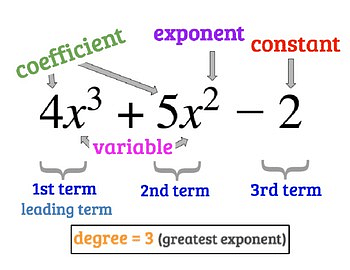
Polynomial
The video below explains this:
Polynomials Detailed Video Explanation:
Check Important Notes for Parabola Graph
Types of Polynomials
[Click Here for Sample Questions]
Polynomials can be classified on various grounds such as
Classification on the basis of Terms
A polynomial is an expression in algebra with more than one term. A polynomial can have one, two or more than three terms. It could have a combination of variables and constants.
- Monomials- Polynomial with only one term
- Binomials- Polynomial with two terms
- Trinomials- Polynomial with three terms

Types of Polynomials Based on Terms
Check Revision Notes for Polynomials
Classification on the basis of Degree
The degree of a polynomial is a number that tells us how many variables are there in the expression. It is represented by the highest exponent in the expression. The degree of a polynomial is the largest degree of that particular polynomial.
- Linear Polynomial: Expression with degree 1
- Quadratic Polynomial: Expression with degree 2
- Cubic Polynomial: Expression with degree 3

Types of Polynomials Based on Degree
Operations in Polynomials
[Click Here for Sample Questions]
Operations on polynomials are some of the elementary, yet most important concepts of algebra. It is often necessary to perform arithmetic operations on polynomials.
There are four basic operations on polynomial: addition, subtraction, multiplication and division.
- The sum of two or more polynomials is called their addition and the result is a polynomial.
- The subtraction of polynomials is similar to the addition of polynomials.
- Multiplying polynomials with rational coefficients is much like multiplying integers together.
- Dividing polynomials with rational coefficients is much like the long division we learned in elementary school.
Read More: Division of Polynomial by Another Monomial
Multiplication of Polynomials
[Click Here for Sample Questions]
When you multiply a polynomial by another polynomial, it's similar to multiplying numbers. You take each term in one expression and multiply it by each term in the other expression. This means that you end up with an expression that contains every possible product of terms from the two expressions. Based upon the types of polynomials, there are different ways of multiplying polynomials.
Multiplying Polynomials using Exponent Laws
The exponent law states that if the multiplication of two monomials takes place, then the base is multiplied and the exponents are added. Multiplying two monomials is not a difficult process. If the variables are the same, then simply add the exponents of the terms.
Example: Multiply 2x2 × 3x
Now, the coefficients and variables are multiplied separately.
= (2 × 3) × (x2 × x)
= 6 × x2+1
= 6x3
Read More: Integers as Exponents
Multiplying Polynomials using Different Variables
Multiplying polynomials is exactly like the usual multiplication of numbers. Distributive law is used to multiply polynomials. If the polynomials have different variables, then each term of one polynomial could be multiplied by each term of the other.
Here, is the given below step by step for Multiplying polynomials:
- Step 1: Place the two polynomials in a line.
For example, for two polynomials, (6x−3y) and (2x+5y), write as (6x−3y)×(2x+5y)
- Step 2: Use distributive law and separate the first polynomial.
⇒ (6x−3y)×(2x+5y) = [6x × (2x+5y)] − [3y × (2x+5y)]
- Step 3: Multiply the monomials from the first polynomial with each term of the second polynomial.
⇒ [6x × (2x+5y)] − [3y × (2x+5y)] = (12x2+30xy) − (6yx+15y2)
- Step 4: Simplify the resultant polynomial, if possible.
⇒ (12x2+30xy) − (6yx+15y2) = 12x2+24xy−15y2
Multiplication of Two Monomials
[Click Here for Sample Questions]
Multiplication of polynomials involves multiplying several monomials. In other words, it is a combination of the multiplication of several monomials. Let us learn how to multiply two monomials.
Let us understand by taking two monomials, 3x and 2x.
- Step 1: In the above monomials, the common variable is x. We will multiply the variable with the variable. Hence, we get x × x = x2.
- Step 2: In the next step, we will multiply the coefficients of both the monomials to get 2 × 3 = 6. Thus, multiplying the polynomials 2x and 3x gives 6x2 as the result.

Multiplying Monomials
Read More: Multiplying a Monomial by a Polynomial
Multiplying Monomial With Binomial
[Click Here for Sample Questions]
To multiply a monomial by a binomial, you need to use the distributive property. When multiplying one term by two terms, it is distributed into the parenthesis. Multiplication of a monomial and binomial involves the distribution of the monomial into each term of the binomial.
For Example: Multiply 3x(4x+2y)
Ans. 3x will be multiplied with each term of the binomial that is +4x and +2y.
Note: signs are also taken along with each term. Also, remember that two same signs result in a plus sign and two opposite signs result in a minus sign while finding the product of two terms.
So, the product of 3x(4x+2y) will be 12x2 + 6xy. Since there are no like terms to add together the answer will remain as it is.

Multiplying Monomial with Binomial
Read More: Roots of Polynomials
Multiplication of Two Binomials
[Click Here for Sample Questions]
Multiplying two binomials can be accomplished by using the FOIL method. Each term of one binomial has to be multiplied by the other binomial. In algebra, FOIL is a mnemonic for the standard method of multiplying two binomials, using the distributive property of multiplication over addition. The letters FOIL stand for the two pairs of corresponding terms that are multiplied in this process: "First" (first terms), "Outer" (outer terms), "Inner" (inner terms), and "Last" (last terms).
Now, Consider two binomials given as (a+b) and (m+n).
Multiplying them we have,
(a+b)×(m+n)
a×(m+n)+b×(m+n) (Distributive law of multiplication)
(am+an)+(bm+bn) (Distributive law of multiplication)
Thus,
(a + b) × (m + n) = am + an + bm + bn
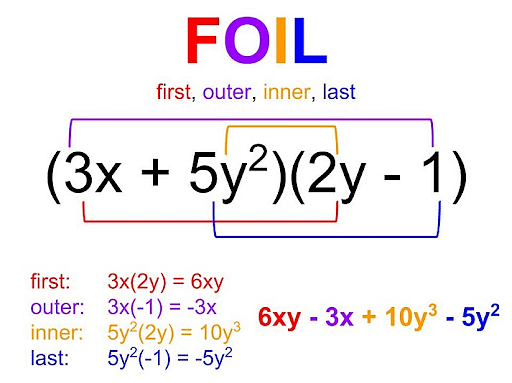
FOIL Method of Multiplication of Polynomials
Also Check: Zeroes of Polynomials
Rules For Multiplying Polynomials
[Click Here for Sample Questions]
Multiplying polynomials is relatively easy. The only thing that you need to consider is the exponents of the variables and the coefficients that represent each term. Polynomials can be multiplied using a three-step process.
- The first step is to multiply each term in one polynomial by each term in the other polynomial using the distributive law.
- The second step is to add the powers of the same variables using the exponent rule.
- The third and final step is to simplify the resulting polynomial by adding or subtracting like terms. It should be noted that the degree of the resulting polynomial will always be higher than the degree of the individual polynomials.
Read More: Polynomial Notation
Things to Remember
[Click Here for Sample Questions]
- A polynomial is an algebraic expression with two or more than two terms and each term consists of a constant, a variable, or their combination.
- Based on the number of terms in a polynomial, it is classified into three parts i.e., monomial, binomial and trinomial.
- Multiplying polynomial is a bit like distributing, but with numbers and variables instead of adding.
- It should be noted that the degree of the resulting polynomial will always be higher than the degree of the individual polynomials.
- To multiply two polynomials, first, multiply each term in one polynomial by each term in the other polynomial using the distributive law. Add the powers of the same variables using the exponent rule, then simplify the resulting polynomial by adding or subtracting like terms.
Sample Questions
Ques. What will be the value after the multiplication of two polynomials (6x +3y) and (2x+ 5y)? (3 Marks)
Ans. (6x−3y)×(2x+5y)
= 6x×(2x+5y)−3y×(2x+5y) (Distributive law of multiplication)
= (12x2+30xy)−(6yx+15y2) (Distributive law of multiplication)
= 12x2+30xy−6xy−15y2 (as xy = yx)
Thus, (6x+3y)×(2x+5y)=12x2+24xy−15y2
Ques. Solve (6x−3y)×(2x+5y) (3 Marks)
Ans. We have (6x−3y)×(2x+5y)
= 6x ×(2x+5y)–3y × (2x+5y) ———- Using distributive law of multiplication
= (12x2+30xy) – (6yx+15y2) ———- Using distributive law of multiplication
= 12x2+30xy–6xy–15y2 —————– as xy = yx
Thus, (6x−3y)×(2x+5y)=12x2+24xy−15y2
Ques. Multiply the two polynomials 7s3+2s2+3s+9 and 5s2+2s+1. (3 Marks)
Ans. We have to multiply (7s3+2s2+3s+9) × (5s2+2s+1)
= 7s3 (5s2+2s+1)+2s2 (5s2+2s+1)+3s (5s2+2s+1)+9 (5s2+2s+1))
= (35s5+14s4+7s3)+ (10s4+4s3+2s2)+ (15s3+6s2+3s)+(45s2+18s+9)
= 35s5+(14s4+10s4)+(7s3+4s3+15s3)+ (2s2+6s2+45s2)+ (3s+18s)+9
= 35s5+24s4+26s3+ 53s2+ 21s +9
Ques. Multiply 5x2 with 3y. (3 Marks)
Ans. We will first multiply the coefficients of both the polynomials i.e., 5 × 3= 15
Since the given polynomials have two different variables, they cannot be multiplied. Hence, we will keep them the same.
The final answer is 5x2× 3y = 15x2y
Ques. Multiply (2x+3)(4x+5) (3 Marks)
Ans. Above polynomials can be solved as:
(2x + 3)(4x + 5)
= 2x(4x + 5) + 3(4x + 5)
8x2 + 10x + 12x + 15
8x2 + 22x + 15
Ques. Simplify xz(x2 + z2) by using rules of multiplication of polynomials. (3 Marks)
Ans. xz(x2 + z2) can be simplified and written as
(xz × x2) + (xz × z2)
x3z + xz3
Therefore, the product is x3z + xz3
Ques. Find the product: (2x + 3y)(4x - 5y) (3 Marks)
Ans. By utilizing the distributive property for multiplying polynomials, we get
2x(4x -5y) + 3y(4x - 5y)
= 8x2 - 10xy + 12xy -15y2
8x2 + 2xy - 15y2
Therefore, the product is 8x2 + 2xy - 15y2
Ques. A cuboid has sides measuring 2y, 3x and 5z as its length, breadth, and height respectively. Find the volume of the cuboid. (3 Marks)
Ans. As we know, the volume of cuboid = length × breadth × height. In this case, all the side lengths are given in the form of monomials, so by applying rules for multiplying monomials, we get,
Volume = 2y × 3x × 5z = 30xyz
Hence, the volume of the given cuboid is calculated as 30xyz cubic units.



Comments