



Exams Prep Master
Line of symmetry in a parallelogram, in basic terms, are the lines that divide the parallelogram into two identical sections or you can also say that a line of symmetry is an axis or imaginary line that can travel through the centre of a shape, facing any direction, in such a way that when sliced into two equal halves, it depicts mirror copies of each other. The line of symmetry of a parallelogram varies from one kind to the next. A parallelogram, as you may know, is a quadrilateral (4-sided figure) with opposing sides that are parallel to one other. The wings of butterflies, for example, are similar on both sides, and the human face likewise has mirror symmetry. In this article, we will discuss the lines of symmetry in a parallelogram in detail along with some important questions.
Read Also: Difference between Square and Rhombus
| Table of Content |
Key Takeaways: Line of symmetry, What is a parallelogram, How many lines of symmetry in a parallelogram, Line of symmetry in a square, Line of symmetry in a rectangle.
Line of Symmetry
[Click Here for Sample Questions]
The line of symmetry is an imaginary line or axis along which you may fold a figure to generate symmetrical halves. It's also known as the symmetry axis. Because it shows two identical reflections of an image, the line symmetry is also known as a mirror line. As a result, it's a sort of reflection symmetry. It essentially splits a thing in half.
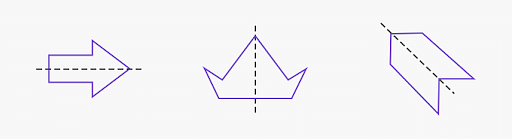
Line of Symmetry
There might be one or many symmetry lines. In reality, a shape might have the following characteristics:
- There is no symmetry line, indicating that the figure is asymmetrical.
- Infinite symmetry lines
- A single symmetry line
- Two symmetry lines
- Multiple (more than two) symmetry lines
Check Important Difference between Square and Rectangle
What is a Parallelogram?
[Click Here for Sample Questions]
A parallelogram is a particular or unique type of quadrilateral that consists of a closed four-sided figure with opposite sides that are parallel to each other and of equal length. Any pair of adjacent interior angles present in any given parallelogram has equal value, and any pair of adjacent interior angles present can be considered to be supplementary angles, meaning that their total is 180°.
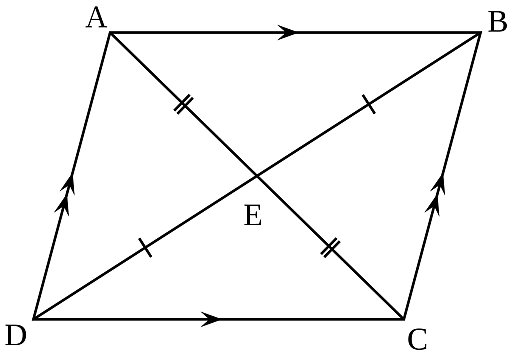
Parallelogram
Check Also: Types of Quadrilateral
Lines of Symmetry in a Parallelogram
[Click Here for Sample Questions]
The symmetry lines are the lines that bisect a parallelogram into two halves, each of which is the mirror reflection of the other. Distinct parallelograms have different symmetry lines and symmetry lines in different numbers. If we cut a square or rectangle in half, we will get a line of symmetry since at least one imaginary line can be drawn through the center of the form, dividing it into two equal halves with mirror images of each other.
There are no symmetry lines in a parallelogram. It possesses order two rotational symmetry.
If we ask why the parallelogram does not have lines of symmetry, the simplest answer is that it is impossible to construct a line of symmetry, an axis, or an imaginary line that passes through the center cutting its image in half where each side represents a mirror image of the other. The diagonals of the parallelogram aren't even close to being symmetrical. This is because we don't obtain the same form as two halves when we fold the parallelogram along the diagonal line.
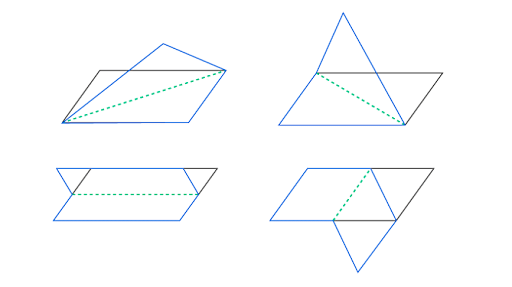
Lines of Symmetry in a Parallelogram
To test this, simply try to construct a line of symmetry on any parallelogram and figure out that it is impossible but parallelograms do contain rotational symmetry. When we look at rotational symmetry from a geometric standpoint, it refers to when a form or figure is precisely the same as its preimage after being rotated a certain number of degrees. A parallelogram will provide the same result as the original or pre-image when turned 180 degrees.
There are a few specific sorts of parallelograms that have lines of symmetry. They are mentioned below:-
| Symmetry Lines in Parallelograms | |
|---|---|
| Parallelogram Name | Number of Symmetry Lines |
| Rhombus | 2 |
| Rectangle | 2 |
| Square | 4 |
Also Read: Quadrilateral Angle Sum Property
Line of Symmetry in Different Parallelogram
[Click Here for Sample Questions]
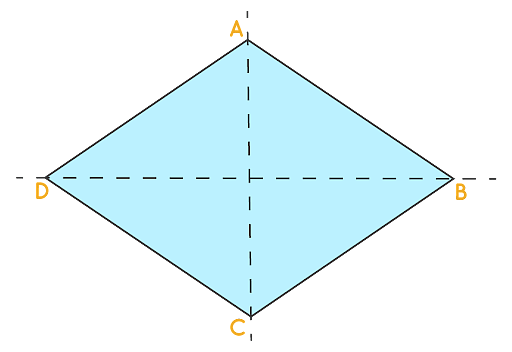
- Lines of Symmetry in a Rhombus: A rhombus is a four-sided quadrilateral that is a particular case of a parallelogram. The opposing sides of a rhombus are parallel, and the opposite angles are equal. Furthermore, all of a rhombus's sides have the same length, and the diagonals bisect each other at right angles. A rhombus can alternatively be referred to as a diamond or a rhombus diamond. The rhombus has 2 lines of symmetry: they are its diagonals. This divides the rhombus into two indistinguishable parts where each part is the identical representation of the other, It means that a rhombus has reflection symmetry over either of its diagonals. Just like a parallelogram, it additionally has a rotational balance of 180º about its midpoint
- Lines of Symmetry in a Rectangle: A rectangle is a quadrilateral with parallel sides that are equal to each other and all four vertices that are 90 degrees. As a result, it's also known as an equiangular quadrilateral. Because the opposing sides of a rectangle are equal and parallel, it is also known as a parallelogram. Rectangle has two lines of symmetry in a rectangle that cuts it into equivalent parts. In a rectangle, the lines of symmetry are those lines which join the midpoint of the opposite and parallel lines (for example the bisector) of the rectangle. Just like the parallelogram, the rectangle also has rotational symmetry of 180º around its midpoint.
- Lines of Symmetry in a Square: The square is a regular quadrilateral with all four sides equal in length and all four angles equal. The square's angles are right angles or equal to 90 degrees. In addition, the square's diagonals are equal and bisect each other at 90 degrees. Square is a unique sort of parallelogram, with four equivalent sides and four equivalent angles. It has 4 lines of symmetry - two diagonals and two lines going through the central points of opposite sides. A square has reflection symmetry when reflected over the line across the central point of its opposite sides as well as over its diagonals. Same as the parallelogram, it also has rotational symmetry of 90º about its midpoint.
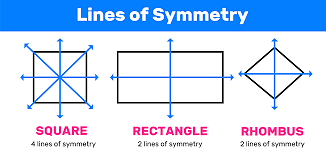
Lines of Symmetry
Check Important Difference between Rhombus and Parallelogram
Things to Remember
[Click Here for Sample Questions]
- A parallelogram is a quadrilateral with two sets of equal sides. The opposite or facing sides of a parallelogram are of equivalent length and the contrary angles of a parallelogram are of equivalent measure.
- Line of symmetry in a parallelogram, in basic terms, are the lines that divide the parallelogram into two identical sections.
- There are no lines of symmetry in parallelogram as it can't be divided into equal symmetry.
- A rectangle is a quadrilateral with parallel sides that are equal to each other and all four vertices that are 90 degrees.
- A trapezoid isn't a parallelogram. A trapezoid has precisely two equal sides though a parallelogram has two sets of equal sides.
- A trapezoid is a parallelogram with no less than one set of equal sides however neither has reflectional symmetry nor rotational symmetry. Accordingly, you cannot mention observation based upon symmetry.
- An isosceles trapezoid is a parallelogram for which each of the four sides is something similar (are similarly lengthy).
- An isosceles trapezoid that has just one set of equal sides has reflectional balance but no rotational evenness.
Sample Questions
Ques. Compose four such English letters which have no line of symmetry arrangement. (1 mark)
Ans. The 4 English letters having no line of balance are: P, F, G and Z.
Ques. Compose 5 such English letters which have a line of symmetry arrangement: (1 mark)
Ans. The required letters are:
E, B, C, D, K
Ques. Compose 4 English letters that have vertical lines of symmetry arrangement: (1 mark)
Ans: The necessary English letters are A, H, I, M
Ques. Count how many symmetrical lines do they have? (3 marks)

Ans.
- This figure is a square, so it has 4 lines of symmetry.

- The below figure is an isosceles triangle and It has one vertical line of symmetry.

- The below figure is a quadrilateral called a rectangle and has two lines of symmetry.

Ques. At what angle is the parallelogram rotationally symmetric? (2 marks)
Ans. If the shape rotates and the shape is the same as the origin, then it is rotationally symmetric. Therefore, if the shape maintains an accurate appearance even after it has been rotated around the center point. In other words, the parallelogram is rotationally symmetric at 180 °.
Ques. Check for the lines of symmetry in a rhombus. (2 marks)

Ans. A rhombus has four equal sides, but what about the diagonals? Are the diagonals the same length? The diagonals of the rhombus intersect at equal angles, so folding along the lines of symmetry produces four equal parts. Therefore, the diamond has two lines of symmetry.
Ques. Name a quadrilateral whose axisymmetry and rotational symmetry are greater than 1. (3 marks)
Ans. Squares, rectangles, rhombus are quadrilaterals with both lines and rotational symmetry of degrees greater than 1.
- The square has four lines of symmetry and has a fourth-order rotational symmetry.
- The rectangle has two lines of symmetry and a second-order rotational symmetry.
- The rhombus has two lines of symmetry and a second-order rotational symmetry.
Ques.Is it possible for the angle of rotation to have rotational symmetry of degree 1 or higher at (i) 45°? (ii) 17°? (3 marks)
Ans. If the angle of rotation of the shape is a factor of 360°, you can see that it has rotational symmetry of order greater than 1.
- You can see that 45° is a factor of 360°. Therefore, at an angle of rotation of 45°, the figure has a rotational symmetry on the order greater than 1.
- 17° is not a factor of 360°. Therefore, a figure with an angle of rotation of 17° does not have rotational symmetry greater than 1.



Comments