



Content Curator
Symmetry is defined as the phenomenon that divides an image or figure into two identical halves. The objects that can be divided into two identical halves are called symmetrical figures whereas objects that cannot be divided into two identical halves are called asymmetrical. Most of the great architecture, insects, and beautiful paintings are all symmetrical. But this does not mean that everything around us is symmetrical. For example, an irregular shaped rock is asymmetrical. The line which divides the object into identical halves is known as the line of symmetry or axis of symmetry. An object can have either one or multiple lines of symmetry.
| Table of Content |
Key Takeaways: Figure of Symmetry, Symmetrical and Asymmetrical Objects, Line of Symmetry, Axis.
What is Symmetry?
[Click Here for Sample Questions]
Symmetry refers to a concept in which an object can be divided into two exactly equal and opposite halves. Hence, one half can be called a mirror image of the other.
Symmetry of an object does not change when the object is rotated, reflected or revolved. Symmetry does not occur in only 2D objects but also in 3D objects.
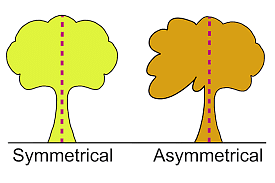
Symmetrical and Asymmetrical Objects
Types of Symmetry
[Click Here for Sample Questions]
We usually relate symmetry to the line of symmetry that divides a figure into mirror halves. But not all figures can be divided by simple lines, some are symmetrical from lines emerging from the center of the object. In some objects, the symmetry is obtained by rotating the object at a certain angle to get the original object. The different types of Symmetry are:
Line Symmetry
This is the common type of symmetry where a line divides a figure into two halves. Each half is equal and opposite to the other half or the mirror image of the other half. A figure can have single or multiple lines of symmetry.
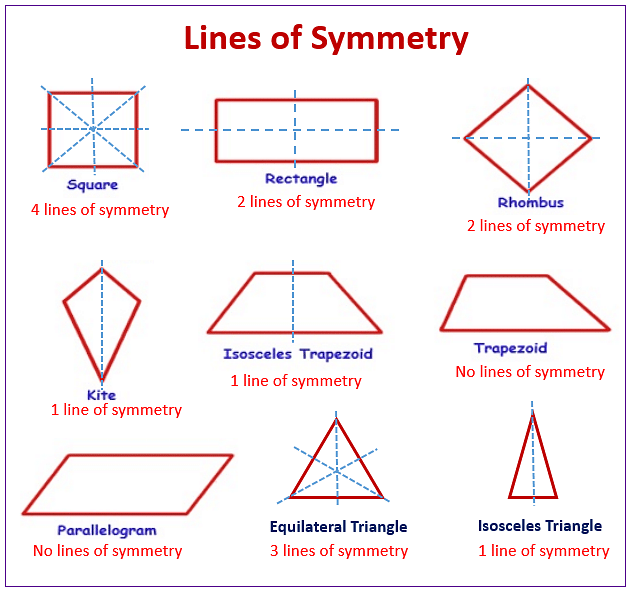
Line Symmetry
Point Symmetry
Point symmetry refers to the condition when an object is rotated upside down but still there is a change in the shape of the object. Point symmetry is also known as rotational symmetry or order 2. Order in symmetry is the number of times an object is exactly like its original image while rotating it 360 degrees once.
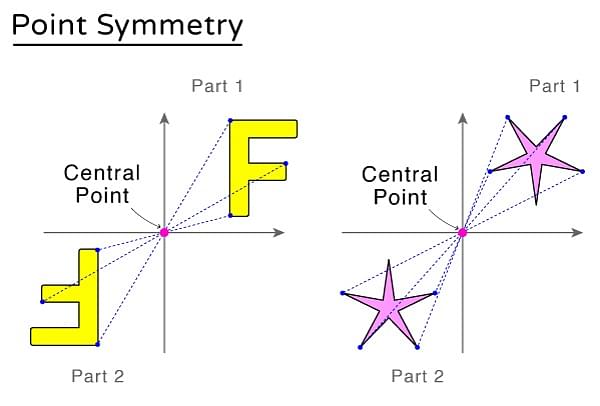
Point Symmetry
Rotational Symmetry
A symmetry is known as rotational symmetry when an object is rotated but still, the result is the original object. For example, in a square, you may rotate it 90o, 180o but the figure obtained after rotating is identical to the original square.

Rotational Symmetry
Translational Symmetry
Translation means the change in position of the object. Therefore, translational symmetry occurs when an object is moved from one position to another at a fixed axis but still there is no change in the shape and size of the object.
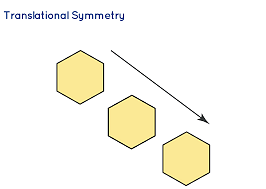
Translational Symmetry
How to Make Symmetrical Objects?
[Click Here for Sample Questions]
There are numerous ways of creating symmetrical figures, some of which are given below.
Using Ink Blot Method
- Take a piece and paper and fold it into two equal halves. Press along the center of the paper to make a crease that divides the paper into two halves.
- Paint one half of the paper as your wish.
- Now carefully place one half of the paper on the other and press it.
- The mirror image of the painting of one half will be formed on the other half. Thus, making a complete picture.
Using Inked Strings
- Here, we shall use strings dipped in ink of any color.
- Take a piece of paper and fold it into two halves by making a center crease.
- Keep the inked string in any design or pattern on one half of the paper.
- Now carefully place one half of the paper on the other and press it.
- The mirror image of the painting of one half will be formed on the other half. Thus, making a complete picture.
Things To Remember
- Figures whose one half is a mirror image of the other half are said to be symmetrical in nature.
- Figures whose both halves are different are said to be asymmetrical.
- There are many types of symmetry such as Point symmetry, Rotational symmetry and Translational symmetry.
- Symmetrical figures can be created by using ink blot method and inked string methods.
Also Read:
Sample Questions
Ques. Define symmetry with suitable examples. (2 Marks)
Ans. Symmetry is defined as a concept that applies some changes to a figure to see whether it retains its shape and size or not. For example if an object is cut into two halves from the center and its two halves are mirror images of each other then it is a symmetrical object. The two halves if joined can again become the complete image.
Ques. If the below given figure is symmetrical then complete it by drawing the other half. (2 Marks)

Ans. The complete figure is

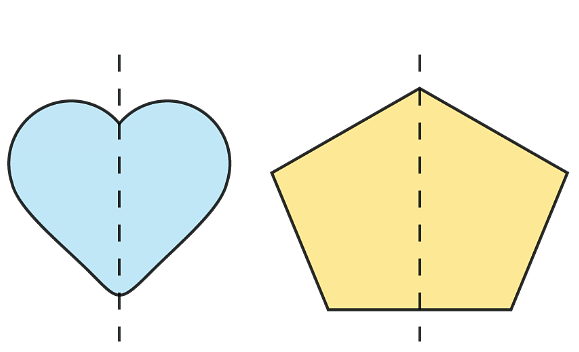
Ques. Which of the following images are symmetric and also state the reason for its symmetry. (2 Marks)
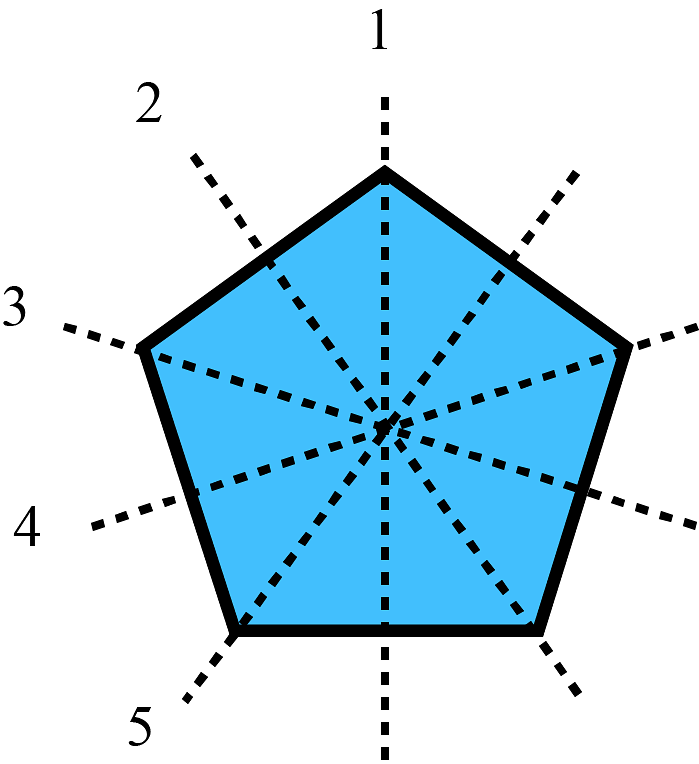
Ans. The first pentagon is symmetric because if we draw a line from the centre, it gets divided into two mirror halves thus, showing line symmetry.
Ques. Draw the lines of symmetry in each of the given objects. (2 Marks)
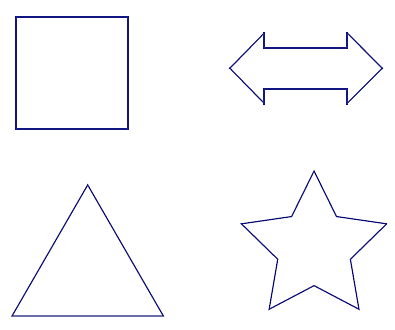
Ans. 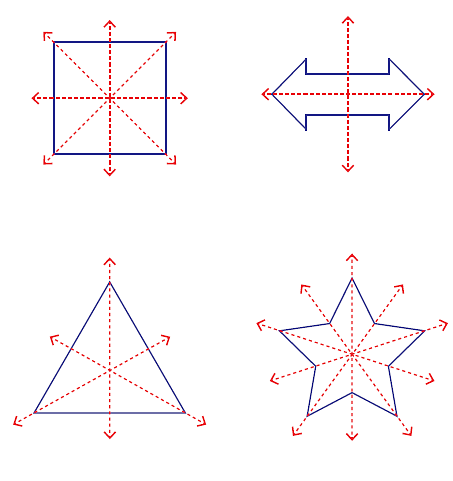
Ques. Draw triangles with the following conditions:
a)No line of symmetry
b)1 line of symmetry
c)2 line of symmetry
d)3 line of symmetry
Ans.
- A scalene triangle with no lines of symmetry

- An isosceles triangle with one line of symmetry

- An equilateral triangle with two lines of symmetry

Ques. Name some English alphabets that are symmetrical. State the symmetry by plotting the line of symmetry. (2 Marks)
Ans. Some symmetrical English alphabets:

Ques. Define radial symmetry with suitable examples. (2 Marks)
Ans. Radial symmetry is also known as point symmetry. It is a symmetry in which the object is divided into multiple parts by the lines passing through the center point of the object. An example of radial symmetry is given below.

Ques. Can lines of symmetry in any object be parallel? (2 Marks)
Ans. No, lines of symmetry drawn in any object can never be parallel. They will surely intersect with each other. A line of symmetry will not intersect with another line of symmetry only if the object has only one line of symmetry.
For Latest Updates on Upcoming Board Exams, Click Here: https://t.me/class_10_12_board_updates
Check-Out:



Comments