


NCERT Solutions for Class 9 Science Chapter 3: Atoms and Molecules

Collegedunia Team logo

Collegedunia Team

Content Curator

The NCERT Solutions for Class 9 Science are provided in this article. Some of the important topics in Chapter 3 Atoms and Molecules include:

Download: NCERT Solutions for Class 9 Science Chapter 4 pdf


NCERT Solutions for Class 9 Science Chapter 3
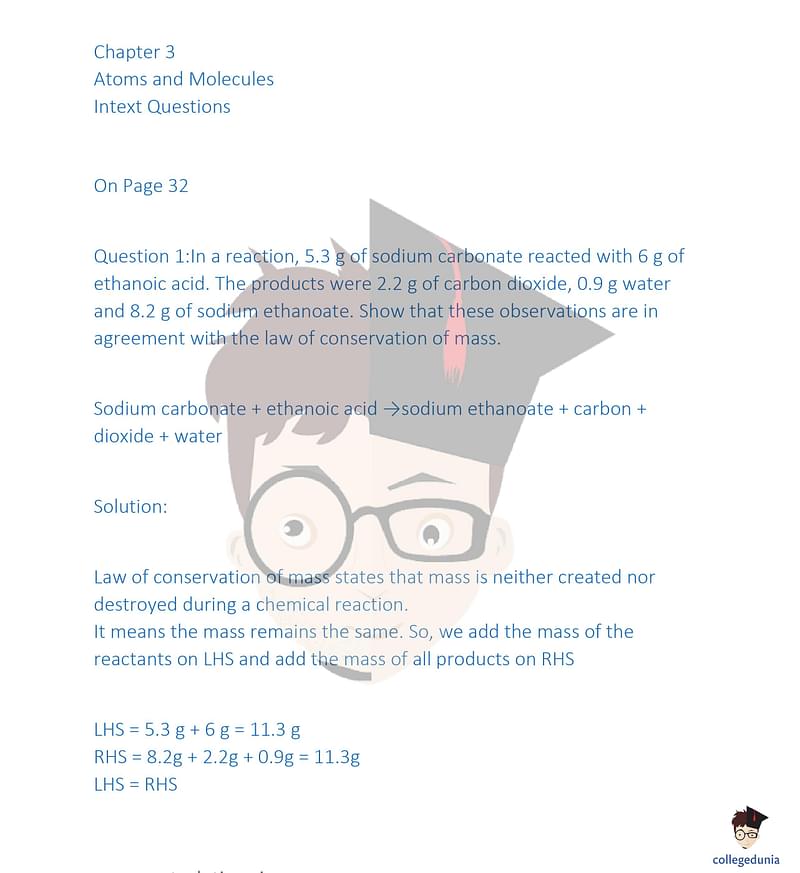
NCERT Solutions

NCERT Solution

NCERT Solution

NCERT SolutionNCERT Solution

NCERT Solution

NCERT Solution

NCERT Solution

NCERT Solution

NCERT Solution

NCERT Solution

NCERT Solution

NCERT Solution

NCERT Solution

NCERT Solution

NCERT Solution

NCERT Solution

NCERT Solution


Class 9 Science Chapter 3 Atoms and Molecules – Important Topics

Atom is the smallest constituent unit of matter that possess the properties of the chemical element. Atoms don’t exist independently, instead, they form ions and molecules which further combine in large numbers to form matter that we see, feel and touch.

Dalton’s Atomic Theory

Dalton’s Atomic Theory hypothesized and further claimed that the law of conservation of mass and the law of definite proportions could possibly de elaborated by using the idea of atoms. According to him, all substances are indestructible building units.

Example: What are two postulates of Dalton’s Atomic Theory?

Solution: The two postulates of Dalton’s Atomic Theory are:

  • The substances around us are composed of matter, which are tiny, indestructible particles called atoms.
  • Every atom of a particular element are identical according to their mass, size, and several other properties. 

Atomic Mass

The complete mass of one atom of a distinct element can be otherwise called as its atomic mass. The unit it has is known as unified atomic mass unit, that is represented by the letter ‘u.’

Example: Calculate the atomic mass of an oxygen isotope that has 9 neutrons.

Solution: To calculate the atomic mass of an oxygen isotope, we need to know the number of protons and neutrons it has.
Number of protons in an oxygen atom = 8
As per the question, the Number of neutrons in oxygen atom = 9
Hence, the Atomic mass of given oxygen atom = number of protons + number of neutrons = 8 + 9 = 17

Mole Concept

Mole concept can be defined as the atomic mass of a mole which is usually measured in grams. Ideally, the gram atomic mass of an element is otherwise referred to as a mole. 

Example: What is the formula of Mole Concept?

Solution: The number of units responsible to compose mole can be evaluated by 6.022 ×10²³. The fundamental constant is called the Avogadro's number (NA) or Avogadro constant. It can be represented using an explicit unit termed per mole. Thus, to calculate Mole Concept,
Number of Moles = (Mass of the Sample)/(Molar Mass)

Read Also:

Also Check:

CBSE X Related Questions

  • 1.
    Which of the plant hormones are responsible for the following processes? Promote cell division Inhibition of growth Detection of light Wilting of leaves


      • 2.
        When an element 'X' reacts with water, it starts floating. Identify the element 'X':

          • Potassium
          • Calcium
          • Sodium
          • Iron

        • 3.
          Rays from the sun converge at a point 25 cm behind a convex lens. The distance at which an object be placed in front of the lens to get a virtual image, is:

            • 20 cm
            • 40 cm
            • 50 cm
            • More than 50 cm

          • 4.

            Identify the type of reproduction shown in the diagram given below: 

              • Budding
              • Fragmentation
              • Spore Formation
              • Binary Fission

            • 5.
              Briefly mention the steps in double-circulation through human heart.


                • 6.
                  Assertion (A): Reflex actions do not involve thinking.
                  Reason (R): Most reflex actions are controlled by the spinal cord.

                    • Both Assertion (A) and Reason (R) are true and Reason (R) is the correct explanation of the Assertion (A).
                    • Both Assertion (A) and Reason (R) are true, but Reason (R) is not the correct explanation of the Assertion (A).
                    • Assertion (A) is true, but Reason (R) is false.
                    • Assertion (A) is false, but Reason (R) is true.

                  Comments


                  No Comments To Show
