



Education Journalist | Study Abroad Lead
Octal number system deals with numbers with base 8. A number system is a mathematical notation used to represent numbers in a logical manner. It includes numbers, alphabets, and symbols. The number system allows us to perform arithmetic operations such as addition, subtraction, and division. Four basic number systems in mathematics are the Binary number system (base-2), Octal number system (base-8), Decimal number system (base-10), and Hexadecimal number system (base-16). The octal number system is a system with a base eight and numbers ranging from 0 to 7. For example, 538, 1438, 678, etc. This number system is mainly used in computers, aviation, and digital number systems. The octal number system can be converted to any other number systems such as decimal, binary, hexadecimal, and vice versa. In this article, we will find out how octal number systems can be transformed into other number systems.
Read More: Decimal Expansion of Rational Numbers
| Table of Contents |
Key Takeaways: Octal, hexadecimal, binary, decimal, base 8, conversion
What is an octal number system?
[Click Here for Sample Questions]
An octal number system has a base of 8 and numbers ranging from 0 to 7. As the name implies, octal refers to the meaning eight. Only three binary bits are required to represent the octal number system. In this system, each position is weighed by the power of 8. The maximum number is 7, and it cannot exceed 7.
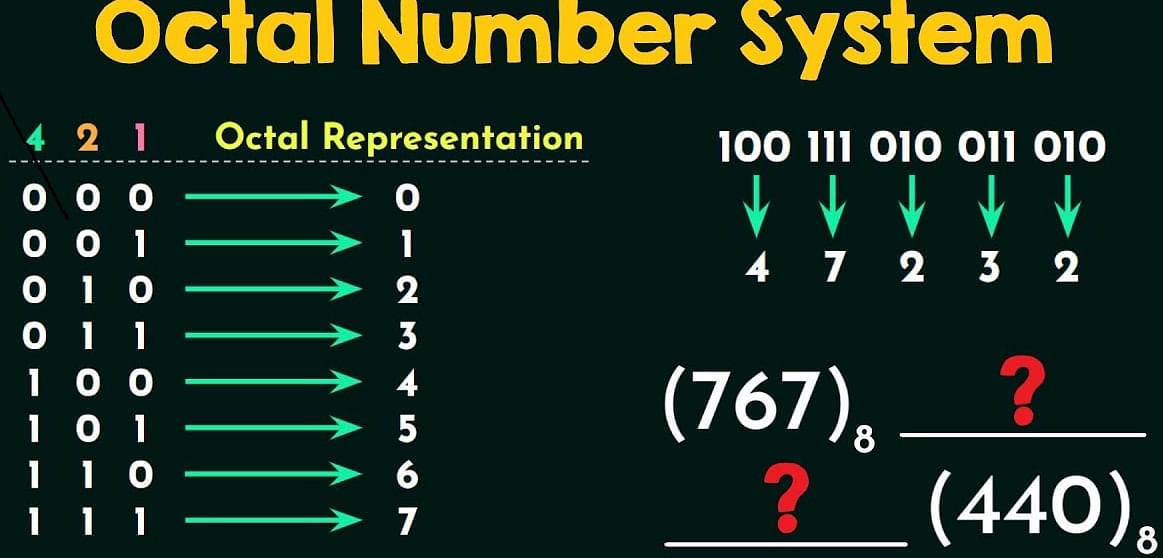
Octal Number System
1. Applications
Below are the basic applications of the octal number system:
- They are used in computer applications and aviation sectors.
- Shorthand for representing file permissions on UNIX systems.
- Shorthand for representing UTF8 numbers.
2. Importance
The possibility and occurrence of error are low in the octal number system compared to the hexadecimal number system. This is because the octal number system consists of 3 bits, whereas the hexadecimal number system has 4 bits.
It is easy and simple to convert from an octal number system to other number systems and vice versa.
Octal to binary conversion
[Click Here for Sample Questions]
The equivalent binary number for the octal number is given in Table 1.
Table 1: Octal and binary number system conversion table:-
| Octal number | Binary number |
|---|---|
| 0 | 000 |
| 1 | 001 |
| 2 | 010 |
| 3 | 011 |
| 4 | 100 |
| 5 | 101 |
| 6 | 110 |
| 7 | 111 |
Each digit has to be converted into a three-digit binary number to convert an octal number to a binary number.
Example:-
(a) Convert (17)8 into a binary number
The equivalent binary number for 1 is (001)2.
The equivalent binary number for 7 is (100)2.
Therefore, the binary equivalent for (17)8 is (001100)2.
Read More: Real Numbers
Binary to octal conversion
[Click Here for Sample Questions]
You can convert binary to octal number systems using Table 1. To convert the binary to octal number system, you must separate the number into three-digit numbers and write their equivalent octal number.
Example:
(a) Convert (1100011010)2 into an octal number.
Now let us separate the given binary number into three-digit numbers set as 001, 100, 011, and 010. Here, zeroes have been added before 1 to make it a three-digit number.
The equivalent octal number for (001)2 is 1.
The equivalent octal number for (100)2 is 4.
The equivalent octal number for (011)2 is 3.
The equivalent octal number for (010)2 is 2.
Therefore, the equivalent octal number for (1100011010)2 is 1432.
Octal to decimal conversion
[Click Here for Sample Questions]
To convert octal to decimal number system, each digit has to be multiplied with the reducing power of 8 and added together.
Examples:
(a) Convert (35)8 into a decimal number.
Multiply 3 with 81. i.e., 3 × 81 = 24.
Multiply 5 with 80. i.e., 5 × 80 = 5.
Therefore, the equivalent decimal number for (35)8 = 24 + 5 = 29.
(b) Convert (121)8 into a decimal number.
Multiply 1 with 81. i.e., 1 × 82 = 64.
Multiply 2 with 80. i.e., 2 × 81 = 16.
Multiply 1 with 80. i.e., 1 × 80 = 1.
Therefore, the equivalent decimal number for (121)8 = 64 + 16 + 1 = (81)10.
Read More: Algebraic Formulas
Decimal to octal conversion
[Click Here for Sample Questions]
To convert decimal numbers to octal, you need to divide the decimal number by 8. The first remainder is LSB (least significant bit), and the last remainder is MSB (most significant bit).
Example:
(a) Convert (342)10 into an octal number.
Divide 342 by 8.
342/8; Quotient is 42 and remainder is 6.
42/8; Quotient is 5 and remainder is 2.
Here, the last quotient is 5, the last remainder is 2, and the first remainder is 6.
Therefore, the equivalent octal number for (342)10 is (526)8.
Octal to hexadecimal conversion
[Click Here for Sample Questions]
To convert the octal to hexadecimal number system, we need to convert the octal number to decimal and then to hexadecimal number. To convert a decimal to a hexadecimal number, we need to divide the decimal number by 16 until the remainder is less than 16.
The hexadecimal number system is a system with a base 16, and it contains both numbers and alphabets. But the first 0–9 is denoted as 0–9, and the remaining 10–15 is denoted as A, B, C, D, E, and F.
Example:
(a) Convert (121)8 into a hexadecimal number.
The equivalent decimal number for (121)8 = (81)10.
81/16; the quotient is 5 and the remainder is 1.
Therefore, the equivalent hexadecimal number for (121)8 is (51)16.
Read More: Binary Operations
Things to remember
- The octal number system is a system with a base eight and numbers ranging from 0 to 7.
- This number system is mainly used in computers, aviation, and digital number systems.
- To convert an octal number to a binary number, each digit has to be converted into a three-digit binary number.
- To convert the binary to octal number system, you must separate the number into three-digit numbers and write their equivalent octal number.
- To convert octal to decimal number system, each digit has to be multiplied with the reducing power of 8 and added together.
- To convert decimal numbers to octal, you need to divide the decimal number by 8. The first remainder is LSB, and the last remainder is MSB.
- To convert the octal to hexadecimal number system, we need to convert the octal number to decimal and then to hexadecimal number.
- To convert a decimal to a hexadecimal number, we need to divide the decimal number by 16 until the remainder is less than 16.
Sample questions
Ques. Convert 0.52 into an octal number. (3 marks)
Ans. To convert, the decimal number has to be multiplied by 8.
0.52 × 8 = 4.16; integer part is 4 and decimal part is 0.16.
0.16 × 8 = 1.28; integer part is 1 and decimal part is 0.28.
0.28 × 8 = 2.24; integer part is 2 and decimal part is 0.24.
0.24 × 8 = 1.92; integer part is 1 and decimal part is 0.92.
0.92 × 8 = 7.36; integer part is 7 and decimal part is 0.36.
(0.52)10 = (0.41217)8.
Ques. Tabulate the octal multiplication table. (5 marks)
Ans. Octal multiplication table is as given below:
| 0 | 1 | 2 | 3 | 4 | 5 | 6 | 7 | |
| 0 | 0 | 0 | 0 | 0 | 0 | 0 | 0 | 0 |
| 1 | 0 | 1 | 2 | 3 | 4 | 5 | 6 | 7 |
| 2 | 0 | 2 | 4 | 6 | 10 | 12 | 14 | 16 |
| 3 | 0 | 3 | 6 | 11 | 14 | 17 | 22 | 25 |
| 4 | 0 | 4 | 10 | 14 | 20 | 24 | 30 | 34 |
| 5 | 0 | 5 | 12 | 17 | 24 | 31 | 36 | 43 |
| 6 | 0 | 6 | 14 | 22 | 30 | 36 | 44 | 52 |
| 7 | 0 | 7 | 16 | 25 | 34 | 43 | 52 | 61 |
Ques. Convert (215)8 into its decimal number. (2 marks)
Ans. Multiply 2 with 82. i.e., 2 × 82 = 128.
Multiply 1 with 82. i.e., 1 × 81 = 8.
Multiply 5 with 80. i.e., 5 × 80 = 5.
Therefore, the equivalent decimal number for (215)8 = 128 + 8 + 5 = (141)10.
Ques. Convert (139)10 into an octal number. (2 marks)
Ans. 139/8; Quotient is 17 and remainder is 3.
17/8; Quotient is 2 and remainder is 1.
Therefore, the equivalent octal number for (139)10 is (213)8.
Ques. What are the basic types of number systems? (3 marks)
Ans. The four basic types of number systems are
- Binary number system (base-2)
- Octal number system (base-8)
- Decimal number system (base-10)
- Hexadecimal number system (base-16)
Ques. Convert the following octal numbers into hexadecimal numbers. (5 marks)
(a) 238
(b) 7708
(c) 1528
Ans. (a) 238
Multiply 2 with 81. i.e., 2 × 81 = 16.
Multiply 3 with 80. i.e., 3 × 80 = 3.
Therefore, the equivalent decimal number for (23)8 = 16 + 3 = (19)10.
19/16; Quotient is 1, and remainder is 3.
Therefore, the equivalent hexadecimal number for (23)8 is (13)16.
(b) 7708
Multiply 7 with 82. i.e., 7 × 82 = 448.
Multiply 7 with 81. i.e., 7 × 81 = 56.
Multiply 0 with 80. i.e., 0 × 80 = 0.
Therefore, the equivalent decimal number for (770)8 = 448 + 56 + 0 = (504)10.
504/16; Quotient is 31 and remainder is 8.
31/16; Quotient is 1 and remainder is 15.
Therefore, the equivalent hexadecimal number for (770)8 is (1F8)16.
(c) 1528
Multiply 1 with 82. i.e., 1 × 82 = 64.
Multiply 5 with 81. i.e., 2 × 81 = 40.
Multiply 2 with 80. i.e., 2 × 80 = 2.
Therefore, the equivalent decimal number for (152)8 = 64 + 40 + 2 = (106)10.
106/16; Quotient is 6 and remainder is 10.
Therefore, the equivalent hexadecimal number for (152)8 is (6A)16.
Ques. Convert binary number (001100101101110)2 to the octal number. (3 marks)
Ans. The equivalent octal number for (110)2 is 6.
The equivalent octal number for (101)2 is 5.
The equivalent octal number for (101)2 is 5.
The equivalent octal number for (100)2 is 4.
The equivalent octal number for (001)2 is 1.
Therefore, the equivalent octal number for (1100011010)2 is 14556.
Ques. What is the difference between decimal and hexadecimal numbers? (2 marks)
Ans. The decimal number system has a base 10, whereas hexadecimal has 16. The elements of the decimal system are 0, 1, 2, 3, 4, 5, 6, 7, 8, and 9. The elements of hexadecimal systems are 0, 1, 2, 3, 4, 5, 6, 7, 8, 9, A, B, C, D, E, and F.
Also Read:



Comments