



Education Journalist | Study Abroad Lead
Octane is a straight chain hydrocarbon molecule. It belongs to the alkane group and is made up of 8 carbon molecules. It is an important component of gasoline. There are also many structural isomers of octane that are used for different purposes. Octane has a tetrahedral structure with 25 bond pairs and 0 lone pairs. The molecular weight of octane is estimated to be approx. 114.23 g/mol. It has sp3 hybridization. It is used as a xenobiotic.
Key Terms: Octane, Gasoline, Hybridization, Structural Isomers, Combustion, Iso-octane, Octane Rating
Chemical Structure of Octane
[Click Here for Sample Questions]
The molecular formula of octane is C8H18 and its condensed structural formula is CH3(CH2)6CH3.
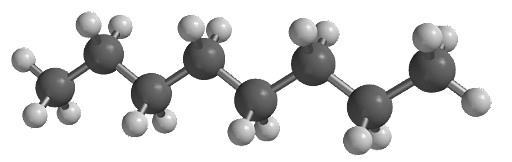
Chemical Structure of Octane
The structure of octane can also be written as follows:
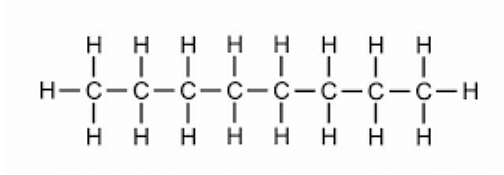
Structural formula of octane
Octane has a tetrahedral structure with 25 bond pairs and 0 lone pairs. The molecular weight of octane is estimated to be approx. 114.23 g/mol. It has sp3 hybridization. It is used as a xenobiotic. There are many structural isomers of octane. In total, it has 18 structural isomers and if stereoisomers are included, the number increases to 24. Some of the isomers of octane are:
- 2-Methylheptane
- 4-Methylheptane
- 2,2-Dimethylhexane
- 3-Ethyl-2-methylpentane
- 2,2,4-Trimethylpentane (iso-octane)
The isomer 2,2,4-Trimethylpentane, commonly called iso-octane, is used as a reference in the octane rating scale.
Read More:
Properties of Octane
[Click Here for Sample Questions]
The physical and chemical properties of octane are as follows:
Physical Properties
- Octane is a colourless liquid. It is less dense than water and insoluble in water.
- It is a clear liquid with a gasoline-like odour.
- The boiling point of octane is 258.1°F (at 760 mmHg) and its melting point is -70.2°F.
- It is soluble in ethyl ether and miscible with ethanol, acetone and benzene.
Chemical Properties
- Upon decomposition, it emits smoke and irritating fumes.
- It is corrosive in nature and can react with plastic, rubber and coatings.
- The combustion of octane releases heat energy i.e. it is an exothermic reaction. The reaction is as follows:
2C8H18 + 25O2 16CO2 + 18H2O + Heat Energy
Read Also:
Octane Rating
[Click Here for Sample Questions]
Octane Rating is defined as the ability of a fuel to resist ‘knock’. In an internal combustion engine (ICE), combustion of a fuel occurs with an oxidizer in a combustion chamber. The high-pressure gases and high temperature produced during the combustion applies force on the different components of the engine, causing them to move, thus converting the chemical energy into kinetic energy. The value of octane rating determines the ability of a fuel to withstand compression in an ICE. A higher octane number suggests that the fuel can withstand more compression.
To check the resistivity of gasoline towards knocking, its octane rating is measured in a test engine and is then compared with a reference like iso-octane. The percentage by volume of iso-octane in the mixture is the octane number of the fuel.
Read Also:
Things to Remember
- Octane is a hydrocarbon molecule that belongs to the alkane group.
- Octane is an 8-carbon molecule with molecular formula C8H18.
- Octane is colourless and its odour is like that of gasoline.
- Octane rating is a fuel’s ability to withstand compression in an internal combustion engine.
- Iso-octane, an isomer of octane, is used as a reference in determining the octane rating of a fuel.
Read Also:
Sample Questions
Ques. Calculate the molar mass of the octane. (2 marks)
Ans. The molecular formula of octane is C8H18.
Atomic mass of hydrogen = 1.00794
Atomic mass of carbon = 12.0107
Number of carbon-atoms = 8
Number of hydrogen-atoms = 18
Molecular mass of octane = 12.0107 8 + 1.00794 18 = 114.22852 g/mol
Ques. What are the necessary conditions for any system to be aromatic? (3 marks) [NCERT]
Ans. Following are the conditions necessary for a system to be aromatic:
- It should be planar to allow cyclic overlapping of p-orbitals.
- It should only have a single cyclic cloud of delocalised n-electrons above and below the plane of the molecule.
- It should contain (4n + 2) n-electrons i.e. Huckel number of electrons.
If a molecule does not meet any one or more of the above requirements, it is considered to be non-aromatic.
Ques. Give reasons for the following:
1. Why are alkenes called unsaturated hydrocarbons?
2. How will you test the presence of a double bond in an alkene?
3.Name the products formed when propene is subjected to ozonolysis. (3 marks) [NCERT]
Ans.
1. Alkenes contain a double bond between two carbon molecules (C=C) in its structure, so they are called unsaturated hydrocarbons. 2. During the reaction of alkene with cold dilute KMnO4 , glycols are formed. The characteristic purple colour of KMnO4 disappears during the reaction. This is an indicator of the presence of a double-bond. 3. During ozonolysis of propene, a mixture of acetaldehyde and formaldehyde is formed.Ques. Discuss the preparation of alkanes by wurtz reaction. What is the limitation of the reaction? (3 marks) [NCERT]
Ans. Alkanes are formed by heating an alkyl halide with sodium metal in the presence of dry ether. This reaction is called the wurtz reaction.

Limitation of wurtz reaction: With wurtz reaction, only symmetrical alkanes can be prepared. Using two different alkyl halides in the reaction gives a mixture of alkanes whose separation is difficult because of less difference in their boiling points.
Ques. Explain the structure of benzene. (3 marks)
Ans. The carbon-atoms in benzene are sp2 hybridised. The two sp2 hybrid orbitals of each carbon atom overlap with adjacent carbon-atoms and form six C-C sigma bonds in a hexagonal plane. The remaining two sp2 hybridised orbitals of C-atoms overlap with an s-orbital of a hydrogen atom and form six C-H sigma bonds. The remaining unhybridized p-orbital of each carbon-atom, perpendicular to the plane of the ring, form a ????-bond by lateral overlapping.

Ques. Draw the cis and trans structures for hex-2-ene. Which isomer will have higher boiling point and why? (3 marks) [NCERT]
Ans. The cis and trans structure of hex-2-ene are as follows:

The dipole-dipole interactions determine the boiling point of a molecule. The cis-isomer of hex-2-ene has higher dipole moment than trans-isomer. Thus, the boiling point of cis-isomer is higher than the trans-isomer.
Ques. How will you convert benzene into:
1. p-nitrobromobenzene
2. m-nitrochlorobenzene
3. p-nitrotoluene
4. Acetophenone (5 marks) [NCERT]
Ans. The conversion reactions are as follows:
1.

2.

3.

4.

Ques. Why does benzene undergo electrophilic substitution reactions easily and nucleophilic substitutions with difficulty? (2 marks)
Ans. Benzene is a rich source of electrons because of the presence of an electron cloud having 6 n-electrons. Due to this, it attracts electrophiles (electron-deficient molecules) and repels nucleophiles (electron-rich molecules). Thus, benzene undergoes electrophilic substitution reactions easily and nucleophilic substitution reactions with difficulty.
Related Links:



Comments