



Content Curator
A parallelogram is a two-dimensional geometrical shape with sides that are parallel to one another. It is a type of polygon with four sides with each pair of parallel sides being the same length. The sum of a parallelogram's adjacent angles equals 180 degrees. The area and perimeter formulas for these shapes differ and are used to solve a variety of problems.
Read Also: Area of Parallelogram
| Table of Content |
Key Takeaways: Parallelogram, Polygon, Quadrilateral, Transversal
Definition of a Parallelogram
[Click Here for Sample Questions]
A parallelogram is defined as a quadrilateral with two parallel sides. A parallelogram's opposite sides are equal in length, and its opposite angles are equal in size. Interior angles on the same side of the transversal are also supplementary. The total of all interior angles equals 360 degrees.
A parallelogram is a three-dimensional shape with parallelogram-shaped faces. The area of a parallelogram is determined by its base (one of its parallel sides) and height (the distance drawn from top to bottom). The length of a parallelogram's four sides determines its perimeter.
A square and a rectangle are two shapes that have parallelogram properties.
Rhombus: A rhombus is formed when all of the sides of a parallelogram are congruent or equal to each other.
A trapezium is defined as having one parallel side and two non-parallel sides.

Check Important Notes for Perimeter of a Parallelogram
Shape of Parallelogram
[Click Here for Sample Questions]
A parallelogram is a shape that has two dimensions. It has four sides, two pairs of which are parallel. In addition, the parallel sides are all the same length. If the lengths of the parallel sides are not equal, the shape is not a parallelogram. Similarly, the opposite interior angles of a parallelogram should be equal at all times. It is not a parallelogram if it is not symmetrical.
Parallelogram Angles
A parallelogram is a flat two-dimensional shape with four angles. The interior angles opposite each other are equal. The angles on the same side of the transversal are supplementary, which means they total 180 degrees. As a result, the sum of a parallelogram's interior angles is 360 degrees.
Parallelogram Characteristics
[Click Here for Sample Questions]
A parallelogram has the following properties:
- Both sides are parallel and congruent.
- The angles that are opposite each other are congruent.
- The angles that come after each other are supplementary.
- If any of the angles is a right angle, then all of the other angles are right angles as well.
- The two diagonals cut each other in half.
- Each diagonal cuts the parallelogram in half, forming two congruent triangles.
- The sum of the squares of all the parallelogram's sides equals the sum of the squares of its diagonals. It is also known as parallelogram law.
Also Read:
Parallelogram Formula (Area & Perimeter)
[Click Here for Sample Questions]
Parallelogram Area
A parallelogram's area is the region it occupies in a two-dimensional plane. The formula for calculating the parallelogram area is as follows:
Area = Base × Height
Parallelogram Perimeter
The perimeter of a parallelogram is the total distance between the parallelogram's boundaries. To calculate the perimeter value, we must first know the length and breadth of the object. The parallelogram has opposite sides that are the same length. As a result, the formula for calculating the perimeter is as follows:
Perimeter=2(a+b) units
Where a and b are the lengths of the parallelogram's sides.
Parallelogram Types
Parallelograms are classified into four types based on a variety of factors. Angles, sides, and other characteristics distinguish all of these different types of parallelograms.
Say PQRS in a parallelogram.
If the equal sides are PQ = QR = RS = SP, the shape is a rhombus. All of the properties of a rhombus are the same as those of a parallelogram.
A parallelogram can also be divided into two types:
Rectangle
Square
Also Read:
Parallelogram Theorem
[Click Here for Sample Questions]
Theorem 1:Parallelograms on the same base and between the same parallel sides are equal in area.
Proof: Two parallelograms ABCD and ABEF, on the same base DC and between the same parallel line AB and FC.
To prove that area (ABCD) = area (ABEF).
Proof:
Consider the figure given below:
Parallelogram ABCD and rectangle ABML are on the same base and between the same parallels AB and LC.
area of parallelogram ABCD = area of parallelogram ABML
We know that area of a rectangle = length x breadth.
Therefore, area of parallelogram ABCD = AB x AL
Hence, the area of a parallelogram is the product of any base of it and the corresponding altitude.
In ∆ADF and ∆BCE,
AD=BC (∴ABCD is a parallelogram ∴ AD=BC)
AF=BE (∴ABEF is a parallelogram ∴AF=BE)
∠ADF=∠BCE (Corresponding Angles)
∠AFD=∠BEC (Corresponding Angles)
∠DAF =∠CBE (Angle Sum Property)
∆ADE ≅ ∆BCF (From SAS-rule)
Area(ADF) = Area(BCE) (By congruence area axiom)
Area(ABCD)=Area(ABED) + Area(BCE)
Area(ABCD)=Area(ABED)+Area(ADF)
Area(ABCD)=Area(ABEF)
Hence, the area of parallelograms on the same base and between the same parallel sides is
equal.

Also Check:
Corollary
[Click Here for Sample Questions]
A parallelogram and a rectangle on the same base and between the same parallels are equal in area.
Proof: Since a rectangle is also a parallelogram, the result is a direct consequence of the above theorem.
Theorem:The area of a parallelogram is the product of its base and the corresponding altitude.
Given: In a parallelogram ABCD, AB is the base.
To prove that Area(||gmABCD) = AB×AF
Construction: Complete the rectangle AFED by Drawing BM perpendicular to CD

Things to Remember
[Click Here for Sample Questions]
- Parallelograms can be divided into three types: rhombuses, rectangles, and squares.
- A parallelogram is a quadrilateral with two pairs of equal and parallel sides.
- If two opposite sides of a quadrilateral are parallel and equal, the quadrilateral is a parallelogram; similarly, if the diagonals of a quadrilateral bisect each other, the quadrilateral is a parallelogram.
- A parallelogram when cut by one of its diagonals forms two obtuse triangles and when cut by the other, forms two acute triangles.
Read More:
Sample Questions
Ques: Prove that any two adjacent angles of a parallelogram are supplementary.
Click here for the answer
Solution: 
Let ABCD be a parallelogram
Then, AD ∥ BC and AB is a transversal.
Therefore, A + B = 180° [Since, sum of the interior angles on the same side of the transversal is 180°]
Similarly, ∠B + ∠C = 180°, ∠C + ∠D = 180° and ∠D + ∠A = 180°.
Thus, the sum of any two adjacent angles of a parallelogram is 180°.
Hence, any two adjacent angles of a parallelogram are supplementary.
Ques: Two adjacent angles of a parallelogram are as 2 : 3. Find the measure of each of its angles.
Click here for the answer
Solution: 
Let ABCD be a given parallelogram
Then, ∠A and ∠B are its adjacent angles.
Let ∠A = (2x)° and ∠B = (3x)°.
Then, ∠A + ∠B = 180° [Since, sum of adjacent angles of a ∥gm is 180°]
⇒ 2x + 3x = 180
⇒ 5x = 180
⇒ x = 36.
Therefore, ∠A = (2 × 36)° = 72° and ∠B = (3 × 36°) = 108°.
Also, ∠B + ∠C = 180° [Since, ∠B and ∠C are adjacent angles]
= 108° + ∠C = 180° [Since, ∠B = 108°]
∠C = (180° - 108°) = 72°.
Also, ∠C + ∠D = 180° [Since, ∠C and ∠D are adjacent angles]
⇒ 72° + ∠D = 180°
⇒∠D = (180° - 72°) 108°.
Therefore, ∠A = 72°, ∠B = 108°, ∠C = 72°and ∠D = 108°.
Ques: In the adjoining figure, ABCD is a parallelogram in which ∠A = 75°. Find the measure of each of the angles ∠B, ∠C and ∠D.
Click here for the answer
Solution: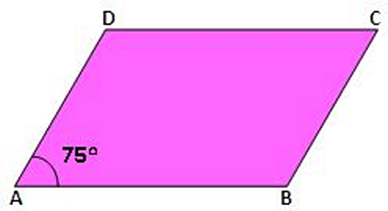
It is given that ABCD is a parallelogram in which ∠A = 75°.
Since the sum of any two adjacent angles of a parallelogram is 180°,
∠A + ∠B = 180°
⇒ 75° + ∠B = 180°
⇒∠B = (180° - 75°) = 105°
Also, ∠B + ∠C = 180° [Since, ∠B and ∠C are adjacent angles]
⇒ 105° + ∠C = 180°
⇒∠C = (180° - 105°) = 75°.
Further, ∠C + ∠D = 180° [Since, ∠C and ∠D are adjacent angles]
⇒ 75° + ∠D = 180°
⇒∠D = (180° - 75°) = 105°.
Therefore, ∠B = 105°, ∠C = 75° and ∠D = 105°.
Ques: In the adjoining figure, ABCD is a parallelogram in which
∠BAD = 75° and ∠DBC = 60°. Calculate:
(i) ∠CDB and (ii) ∠ADB.
Click here for the answer
Solution: 
We know that the opposite angles of a parallelogram are equal.
Therefore, ∠BCD = ∠BAD = 75°.
(i) Now, in ∆ BCD, we have
∠CDB + ∠DBC + ∠BCD = 180° [Since, sum of the angles of a triangle is 180°]
⇒∠CDB + 60° + 75° = 180°
⇒∠CDB + 135° = 180°
⇒∠CDB = (180° - 135°) = 45°.
(ii) AD ∥ BC and BD is the transversal.
Therefore, ∠ADB = ∠DBC = 60° [alternate interior angles]
Hence, ∠ADB = 60°.
Ques: In the adjoining figure, ABCD is a parallelogram in which
∠CAD = 40°, ∠BAC = 35° and ∠COD = 65°.
Calculate: (i) ∠ABD (ii) ∠BDC (iii) ∠ACB (iv) ∠CBD.
Click here for the answer
Solution: 
(i) ∠AOB = ∠COD = 65° (vertically opposite angles)
Now, in ∆OAB, we have:
∠OAB + ∠ABO + ∠AOB =180° [Since, sum of the angles of a triangle is 180°]
⇒ 35°+ ∠ABO + 65° = 180°
⇒∠ABO + 100° = 180°
⇒∠ABO = (180° - 100°) = 80°
⇒∠ABD = ∠ABO = 80°.
(ii) AB ∥ DC and BD is a transversal.
Therefore, ∠BDC = ∠ABD = 80° [alternate interior angles]
Hence, ∠BDC = 80°.
(iii) AD ∥ BC and AC is a transversal.
Therefore, ∠ACB = ∠CAD = 40° [alternate interior angles]
Hence, ∠ACB = 40°.
(iv) ∠BCD = ∠BAD = (35° + 40°) = 75° [opposite angles of a parallelogram]
Now, in ∆CBD, we have
∠BDC + ∠BCD + ∠CBD = 180° [sum of the angles of a triangle is 180°]
⇒ 80° + 75° + ∠CBD = 180°
⇒ 155° + ∠CBD = 180°
⇒∠CBD = (180° - 155°) = 25°.
Hence, ∠CBD = 25°.
Ques: In the adjoining figure, ABCD is a parallelogram, AO and BO are the bisectors of ∠A and ∠B respectively. Prove that ∠AOB = 90°.
Click here for the answer
Solution: 
We know that the sum of two adjacent angles of a parallelogram is 180°
Therefore, ∠A + ∠B = 180° ……………. (i)
Since AO and BO are the bisectors of ∠A and ∠B, respectively, we have
∠OAB = 1/2∠A and ∠ABO = 1/2∠B.
From ∆OAB, we have
∠OAB + ∠AOB + ∠ABO = 180° [Since, sum of the angles of a triangle is 180°]
⇒ ¹/â‚‚∠A + ∠ABO + ¹/â‚‚∠B = 180°
⇒ ¹/â‚‚(∠A + ∠B) + ∠AOB = 180°
⇒ (¹/â‚‚ × 180°) + ∠AOB = 180° [using (i)]
⇒ 90° + ∠AOB = 180°
⇒∠AOB = (180° - 90°) = 90°.
Hence, ∠AOB = 90°.
Ques: The ratio of two sides of a parallelogram is 4 : 3. If its perimeter is 56 cm, find the lengths of its sides.
Click here for the answer
Solution:
Let the lengths of two sides of the parallelogram be 4x cm and 3x cm respectively.
Then, its perimeter = 2(4x + 3x) cm = 8x + 6x = 14x cm.
Therefore, 14x = 56 ⇔ x = âµâ¶/â‚â‚„ = 4.
Therefore, one side = (4 × 4) cm = 16 cm and other side = (3 × 4) cm = 12 cm.
Mathematics Related Links:



Comments