



Content Curator
When two lines intersect each other at a single point, there is a formation of a Linear Pair of Angles. Angles that are adjacent to each other after the intersection of two lines are called linear angles. A linear pair of angles always have a total sum of 180°. These angles are also known as Supplementary Angles. Since adjacent angles have a common vertex, linear pairs of angles also share a common vertex. They also have a common arm representing both angles. We can see a linear pair of angles in real-life in objects such as the ladder, which forms linear angles at the ground when placed steadily against a wall.
Read More: Differential Equation
Linear angles are always formed into a straight line, fitting perfectly with the meaning of linearity that is straightness. The pair of adjacent angles are constructed on a line segment although all adjacent lines are not linear. Therefore, it can be concluded by saying that a linear pair of angles is the adjacent angles that have non-common arms basically formed as opposite rays.
| Table of Content |
Read More: Eccentricity
Explanation of Linear Pair of Angles
When the angle formed between two lines is 180°, the angle formed is a straight angle. It is just another way to represent a straight line. A straight line can even be visualized as a circle that has an infinite radius. Any portion of a line with two endpoints is called a line segment, while a portion of a line with just one endpoint is called a ray. A line segment that has endpoints A and B respectively are represented as AB. The following figure shows the line segment AB in a long line:

Now let us suppose that a point O is taken anywhere on the line segment AB. Hence, the angle that will form between the two line segments AO and OB is 180°, i.e., a straight line.

Now if we consider a ray OP standing on the line segment AB as follows:

∠POB and ∠POA are the angles formed at O. Since it is known that the angle between the line segments AO and OB is 180°, the sum of the angles ∠POB and ∠POA add up to 180°.
Therefore, ∠POB + ∠POA = ∠AOB = 180°
∠POB and ∠POA are adjacent to each other. When the sum of such adjacent angles is 180°, then these angles form linear pair of angles. This discussion can be stated as an axiom.
Also Read:
Explanation of Axioms
Axiom 1: When a ray stands on a line then the adjacent angles formed are linear pairs of angles.
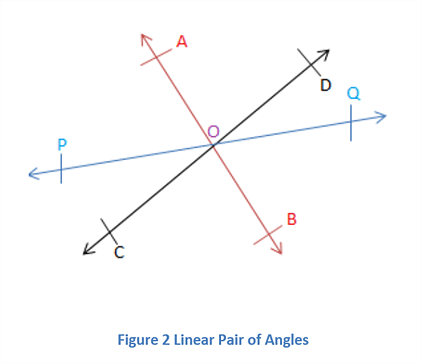
In figure 2 given above, point O is an intersection for all line segments. Since the ray OA lies on the line segment CD, angles AOC and AOD form a linear pair of angles. In the same way, angles POD and QOD form a linear pair of angles and so on.
Read More:
The converse of the above-mentioned axiom can also be true. This is stated in the axiom given below.
Axiom 2: When two angles form a linear pair, then the uncommon arms of both the angles form a straight line.

In the image given above, only the last figure shows a linear pair, since the sum of the adjacent angles is 180°. AB, therefore, represents a line. The other two pairs of angles are adjacent angles although they are not linear pairs of angles. Therefore, they do not form a straight line.
The two axioms that have been mentioned above thus form the Linear Pair Axioms that are primarily required to solve various problems in mathematics.
Read More:
Things to Remember
- If two intersecting lines form nearby angles, the angles are said to be linear.
- Because a straight angle is 180 degrees, a linear pair of angles must add up to 180 degrees. These are also known as supplementary angles.
Also Read:
Sample Questions
Ques: Can all adjacent angles be called Linear Angles?
Ans No, all adjacent angles are not linear angles but all linear angles are adjacent angles. Adjacent angles are basically the angles that lie next to each other. Since linear angles always lie next to each other, they can be classified as adjacent angles. In a linear pair, the arms of the angles formed are not always collinear or common and lie on a straight line.
Ques: Can three vertical angles form a Linear Pair?
Ans: No, vertical angles cannot form a linear pair. Supplementary angles are two angles that sum up to 180 degrees. A linear pair is formed of these two angles that have a sum of 180 degrees. Hence vertical angles cannot be adjacent.
Read More:
Ques: Given angles ∠1 and ∠3 are vertically opposite to each other. Using the Linear Pair Axioms, prove that ∠1 = ∠3.
Ans: Using Linear Pair Axioms,
∠1+ ∠2=180° -- (i)
∠3+ ∠2=180° -- (ii)
Therefore, comparing the two equations,
∠1+ ∠2=∠3+ ∠2
or, ∠1= ∠3 (proved)
Ques: Linear pair of angles AOC and BOC stand on point O inline segment AB. If the difference between the two angles is 60 degrees, what are the values of each angle?
Ans: Since angles AOC and BOC are linear pair, the sum of them is 180 degrees.
Therefore, ∠AOC + ∠ BOC =180° --- (i)
Also given,
∠AOC – ∠ BOC = 60° --- (ii)
Adding (i) and (ii) we get,
∠AOC = 180° + 60° = 240°
∠AOC = 240°/2 = 120°
Putting the value of angle AOC in (i) we get,
∠BOC = 180° – ∠AOC
= 180° – 120°
∠BOC = 60°
Read More:
Ques: If one of the angles in a linear pair is 90°, how can we find out the other angle?
Ans: If the two angles in a linear pair are considered ∠A and ∠B,
∠A = 90° and sum of supplementary pair ∠A + ∠B = 180°
Therefore,
∠A + ∠B = 180°
⇒ 90° + ∠B = 180°
⇒ ∠B = 180° - 90°
⇒ ∠B = 90°
Hence, in a linear pair of angles, if the value of one angle is given as 90 degrees, the other angle is meant to also be at a right angle.
Also Read:



Comments