



Education Journalist | Study Abroad Lead
Isosceles Triangle is the type of triangle in which any two of the sides are equal. The angles that are found the opposite to these equal sides are also equal. We can calculate the area of an isosceles triangle with the help of the length of its sides. For triangle ABC whose sides AB and AC are equal, so, ∠ B will also be equal to ∠ C. The theorem that explains the definition of the isosceles triangle is that “if the two sides of a triangle are congruent, then the angle opposite to these sides are congruent”. The perimeter of an isosceles triangle refers to the total length of its boundary which is the sum of all its sides.
| Table of Contents |
Key Words: Isosceles Triangle, Triangles, Perimeter, Angles, Base, Height, Congruency, Hypotenuse, Vertex, Right Isosceles Triangle, Obtuse Isosceles Triangle, Acute Isosceles Triangle
Properties of An Isosceles Triangle
[Click Here for Sample Questions]
An isosceles triangle is a type of a triangle along with equilateral triangle and scalene triangle. It can be defined as a triangle with two equal sides. Here are some of the important properties of an isosceles triangle:
- Any of the two sides are equal in an isosceles triangle, and the unequal side is known as the triangle’s base.
- The angles that are opposite to the two equal sides, will also be equal.
- An Isosceles triangle’s height is taken from the base of the triangle to the vertex of the triangle.
- The remaining unequal angle of a right isosceles triangle is equal to 90 degrees.
- An isosceles triangle can be generally classified into different types, such as
the Isosceles acute triangle, the Isosceles right triangle and the Isosceles obtuse triangle.
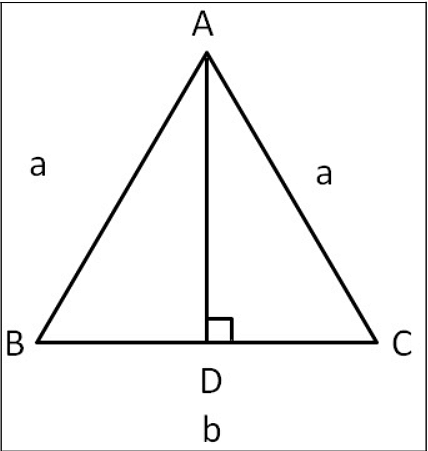
Isosceles Triangle
What is an Isosceles Acute Triangle?
[Click Here for Sample Questions]
As we are aware of the fact that the various dimensions of a triangle are base, legs, and height. The axis of symmetry of an isosceles triangle is found along its base’s perpendicular bisector. An Isosceles triangle can be classified as either acute, right or obtuse depending upon the angle between the two legs. The isosceles triangle is known as an Isosceles acute triangle if the angles opposite to the equal legs are equal and are lower than 90 degrees.
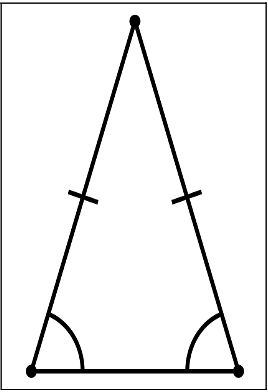
Isosceles Acute Triangle
Read More: Properties of Triangle
What is an Isosceles Right Triangle?
[Click Here for Sample Questions]
A right isosceles triangle consists of two equal sides, in which one equal side is the perpendicular and another one is the base of the triangle. The third unequal side is called the hypotenuse. Therefore, the Pythagoras theorem can be applied here, where the square of the hypotenuse is equal to the sum of the square of base and perpendicular. Let’s assume that the sides of the right isosceles triangle are a, a, and h, where a is the length of two equal sides and h is the length of the hypotenuse, then; h = √(a2+a2) = √2a2= a√2 or h = √2a
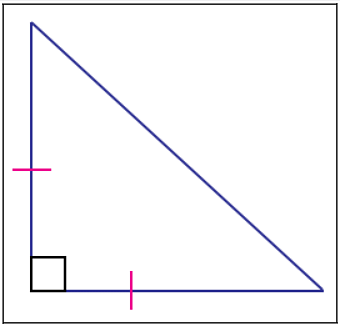
Isosceles Right Triangle
Read More: Right Angle Triangle Theorem
What is an Isosceles Obtuse Triangle?
[Click Here for Sample Questions]
An obtuse triangle is a triangle where one angle is larger than 90 degrees. Also, it is impossible to draw a triangle consisting of more than two obtuse angles. The obtuse triangle can be of two main types, that are, scalene triangles or isosceles triangles. Therefore, the isosceles obtuse triangle is a triangle consisting of two equal sides with an obtuse angle.

Isosceles Obtuse Triangle
Read More: Congruence of Triangles
Perimeter of an Isosceles Triangle
[Click Here for Sample Questions]
The perimeter of any kind of shape is calculated by measuring the total boundary of that shape. In the same way, the perimeter of an isosceles triangle is measured as the sum of all three sides of an isosceles triangle. The perimeter of an isosceles triangle can be measured if its base and side are available. The formula for the perimeter of an isosceles triangle is given by:
The perimeter of an isosceles triangle’s formula is as follows:
P = 2a + b Units
Here ‘a’ is the two equal sides’ length of an isosceles triangle and ‘b’ is the base of that triangle.
Example: Calculate the perimeter of an isosceles triangle whose equal sides are 10 cm and the base is given as 5 cm.
Solution: To calculate the perimeter of an isosceles triangle, we will use the perimeter formula:
P = 2a + b Units
Here, the length of equal sides is 10 cm and the base is given as 5 cm. So,
Perimeter of the isosceles triangle = 2 x 10 + 5 = 20 + 5 = 25 cm.
Thus, the perimeter of the given isosceles triangle is 25 cm.
Read More: The Perimeter of a Triangle
Things To Remember
- Isosceles Triangle can be defined as a type of triangle that has two equal sides and the angles that are found the opposite to these equal sides are also equal. The third unequal side is called the hypotenuse.
- An Isosceles triangle can be classified as either acute, right or obtuse depending upon the angle between the two legs.
- The isosceles triangle is known as an Isosceles acute triangle if the angles opposite to the equal legs are equal and are lower than 90 degrees.
- A right isosceles triangle consists of two equal sides, in which one equal side is the perpendicular and another one is the base of the triangle.
- An obtuse triangle is a triangle where one angle is larger than 90 degrees.
- The perimeter of an isosceles triangle refers to the sum total of all the sides of an isosceles triangle.
- The formula for the perimeter of an isosceles triangle is P = 2a + b units. Here ‘a’ is the length of the two equal sides of an isosceles triangle and ‘b’ is the base of the triangle.
Sample Questions
Ques. Find the perimeter of an isosceles triangle, with equal sides of 5 cm and a base of 4 cm. (3 Marks)
Ans. Given that, the length of the base is 4 cm.
The length of the two equal sides is 5 cm.
We know that the formula to calculate the perimeter of an isosceles triangle is P = 2a + b units.
Now, substitute the value of base and side in the perimeter formula, we get
P = 2(5) + 4 = 10 + 4 = 14 cm
Therefore, the perimeter of an isosceles triangle is 16 cm.
Ques. Find the area of an isosceles triangle given its height as 5 cm and base as 4 cm? (3 Marks)
Ans. Given that, base = 4 cm and height = 5 cm
We know that the area of an isosceles triangle is ½ × b × h square units
Now, substitute the base and height value in the formula to calculate the area
Area of an isosceles triangle is ½ × b × h
A = ½ × 4 × 5 = 10 cm2
Therefore, the area of an isosceles triangle is 10 cm2
Ques. What is the perimeter of an isosceles triangle when a = 9 cm and b = 6 cm? (3 Marks)
Ans. Given,
a = 9 cm
b = 6 cm
Perimeter of an isosceles triangle = 2a + b
= 2(9) + 6
= 18 + 6 cm
= 24 cm
Ques. What is the perimeter of an isosceles triangle when the length of one of the equal sides is 10 cm and the base is 6 cm? (3 Marks)
Ans. To find the perimeter of an isosceles triangle, we use the formula: perimeter = 2a + b. In this case, the length of one equal side (a) = 10 cm; base (b) = 6 cm
Substituting the values in the formula:
= 2 (10) + 6
= 20 + 6
= 26 cm
Ques. The perimeter of an isosceles triangle is 12 units. Find out the length of the third side of the triangle if the equal sides measure 3 units each. (3 Marks)
Ans. Let the third side of the isosceles triangle be 'b'
Given, Perimeter = 12 units, a = 3 units, b =?
Using the formula for the perimeter of isosceles triangle = 2a + b
Substituting the given values in the above formula,
12 = 2 (3) + b
12 = 6 + b
12 - 6 = b
Therefore, b = 6 units
Ques. Find the perimeter of an isosceles right triangle in which the hypotenuse is 8 units. (3 Marks)
Ans. When only the hypotenuse is given, the perimeter of an isosceles right triangle can be calculated with the formula, Perimeter of isosceles right triangle = h(1 + √2); where h = hypotenuse
After substituting the value of h = 8, we get,
Perimeter of isosceles right triangle = h(1 + √2) = 8(1 + √2) units.
Ques. Calculate the perimeter of an isosceles triangle whose base is 3 cm, and congruent sides are 5 cm. (3 Marks)
Ans. Given that congruent sides are 5 cm, and the base is 3 cm.
If a and a are the two equal sides and b is the base of an isosceles triangle, then:
P = a+a+b = (2a+b) units.
Therefore, the perimeter of the given triangle = 2×5+3 = 13 cm
Hence, the perimeter of the given isosceles triangle is 13 cm.
Ques. Calculate the base of an isosceles triangle whose perimeter is 30 cm, and congruent sides are 8 cm. (3 Marks)
Ans. Given that congruent sides are 8 cm, and the perimeter is 30 cm.
If a and a are the two equal sides and b is the base of an isosceles triangle, its perimeter
P = a+a+b = (2a+b) units
Now, substituting a = 8 in the above we have,
(2a+b) = 2×8+b = 16+b
According to the statement, 16+b=30
⇒b=30–16=14
Therefore, the base of the isosceles triangle is 14 cm.
Ques. The base of an isosceles triangle is 10 cm, and the perimeter is 40 cm. Find the other two sides. (3 Marks)
Ans. It is given that the base is 10 cm and the perimeter is 40 cm.
If a and a are the two equal sides and b is the base of an Isosceles triangle,
Perimeter P = a+a+b = (2a+b) units
Now, substituting b = 10 in the above we have,
(2a+b) = 2a+10
According to the statement, 2a+10 = 40
⇒2a = 40–10 = 30
⇒a = 30/2
=15
Therefore, the other two sides of the isosceles triangle are 15 cm.
Ques. The hypotenuse of an isosceles triangle is 5 cm. Then, find the perimeter. (3 Marks)
Ans. Given that the hypotenuse is 5 cm.
We know, if the length of the hypotenuse (h) is given, then the perimeter of an isosceles right triangle will be
P = h+2l
⇒ h+2× h/√2 = h + √2h = h(1 + √2)
Hence, the perimeter of the given triangle = 5 (1+ √2) cm.
Read Also:



Comments