



Education Journalist | Study Abroad Lead
The peripheral nervous system along with the central nervous system is a part of the nervous system. The nervous system is a network of nerves and cells that send and receive information from the brain and spinal cord to other areas of the body. It is referred to as the regulating mechanism of the body. The central nervous system is made up of the brain and spinal cord while the peripheral nervous system consists of autonomic and peripheral nervous systems. There are two kinds of nerve fibers in our body afferent and efferent nerve fibers. The network of nerves that link the brain and spinal cord is known as the peripheral nervous system. In this article, we will have a look at the peripheral nervous system, understand its structure and functions.
What is Peripheral Nervous System?
The nervous system regulates the body's function and communication system. The nervous system is divided into two parts: the peripheral nervous system and the central nervous system. The peripheral nervous system includes the nerves, spinal cord, and ganglia. The nervous system's route transports responses and information from the brain and spinal cord to the CNS. The communication between CNS and the body is handled by the peripheral nervous system. The peripheral nervous system is mainly made up of a network of nerves. The nerves in our peripheral nervous system are of two types: afferent and efferent nerve fibers.
- The afferent nerve fibers are in charge of transmitting impulses from the tissues to the central nervous system.
- The efferent nerve fibers are in charge of transmitting impulses from the central nervous system to the tissues or organs in question.
The peripheral nervous system consists of:
- The somatic nervous system which is made up of nerves that go from the brain to the skin and muscles and play a role in conscious actions.
- The autonomic nervous system which comprises nerves that connect the CNS to visceral organs like the heart, stomach, and intestines. It acts as a conduit for unconscious actions.
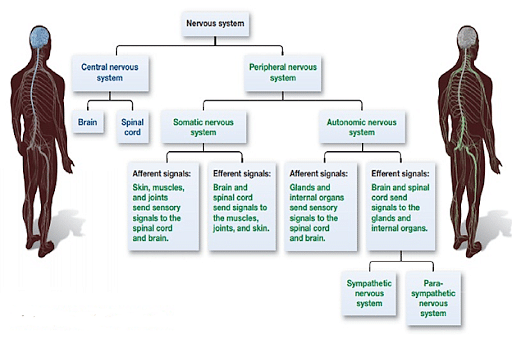
Divisions of Peripheral Nervous System
The peripheral nerve system is comprised of two main systems which are:
- Somatic Nervous System
- Autonomic Nervous System
Somatic Nervous System
The somatic nervous system's primary purpose is to transmit impulses from the central nervous system to the skeletal muscles. The primary components of the Somatic Nervous System are the cranial and spinal nerves. It is in charge of relaying messages from the outside of the body.
It consists of:
1. Cranial Nerves
The inferior surface of the brain has twelve pairs of cranial nerves. Except for the vagus nerve, all of these nerves go via foramina in the skull to innervate tissues in the head, neck, and face.
- According to the sequence in which they emerge on the inferior surface of the brain, the cranial nerves are named and assigned Roman numerals.
- The majority of nerves have both sensory and motor functions.
- Only sensory fibers go through three of the nerves, which are linked with the unique senses of smell, vision, hearing, and balance.
- Five additional nerves are mainly motor in nature, but they do contain some proprioceptive sensory fibers.
- The remaining four nerves include a large number of sensory and motor fibers.
- The balance nerve, commonly known as the eighth cranial nerve or vestibulocochlear nerve, produces benign fibrous growths termed acoustic neuromas.
- These tumors are non-malignant, which means they don't spread or spread to other regions of the body. These tumors are found deep within the skull, close to critical brain regions in the brain stem. As tumors grow larger, they engulf neighboring structures that perform critical activities. These tumors, in the vast majority of instances, develop slowly over time.

In certain situations, the rate of development is quicker, and individuals acquire symptoms more quickly. The symptoms are usually minor, and many individuals are not detected until their tumor has progressed. When patients are tracked by yearly MRI scans, many of them show no tumor development over time.
2. Spinal Nerves
The spinal cord has thirty-one pairs of spinal nerves that exit laterally. Each nerve pair corresponds to a section of the spinal cord and is referred according to that. There are eight cervical nerves, twelve thoracic nerves, five lumbar nerves, five sacral nerves, and one coccygeal nerve in all.

A dorsal root and a ventral root link each spinal neuron to the spinal cord. Sensory neuron cell bodies are found in the dorsal root ganglion, whereas motor neuron cell bodies are found in the grey matter. Just before the nerve leaves the vertebral column, the two roots unite to create the spinal nerve. All spinal nerves are mixed nerves because they contain both sensory and motor components.
Autonomic Nervous System
The autonomic nervous system is responsible for sensing and controlling involuntary actions. It's in charge of keeping an eye on the internal environment and making necessary modifications. In general, the autonomic nervous system is in charge of all internal bodily functions that occur without your conscious knowledge or active participation.
The autonomic nervous system is made up of sensory and motor nerves that connect the central nervous system (particularly the hypothalamus in the brain) to internal organs (including the heart, lungs, and digestive organs) and glands (such as the sweat glands and pancreas).
- The autonomic nervous system's sensory neurons monitor interior body circumstances and transmit information to the brain.
- The autonomic nervous system's motor neurons regulate the contractions of smooth or cardiac muscle, as well as glandular tissue.
When the autonomic nervous system detects a rise in body temperature, motor neurons instruct smooth muscles in blood vessels near the body surface to dilate, and sweat glands in the skin generate more perspiration to cool the body.
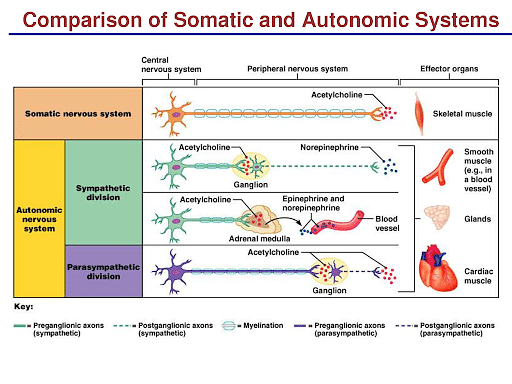
Somatic vs autonomic nervous system
The sympathetic and parasympathetic divisions of the autonomic nervous system are two subdivisions of the autonomic nervous system.
It is split into two sections:
- Sympathetic Nervous System
- Parasympathetic Nervous System
Both divisions supply fibers to a large number of visceral organs. One stimulates and the other inhibits, in this situation. This antagonistic functional connection helps to preserve homeostasis by providing a balance.
Sympathetic Nervous System
It is made up of nerves that originate in the spinal cord. It is discovered in the area between the neck and the waist. The sympathetic nervous system is stimulated by the hormone adrenalin. It is in charge of preparing the body for any aggressive acts that may occur as a result of aberrant bodily circumstances.
Parasympathetic Nervous System
It is found in the neck and head. The sacral area, on the other hand, is the site of the posterior. When the violent activity is complete, this nerve system is entirely responsible for restoring the body's normal state.

Also Read:
Functions of Peripheral Nervous System
The functions of the peripheral nervous system are:
- This nerve system is in charge of maintaining internal homeostasis.
- The peripheral nervous system regulates the release of secretions from exocrine glands.
- The peripheral nervous system connects the brain and spinal cord to the rest of the body as well as the outside world.
- It serves as a connection between the body's central nervous system, organs, skin, and limbs.
- The peripheral nerve system is in charge of complicated behaviour and motions.
- Any feeling felt in any region of the body is transmitted to the CNS via the sensory receptor of the skin. The signal is then sent to the sense organs.
- Autonomic motor cells are discovered to govern involuntary muscles.
- The PNS is responsible for voluntary actions including chewing, walking, and facial expressions.
- The PNS also controls autonomic activities including breathing, heart rate, and digestion, which are all automatic physiological functions.
As a result, the PNS is critical for human survival. The nerves and cells of the PNS are not covered by bones, unlike the CNS, which is protected by the skull and vertebrae of the spine. As a result, the PNS is more vulnerable to trauma.

Disorder of the Peripheral Nervous System
The peripheral nervous system can be affected by over a hundred different diseases. This can cause damage to one or more nerves.
- Guillain-Barre syndrome, diabetic nerve issues, thoracic outlet syndrome, and other illnesses can be caused by other diseases or viral infections.
- An injury can sometimes result in complications such as complicated regional pain syndrome.
- In certain situations, the condition may be traced back to a genetic mutation.
- The signs of many disorders go unnoticed at first, but they progressively worsen.
- In order to heal such diseases, people should engage in regular workouts and yoga, which will assist to reduce discomfort.

Symptoms of Peripheral Nerve Disorder
Also Read:
Things to Remember
- All nerves branching out of the brain and spinal cord makes up the peripheral nervous system (PNS).
- Spinal nerves and cranial nerves are the two primary kinds of nerves of the peripheral nervous system.
- The autonomic and somatic nervous systems are two functional divisions of the PNS. Both of these may be split further, with the former being divided into sympathetic and parasympathetic arms and the latter being divided into sensory and motor divisions.
- Nerves and ganglia are the tissues that make up the PNS. Ganglia are nerve tissues that serve as relay sites for messages sent through the PNS's nerves.
- The bulk of PNS tissues are made up of nerves, which are cable-like bundles of axons.
- Sensory, motor and mixed nerves are the three types of nerves that convey nerve signals in different directions.
- Sensory nerves provide information from the body's sensory receptors to the CNS. Afferent nerves are another name for sensory nerves.
- Motor nerves provide information from the central nervous system (CNS) to muscles, organs, and glands. Efferent nerves are another name for motor nerves.
- Sensory and motor neurons coexist in mixed nerves, allowing them to send information in both directions. Both afferent and efferent functions are performed by them.
Sample Questions
Ques. What are the symptoms of peripheral neuropathy? (5 marks)
Ans. The symptoms of peripheral neuropathy are:
- Prickling in the fingers and numbness are early signs of peripheral neuropathy.
- It can extend to the hands or legs, causing freezing, burning, and discomfort.
- It is frequently worse at night. It is possible to experience continuous discomfort on both sides of the body.
- When a person tries to touch anything, he or she may experience sensitivity. The agony is described as intense and excruciating.
- Muscles can deteriorate over time. Individuals may find it difficult to move or walk.
- Sweating is also seen as a sign of peripheral neuropathy.
- Blood pressure can rise to dangerous levels.
Ques. What will happen if the peripheral nervous system gets damaged? (3 marks)
Ans. The peripheral nervous system not only controls organ functions but also transmits motor and sensory information. PNS can be injured by trauma, resulting in Charcot-Marie-Tooth disease (CMT). This type of injury can have an impact on the brain's capacity. The brain's communication with the organs and muscles will be harmed as a result. Peripheral nerve damage needs prompt medical attention and treatment. If these precautions are not performed at the appropriate time, they might result in serious problems and long-term harm.
Ques. What are the disorders of the Peripheral Nervous System? (3 marks)
Ans. The PNS does not have the same safeguards as the CNS, which is shielded by bones, meninges, and cerebrospinal fluid. In addition, the PNS lacks a blood-brain barrier to protect it from poisons and infections in the bloodstream. As a result, the PNS is more vulnerable to illness and damage than the CNS. Diabetes, viral illnesses such as shingles, and poisoning by poisons such as heavy metals are all causes of nerve damage. Symptoms of PNS disorders include loss of feeling, tingling, burning sensations, and muscular weakness. If a nerve is transacted (cut all the way through) as a result of a severe injury, it can recover, but it is a lengthy process that can take months.
Ques. What is the autonomic nervous system? (3 marks)
Ans. The central nervous system sends impulses to the body's involuntary organs and smooth muscles via the autonomic nervous system. Because the autonomic nervous system is a visceral efferent system, it delivers motor impulses to the visceral organs. It innervates cardiac muscle, smooth muscle, and glands automatically and constantly, without any conscious effort. Heart rate, breathing rate, blood pressure, body temperature, and other visceral processes all play a role in maintaining homeostasis.
Ques. What is Somatic Nervous System? (5 marks)
Ans. The somatic nervous system is largely responsible for sensing the external world and controlling voluntary behaviors, with choices and orders coming from the brain's cerebral cortex. You're employing your somatic nervous system when you're too hot and decide to switch on the air conditioner and go across the room to the thermostat. All of your conscious impressions of the outside world, as well as all of the voluntary motor movements you conduct in response, are controlled by the somatic nervous system. You may credit your somatic nervous system for allowing you to do things like play the piano, drive a vehicle or play basketball.
The somatic nervous system is made up of 12 pairs of cranial nerves and 31 pairs of spinal nerves in terms of structure.
Cranial nerves are located in the head and neck and link to the brain directly. Smells, tastes, light, noises, and body position are all sensed via sensory cranial nerves. Face, tongue, eyes, throat, head, and shoulder muscles are all controlled by motor cranial nerves. The salivary glands and swallowing are likewise controlled by the motor neurons. As mixed nerves with both sensory and motor neurons, four of the 12 cranial nerves perform both sensory and motor tasks.
The somatic nervous system's spinal nerves emerge between vertebrae from the spinal column. All of the nerves in the spine are mixed nerves, meaning they include both sensory and motor neurons. Motor nerves, which trigger skeletal muscle contraction and allow for voluntary bodily motions, are also found in the spinal nerves.
Ques. What are the tissues of the Peripheral Nervous System? (3 marks)
Ans. Nerves and ganglia are the tissues that make up the PNS. Ganglia are nerve tissues that serve as relay sites for messages sent through the PNS's nerves. The bulk of PNS tissues are made up of nerves, which are cable-like bundles of axons. Sensory, motor and mixed nerves are the three types of nerves that convey nerve signals in different directions.
- Sensory nerves provide information from the body's sensory receptors to the CNS. Afferent nerves are another name for sensory nerves.
- Motor nerves provide information from the central nervous system (CNS) to muscles, organs, and glands. Efferent nerves are another name for motor nerves.
- Sensory and motor neurons coexist in mixed nerves, allowing them to send information in both directions. Both afferent and efferent activities are present in them.
Ques. What is your peripheral nervous system made up of? (2 marks)
Ans. The peripheral nervous system refers to the parts of the nervous system that exists outside of the spinal cord and the brain The cranial nerves, spinal nerves, their roots and branches, peripheral nerves, and neuromuscular connections are all included.
Ques. What is the main role of the peripheral nervous system? (2 marks)
Ans. The fundamental functions of PNS are:
- Transmitting motor orders to all voluntary striated muscles in the body.
- Delivering sensory information about the external environment and the body to the brain and spinal cord (except for vision information, which is carried by the optic nerves).



Comments