



The medulla oblongata, often known as the medulla, is the lowest region of the brain and the brainstem. The medulla oblongata is connected to the midbrain by the pons and is continuous with the spinal cord posteriorly, merging at the foramen magnum at the base of the skull.
- The medulla oblongata is responsible for conveying signals from the spinal cord to the brain's higher levels.
- It also directes autonomic functions like heartbeat and respiration.
- The main function is to control vital proceeses of the body.
- For example, it controlls the breathing,heart function, blood vessel function, diigestion etc.
Also Check: Human Brain
Key Words: Medulla oblongata, Medulla, Brain, Function, Cerebellum,
Location of Medulla Oblongata
It is found in the brain stem, anterior to the cerebellum and inferior to the pons. It is located at the base of the hindbrain. It can be found in the front part of the posterior cranial fossa, going all the way down to the foramen magnum.
- The cerebellum's vallecula is located in the back. Meninges and clivus are located anteriorly.
- The fourth cerebral ventricle is formed from the uppermost section of the medulla.
- The cerebral aqueduct connects this ventricle to the cerebral aqueduct, which holds the cerebrospinal fluid.

Structure of Medulla Oblongata
[Click Here for Sample Questions]
The medulla oblongata is a brainstem segment that connects the spinal cord to the pons. It reaches the levels of the atlas through the foramen magnum. The cerebral hemispheres encircle it dorsally above the foramen magnum.
- The medulla extends for about 0.5 cm from the pronto-medullary junction to the plane below the foramen magnum.
- It spinalis contains a central canal that runs from the bottom half to the higher half, opening in the four ventricles.
- It is surrounded by the cerebrospinal fluid on both sides (central canal) (subarachnoid space).
- Between the two lobes of the cerebellum is the medulla (anterior cerebellar notch).

Read More
| Related Articles | ||
|---|---|---|
| Central Nervous System | Nervous System | Nervous System Diseases |
Components of Medulla Oblongata
[Click Here for Sample Questions]
Below are the major components of medulla oblongata.
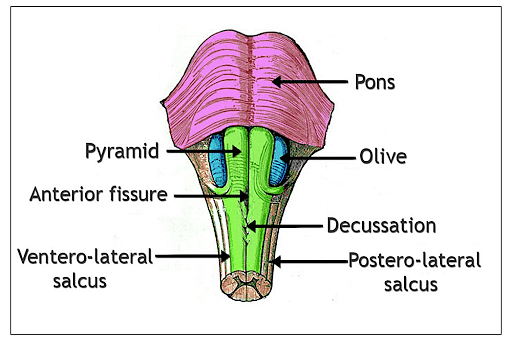
Median Fissures
The median fissures are shallow grooves occurring along the posterior and anterior sections of the medulla.
Pyramids
The pyramids are a deeply grooved midline in the upper section of the medulla ventrally, with a bold complexity on either side.
- It's because of the corticospinal fibers that have been trapped.
- The decussation of the pyramids occurs when some of the fibers overlap each other, obliterating the anterior median fissure.
- The external arcuate fibers emerge from the anterior medial fissures above the pyramids' decussation and go lateral over the pons' surface.
Bodies of Olivary
The area between the posterolateral and anterolateral sulcus in the upper section of the medulla is identified by swelling, a pair of oval structures known as the olivary bodies or olives. It contains nerve fibers that connect the cerebellum, pons, and medulla. The enlargement is caused by the inferior olivary nucleus, a vast mass of grey matter.
Fasciculus Gracilis
Tracts entering from the posterior funiculus of the spinal cord enter the medulla between the posterolateral sulcus and the posterior median.
- These structures are the Fasciculus Gracilis, which is located midway between the midline and the fasciculus cuneatus.
- The fasciculi's terminal end features gracile and cuneate tubercles, which are round elevations.
- The floor of the 4th ventricle is formed by a triangular depression that occupies the posterior portion of the medulla, overlying the tubercles.
- The inferior cerebellar peduncle surrounds this depression on both sides.
- The tuberculum cinereum is immediately laterally adjacent to this fasciculus cuneatus.
Functions of Medulla Oblongata
[Click Here for Sample Questions]
The medulla oblongata is involved in several body activities, including the control of critical sensory, motor, and mental processes, such as:
- Control of autonomic functions
- Nerve signal transmission between the brain and the spinal cord
- Body movement coordination
- Mood management
The medulla is the main control center for the cardiovascular and respiratory systems. It controls heart rate, blood pressure, breathing rate, and other life-sustaining activities without requiring a person to think about them. Involuntary reflexes such as swallowing, sneezing, and gagging are also controlled by the medulla. Coordination of eye movement is another important job.
- The medulla houses several cranial nerve nuclei.
- Speech, head and shoulder movement, and food digestion all rely on these nerves.
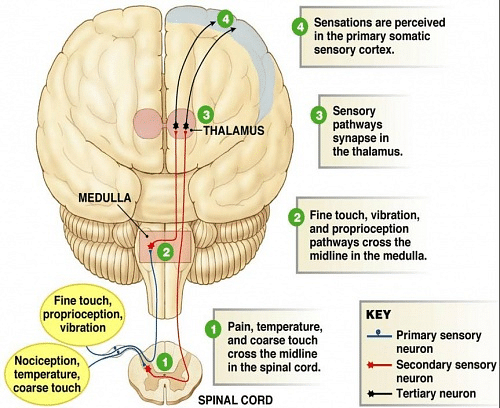
- The medulla also helps the peripheral nervous system and the central nervous system communicate sensory information.
- Sensory information is relayed to the thalamus, which then sends it to the cerebral cortex.
Read more: Neural Conrol and Coordination
Damage to Medulla Oblongata
[Click Here for Sample Questions]
When the medulla oblongata is injured, it can cause a variety of sensory issues.
- Numbness, paralysis, trouble swallowing, acid reflux, and loss of motor function are all non-fatal consequences.
- Damage to the medulla, however, can be lethal because it also controls important autonomic activities like breathing and heart rhythm.
- The medulla's ability to function can be harmed by drugs and other chemical compounds.
- Overdosing to opiates can be fatal since they inhibit medulla activity to the point that the body is unable to regulate vital activities.
- The activity of the medulla oblongata is sometimes deliberately and very carefully repressed.
- Chemicals used in anesthesia, for example, act on the medulla to reduce autonomic activity.
- This causes a reduction in respiration and heart rate, as well as muscle relaxation and loss of consciousness.
- This allows for surgery and other medical operations.

Read More
| Related Articles | ||
|---|---|---|
| Human Body | Mensuration | Reproductive System |
Conclusion
[Click Here for Sample Questions]
The medulla oblongata's functions are extremely diversified, encompassing both life-sustaining and critical behaviors such as movement. However, because of its involvement in controlling essential activities, the medulla could be considered the most crucial part of the brain.
Things to Remember
- Medulla oblongata or medulla is a part of brainstem located in hindbrain.
- The medulla transmits nerve signals from the spinal cord to the brain and regulates autonomic activities.
- Medulla is the reflex center for coughing, vomiting, sneezing, and swallowing, and it regulates mood and coordinates body motions.
- The vasomotor centre is: baroreceptors
- The cardiac centers are to blame: sympathetic and parasympathetic nervous systems
- Medulla controls all vital processes in the body.
- Damge to the medulla can be lethal to the person.
Sample Questions
Ques: What is the function of the medulla? (2 marks)
Ans: The medulla oblongata is responsible for conveying signals from the spinal cord to the brain's higher levels, as well as directing autonomic functions like heartbeat and respiration.
Ques: How does the medulla regulate our actions? (2 marks)
Ans: Involuntary reflexes such as swallowing, sneezing, and gagging are also controlled by the medulla. Coordination of voluntary motions such as eye movement is another important function. The medulla houses several cranial nerve nuclei.
Ques: What occurs when the medulla oblongata is compressed? (3 marks)
Ans: The person will die immediately if the medulla oblongata is crushed. Note: The medulla is responsible for conveying messages from the spinal cord to the brain as well as controlling autonomic functions. Damage to the medulla can result in respiratory failure, stroke, paralysis, sensory loss, and even death.
Ques: What is the purpose of the medulla oblongata? (3 marks)
Ans: The medulla oblongata controls various autonomic nervous system functions, including respiration, heart function, vasodilation, and reflexes including vomiting, coughing, sneezing, and swallowing.
Ques: Involuntary activities are controlled by which component of the brain? Write down the function of any two of its areas. (3 marks)
Ans: The involuntary activities are controlled by the hindbrain. The cerebellum is in charge of body movement and posture coordination. Sucking, coughing, sneezing, and vomiting are all controlled by the medulla oblongata.
Ques: Write the name of any two sections of the human hindbrain along with their functions. (2 marks)
Ans: The functions of any two components of the human hindbrain are as follows:
(i) Cerebellum, which is in charge of bodily movement and postural coordination. (ii) Medulla oblongata, which controls the swallowing, coughing, sneezing, and vomiting centers.
Ques: Where is medulla oblongata located? (3 marks)
Ans: It is found in the brain stem, anterior to the cerebellum and inferior to the pons. It is located at the base of the hindbrain. It can be found in the front part of the posterior cranial fossa, going all the way down to the foramen magnum. The cerebellum's vallecula is located in the back. Meninges and clivus are located anteriorly. The fourth cerebral ventricle is formed from the uppermost section of the medulla. The cerebral aqueduct connects this ventricle to the cerebral aqueduct, which holds the cerebrospinal fluid.
Ques: What are the consequences of damage to the medulla oblongata? (4 marks)
Ans: When the medulla oblongata is injured, it can cause a variety of sensory issues. For instances, numbness, paralysis, trouble swallowing, acid reflux, and loss of motor function are non-fatal consequences but damage to the medulla can be lethal because it also controls important autonomic activities like breathing and heart functions.
The medulla's ability to function can be harmed by drugs and other chemical compounds. The activity of the medulla oblongata may be hindered and very carefully repressed. Chemicals used in anesthesia do act on the medulla to reduce autonomic activity. This causes a reduction in respiration and heart rate, also muscle relaxation and loss of consciousness. This helps to give anasthesis for surgery.
Ques: Write a short note on the structure of the medulla oblongata. (3 marks)
Ans: The medulla oblongata is a brainstem segment that connects the spinal cord to the pons. It reaches the levels of the atlas through the foramen magnum. The cerebral hemispheres encircle it dorsally above the foramen magnum.
The medulla extends for about 0.5 cm from the pronto-medullary junction to the plane below the foramen magnum. The medulla spinalis contains a central canal that runs from the bottom half to the higher half, opening in the four ventricles. The medulla is surrounded by the cerebrospinal fluid on both sides (central canal) (subarachnoid space). Between the two lobes of the cerebellum is the medulla (anterior cerebellar notch).
Ques: What are the components that make up medulla oblongata? (4 marks)
Ans: The components that make up medulla oblongata are:
Median Fissures
They are shallow grooves located at the posterior and anterior sections of the medulla.
Pyramids
The pyramids are a deeply grooved midline in the upper section of the medulla ventrally. It has a bold complexity on either side. The decussation of the pyramids occurs when some of the fibers overlap each other.
Bodies of Olivary
A pair of oval structures known as the olivary bodies or olives. It is the area between the posterolateral and anterolateral sulcus in the upper section of the medulla is identified by swelling, It contains nerve fibers that connect the cerebellum, pons, and medulla.
Fasciculus Gracilis
Fasciculus Gracilis are the tracts entering from the posterior funiculus of the spinal cord enter the medulla between the posterolateral sulcus and the posterior median. It is located midway between the midline and the fasciculus cuneatus.
Do Check Out



Comments