



Content Writer
Photon energy refers to the single energy that is being carried by single photons. Photon, also popular with the name light quantum, refers to an energy packet of electromagnetic radiation.
- In simpler terms, light particles are called photons.
- Light is an electromagnetic wave that travels through space and transports energy.
- The intensity of the electric field of a light wave is exactly proportional to the square of its amplitude.
- Hence, energy per unit area and unit time are defined as intensity.
- This energy is delivered in discrete units rather than in a continuous stream.
- The energy carried by each photon can be calculated by the Photon Energy Formula, which is given as
E (Photon energy) = h (Plank’s Constant) x f (electromagnetic frequency).
- This energy of the photon equation is also known as Planck-Einstein Relation.
Key Terms: Photon Energy Formula, Photon Energy, Photons, Plank’s Constant, Frequency, Intensity, Kinetic Energy, Amplitude, Electric Field, Energy
Photon Energy
[Click Here for Sample Questions]
Photon energy is expressed as energy carried by the quantum of electromagnetic radiation. The energy is directly proportional to the frequency of the photon. It is also inversely proportional to the wavelength.
- It means if the value of the frequency of the photon increases, then energy also increases.
- Similarly, it decreases with an increase in the wavelength.
- The SI unit of photon energy is electronvolt (eV) or the joule (multiples, such as microjoule).
- The big units are typically useful in representing photon energy with higher frequency and higher energy, such as gamma rays.
- On the other hand, lower energy photons represent a radiofrequency area of the electromagnetic spectrum because 1 Joule = 6.24 x 10 eV.
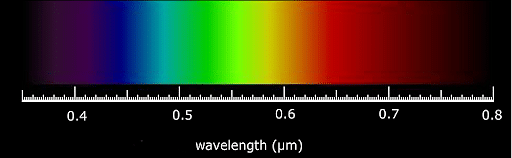
Photon Energy
Also check:
Formula of Photon Energy
[Click Here for Sample Questions]
The photon energy formula can be expressed in the way given below:
E = hf
- In addition, the frequency of the energy photon formula is c/ λ.
- Changing the value of 'f' in the equation above:
E = hc/ λ .... (2)
- E is the energy of a photon in Joules.
- λ is the wavelength of a photon in meters
- c is the speed of light in a vacuum, which is 3 x 10 meters per second, and h is the Planck constant, which is 6.626 10 kgm / s or J.s.
- At 1 Hz, the photon energy is equal to 6.626 x 10 J.
- Planck's constant is 4.14 x 10 eV.s.
Example of Formula of Photon EnergyExample: Determine the photon energy if the wavelength is 550nm. Ans: Given parameters are λ = 550nm c = 3×108×108m/s h = 6.626×10−34×10−34Js Photon energy formula is given by, E = hc / λ E = 6.626×10−34 ×3×108 / 550×10−9 E = 19.878 x 1028 / 550×10−9 |
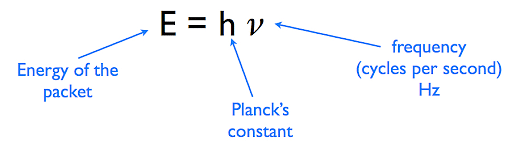
The Formula of Photon Energy
Energy of Photon Formula
[Click Here for Sample Questions]
On the basis of the photon energy formula, we observe that the energy of a photon depends on the following parameters:
- The energy of a photon is directly associated with the photon's electromagnetic frequency.
- It is based on wavelength in such a way that the energy of photons is inversely proportional to the wavelength.
- The higher the photon energy frequency, the more its energy.
- However, on the other hand, the longer the photon's wavelength, the lower its energy.
Photon Wavelength Formula
[Click Here for Sample Questions]
Photon depends upon the value of wavelength 'λ' or equivalently energy, 'E'. It can be expressed using any unit of energy. It is a massless quantity that travels at the speed of light in a vacuum.
- The idea was first proposed by Albert Einstein in 1905.
- It explains the properties of both waves and particles.
- The German physicist Max Planck also introduced the concept of photons while studying black-body radiation
- One can easily calculate the wavelength by knowing the frequency of the photon.
- It is calculated with the help of the equation λ=cν, where c is the speed of light and ν is the frequency.
Example of Photon Wavelength FormulaExample: If a photon has a frequency of 6×10¹²s−1 the wavelength is λ=3×10⁸ms/ 6×10¹²s−1 = 5×10⁻⁵ m=50 micrometres. |
Kinetic Energy of Photon Formula
[Click Here for Sample Questions]
We need the energy in order to help them come out of the metal, i.e., to lead the photoemission process, as we know that the electrons are tightly bonded to the metal.
- Therefore, the electrons that are released from the metal have some energy.
- The maximum kinetic energy of ejected electrons is given below:
KEe = hf - BE
- Here,
- E = the photon energy
- BE = binding energy/ the Work function of the electron, that is particular to the given material.
- KEe = kinetic energy (in Joules)
Also check:
| Related Concepts | ||
|---|---|---|
| Quantum Theory of Light | Electron Spin | Maxwell Equations |
| Wavelength Formula | Electromagnetic Waves MCQ | Types of Radiation |
Kinetic Energy vs Frequency Graph
[Click Here for Sample Questions]
A graph drawn between the required kinetic energy of electrons and the frequency of incident photons in a photoelectric effect is indicated by the ejected electron. The slope of the graph is equivalent to the plank’s constant.
- The frequency affects the electromagnetic radiation of materials.
- There is a threshold limit below which no electron is ejected.
- The threshold energy increases linearly with respect to the frequency of radiation.
hν=ϕ+Ek
- where ϕ is a constant and a property of the material.
Photon Applications
[Click Here for Sample Questions]
The applications of photons are as follows:
- Photons with an energy of roughly 4.1357 x 10 eV are released by an FM radio station transmitting at 100 MHz electromagnetic frequency.
- We know that this quantity of energy is approximately 8 to 10 times the mass of the electron or 9.1 x 10 kg.
- It is based on the mass-energy equivalency.
- Gamma rays are high-energy rays with photon energies of 100 GeV to over 1 PeV.
Things to Remember
- Photons are a combination of different electromagnetic energy, which includes microwaves, radio waves, and X-rays.
- Albert Einstein came up with the concept of the photon in the first place.
- Scientist Gilbert N. Lewis was the first to coin the term "photon" to characterize it.
- The wave-particle duality hypothesis claims that light behaves as a wave and a particle at the same time.
- In 1905, Einstein applied the discrete nature of light to explain the photoelectric effect.
Sample Questions
Ques: What is this photon's energy? (2 marks)
Ans: The velocity of photons is equivalent to the speed of light. Photons have no mass, but their energy is E = hf = hc/. Planck's constant is h = 6.626*10-34 Js in this case. The photon energy is inversely related to the electromagnetic wave's wavelength.
Ques: What purpose does photon energy serve? (2 marks)
Ans: Although photon energy (light energy as quantum energy) is more valuable than heat energy, most solar beams tend to convert to ambient heat. Solar beams' most efficient work will be done by using quantum characteristics of them, just as plants' photosynthetic processes do.
Ques: What is the mechanism by which a photon transports energy? (2 marks)
Ans: Despite its lack of bulk, light does carry energy via its motion. Because photons (light particles) have no mass, they must obey E = pc and derive their whole energy from their momentum. In the general equation, there is now an interesting additional impact.
Ques: Is a photon a particle or a wave? (2 marks)
Ans: Light is a particle (photon), and the passage of photons is a wave, according to Einstein. Einstein's light quantum theory's fundamental premise is that light's energy is proportional to its oscillation frequency.
Ques: Is it true that photons have spin? (2 marks)
Ans: Electrons and quarks (matter particles) can have spins of –1/2 or +1/2; photons (light particles) can have spins of –1 or +1, and Higgs bosons must have spins of 0. Particle spins, despite their small size, have a significant impact on our daily lives. We can make 3D movies thanks to photons' spin characteristics.
Ques: A sodium lamp emits yellow light with a frequency of 5.10∗1014 Hz. How much energy is contained in 1.5 mol of photons? h=6.63∗10−34 J⋅s? (3 marks)
Ans: The energy of a single photon is given by the equation:
E=hv
We are given the frequency and the value of the constant, allowing us to solve.
E= (6.63∗10−34 J⋅s) (5.10∗1014 Hz) =3.38∗10−19 J
The above gives the energy contained in one photon. Next, solve for the energy contained in 1.5mol using Avogadro's number:
(1.5mol∗6.022∗1023photons/1mol) x (3.38∗10−19J/1photon) = 3.1∗105J
Ques: What happens when a photon is created? (2 marks)
Ans: When an electron in a higher-than-normal orbit returns to its normal orbit, a photon is produced. During the transition from high to low energy, the electron emits a photon, which is a packet of energy with highly precise properties. Photons are generated when sodium atoms are energized by a sodium vapor light.
Ques: If the energy of a photon is 350×10−10 J, determine the wavelength of that photon? (3 marks)
Ans: Given parameters are,
E = 350×10−10J
c = 3×10⁸m/s
h = 6.626×10⁻³⁴Js
Photon energy formula is given by,
E = hc / λ
λ = hc / E
λ = 6.626×10−34×3×108 / 350×10−10
λ = 19.87 x 10⁻²⁸ / 350 x 10−10
λ = 0.056 x 10⁻¹⁶ m
Ques: Which Photons Have the Most Energy? (4 marks)
Ans: The formula clearly shows how the energy of a photon is affected by its frequency and wavelength. Let's take a look at each of the formulas above and see what they mean in terms of photon physics.
- For starters, because wavelength and frequency always multiply to equal a constant, if photon A has a frequency two times that of photon B, photon A's wavelength must be 1/2 of photon B's wavelength.
- Second, you can learn a lot about how a photon's frequency can give you a rough estimate of its energy.
- We know photon A is twice as energetic as photon B since it has a greater frequency.
- We can observe that energy scales directly with frequency in general.
- Similarly, because the energy of a photon is inversely proportional to its wavelength, photon A is more energetic than photon B if its wavelength is shorter.
Ques: What are the properties of photon? (3 marks)
Ans: The propertiesof photons are as follows:
- Photons can be generated and destroyed with minimal loss of energy or momentum.
- When EM waves are emitted by a source, photons are created, and when they come into contact with matter, they can be absorbed and their energy transferred.
- By shining light on a metal surface, it was demonstrated.
- If the frequency of the light is higher than the cut-off frequency fc, photoelectric electrons are produced; if the frequency of the light is lower than this cut-off frequency fc, no photoelectric electrons are generated.
- The wavelength of a photon is 0.377 um (377 nm). 3.2883eV photon energy.
Ques: Determine the photon energy if the wavelength is 450nm? (3 marks)
Ans: Given parameters are
λ = 450nm
c = 3×108×108m/s
h = 6.626×10−34×10−34Js
Photon energy formula is given by,
E = hc / λ
E = 6.626×10−34 ×3×108 / 450×10−9
E = 19.878 x 1028 / 450×10−9
For Latest Updates on Upcoming Board Exams, Click Here: https://t.me/class_10_12_board_updates
Check-Out:



Comments
Found 2 Comments
The formula for energy of photon is given as: E=h?
1 eV is equal to 1.6 x 10⁻¹⁹
E = 2 x 1.6 x 10-19
= E/h
= 2 x 1.6 x 10-19/6.626×10-34
= 4.826 x 10¹⁴ Hz
A significant momentum and energy value suggested that the light might be connected to a particle. This particle was called a photon. Although they lack mass, photons have a fixed quantity of energy. The wavelength of a photon determines its energy, which means photons with shorter wavelengths have more energy than those with longer wavelengths. Thus, a discrete bundle (or quantum) of electromagnetic (or light) energy is defined as a photon.
The speed of photons slows down in different mediums, such as air, water, and glass. The reason is that light scatters off the molecules responsible for the formation of different materials. The ratio by which the speed of light is slowed is called the refractive index of the medium. The photons themselves are not slowed down, but the medium through which they are travelling involves absorption by electrons and re-emission.
A photon's energy increases with its frequency. In a similar manner, a photon's energy decreases with wavelength. Any energy unit can be used to express photon energy. All photons will have exactly the same amount of energy.