



Education Journalist | Study Abroad Lead
Light is an electromagnetic radiation. If it had not been for light, we would not have been able to see the world around us. The human eye can only see a certain range of frequency of this electromagnetic radiation (about 390-700 nm). Light is a type of energy that, like all energies, comes from some sources which are known as light sources, responsible for producing the energy. In this article, we will discuss the definition, types, and sample questions of light sources.
| Table of Content |
Keyterms: Light, Radiation, Human eye, Electromagnetic radiation, Energy, Ultraviolet rays, Brain, Light sources, Rainbow, Light striking, Water droplets
Light
[Click Here for Sample Questions]
Light is an electromagnetic radiation that comes from a variety of sources known as light sources. It is a form of energy that may travel at high speed as a wavelength. The rainbow we see in the sky is a common example of light striking water droplets to split colors with distinct wavelengths, causing human eyes to interpret those different wavelengths of colors like a rainbow.
- The particles of light can emit radiation with a wavelength of roughly 390–700 nm, which is visible to the naked eye.
- Except for infrared and ultraviolet rays, the human eye can see practically all forms of light.
- The light recorded by our eyes is further processed by our brain, which converts the energy bandwidth into the color spectrum that our brain and eyes are sensitive to.
- Humans are also making artificial light in the modern world, which is the most appropriate source of electrical energy in the current world.
- Electrical light includes things like neon lights, light bulbs, and fluorescent tubes. Artificial light can also be seen in the form of lasers.
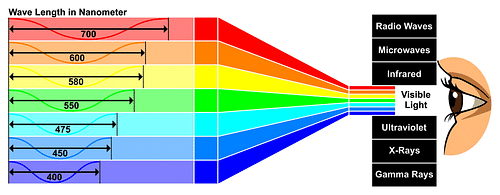
Light Spectrum
Also Read:
| Concepts Related to Ray Optics and Optical Instruments | ||
|---|---|---|
| Biconvex Lens | Telescope | Luminance |
| Snell’s Law Formula | NCERT Solutions of Light | Dispersion of Light |
| Refraction at spherical surfaces and lenses | Refraction through a prism | Transmission, Absorption and Reflection of Light |
Types of Light sources
[Click Here for Previous Year Questions]
Light sources are of multiple types and fall into various categories. They can be categorized as follows:
Natural Sources
Our universe has abundant light-emitting objects throughout it that release light naturally. The light from these natural sources reaches the surface of the earth in the following ways:
- The Sun is the primary source of light for our planet. As it undergoes the process of nuclear fusion, immense energy is produced at the center of the sun, which makes it seem like a gigantic ball of fire. This energy at the core of the sun is released in the form of heat or light. The sun's light is one of the most important contributing factors for the long-term viability of life on Earth.
- Stars emit light as well, but due to the vast distance between the stars and the Earth, only a small fraction of light emitted by the stars reaches us.
- The moon is also responsible for providing light, although it cannot do so on its own. The light we see from the moon comes from the sun, which it then reflects.
- Due to some chemical reactions within various organisms, some of them are also able to produce light. This phenomenon is known as bioluminescence. Some examples of the organisms that can emit light are glow-worm, jellyfish, fireflies, microorganisms, and some other deep-sea plants.
- Lightning and volcanic explosions are also some examples of natural events that emit light.
Artificial Sources
- Artificial light includes light produced by technological means that bear a resemblance to sunlight (natural light). For instance, bulbs and tube lights.
- Artificial lights were invented at the turn of the twentieth century and since then have been widely used. They can be seen all around our surroundings.
- People commonly use artificial light in a variety of settings, including their homes, businesses, and other public spaces. These are available in a wide range of shapes, sizes, colors, and even brightness levels.
The artificial light sources can further be categorized as:
Incandescent Sources
Some objects, when heated at high temperatures, emit both visible and infrared light. These light sources are known as incandescent sources.
- They are the most prevalent sources of light which include the sun, light bulbs, and fires.
- When atoms are heated, thermal vibrations are emitted in the form of electromagnetic radiation. Incandescent light sources contain these vibrations in the entire atom.
- Materials emit different amounts of energy depending on their temperature; for example, at low temperatures, photons emit radiation with an infrared wavelength.
- When a metal is heated, the atoms in the metal vibrate and generate photons, which emit radiations that are visible to the human eye by increasing the wavelength in the spectrum.
- The most prominent example of incandescent light is fire, which involves a chemical reaction that emits both gases and heat, leading the substance to achieve a high temperature and become incandescent (lighten up).
- Similarly, electric light bulbs generate heat when an electrical current runs through them, raising the cable's temperature and eventually giving rise to incandescent light.

Electric Bulbs as an incandescent light source
Luminescent Sources
Luminescent Sources produce light by accelerating charges inside them. One way of accelerating charges is by passing a current through the material.
- These sorts of sources differ from incandescent light sources in that they only involve electrons rather than the entire material vibrations, and they occur at normal or lower temperatures, making them different from incandescent light sources.
- In general, we may say that luminescence light occurs when electrons emit some of their energy in the form of electromagnetic radiation.
- When an electron's temperature decreases, the energy level also decreases, resulting in the production of a certain color of light.
- Neon lights, fluorescent lights, bioluminescence, fluorescence light, and other luminescent light sources are common examples.
- Fluorescence light is the most prevalent type of luminescent light source, which is further separated into two types: electroluminescent and photoluminescent, both of which can be found on computer displays and televisions. Bioluminescence, which includes animals such as fireflies, is the most prevalent type of luminescence.

Luminescent Souce of Light
Also Read:
Things to Remember
- Light is an electromagnetic radiation that comes from a variety of sources known as light sources, which can be described as the sources through which light (a type of energy) is created.
- Light is an energy form. It is essential for our existence because, without it, we would have to survive in the dark.
- We all know that the sun is the most natural source of light, but other sources of light include electric bulbs, candles, torches, kerosene lamps, and so on.
- There are mainly two types of light sources i.e. Natural Light Sources and Artificial Light Sources. The artificial sources are further categorized as Incandescent Sources and Luminescent Sources
- Except for infrared and ultraviolet rays, the human eye can see practically all forms of light. The light recorded by our eyes is further processed by our brain, which converts the energy bandwidth into the color spectrum that our brain and eyes are sensitive to.
Previous Year Questions
- When light is incident on a diffraction grating the zero-order … [KCET 2004]
- The width of the diffraction band varies … [KCET 2006]
- For a transparent medium relative permeability and permittivity … [NEET 2019]
- A transparent cube of 0.21m edges contains a small air bubble … [KCET 2006]
- Reflection of the point … [KCET 2017]
- For a normal eye, the cornea of the eye provides a converging power … [NEET 2013]
- Focal length of a convex lens of refractive index … [NEET 1988]
- Find the value of the angle of emergence from the prism … [NEET 2021]
- Assume that light of wavelength 600nm is coming from a star … [NEET 2020]
- An object is placed at a distance of 40 cm … [NEET 2018]
- A and B are two parallel-sided transparent slabs of refractive indices … [WBJEE 2016]
- A ray of light passes through four transparent media with refractive indices … [JEE Advanced 2001]
- A transparent slab of thickness dd has a refractive index n(z) … [JEE Advanced 2016]
- The angle of minimum deviation for an incident light ray on an equilateral prism … [KCET 2009]
- In refraction, light waves are bent on passing from one medium … [KCET 2021]
- Two plane wavefronts of light, one incident on a thin convex lens … [KEAM]
- For a crystal, the angle of diffraction … [BITSAT 2008]
Sample Questions
Ques. What do you mean by light sources? (2 marks)
Ans. Light comes from a variety of sources known as light sources, which can be described as the sources through which light, a type of energy, is created. Light is a form of energy that may travel as a wavelength at a high speed. A rainbow generated in the air is a common example of light striking water droplets to split colors with distinct wavelengths, causing human eyes to interpret those different wavelength colors like a rainbow.
Ques. What are different types of light sources? (2 marks)
Ans. There are two different types of light sources:-
- Natural sources
- Artificial sources
- Incandescent Sources
- Luminescent Sources
Ques. State the difference between natural light and artificial light. (3 marks)
Ans. The most significant distinction between natural and artificial light is that natural light is found in nature, whereas artificial light is electrical and created using advanced technology.
We have no control over natural light and over how it is used because it is based on the length of time, while we do have control over artificial light. The key consideration when employing artificial light is the amount of light produced. When artificial light is produced in smaller quantities, consumption is reduced as well.
Ques. Give examples of Luminescent sources. (2 marks)
Ans. Fluorescent light is the most prevalent type of luminescent light source, which is further separated into two types: electroluminescence and photoluminescence, both of which can be found on computer displays and televisions. Bioluminescence, which includes animals such as fireflies, is the most prevalent type of luminescence.
Ques. Define light. (2 marks)
Ans. Light is an electromagnetic radiation. The human eye can only see a certain frequency of this radiation (about 390-700 nm). Light is responsible for all we see around us. Light is a type of energy that like all energies, comes from some sources known as light sources.
Ques. Define bioluminescence. (3 marks)
Ans. A chemical process within a living organism produces bioluminescence, which is light. The ocean is home to the majority of bioluminescent species. Fish, bacteria, and jellyfish are among the bioluminescent marine animals. On land, bioluminescent creatures such as fireflies and mushrooms can be found.
Ques. What are gas discharge sources of light? (2 marks)
Ans. Light can also be produced by passing electricity through specific gases at very low pressure. Neon lamps and Sodium lamps are two examples.
Ques. What Does "Unpolarized Light" Mean? (2 marks)
Ans. A light wave that vibrates in more than one plane is known as unpolarized light. Light waves having vibrations that occur in a single plane are referred to as polarised light waves. Polarisation is the process through which the transformation of unpolarized light into polarized light is done.
Ques. What are incandescent light sources? (5 marks)
Ans. Some objects, when heated at high temperatures, emit both visible and infrared light. These light sources are known as incandescent sources.
- They are the most prevalent sources of light which include the sun, light bulbs, and fires.
- Materials emit different amounts of energy depending on their temperature; for example, at low temperatures, photons emit radiation with an infrared wavelength.
- The most prominent example of incandescent light is fire, which involves a chemical reaction that emits both gases and heat, leading the substance to achieve a high temperature and become incandescent (lighten up).
- Similarly, electric light bulbs generate heat when an electrical current runs through them, raising the cable's temperature and eventually giving rise to incandescent light.
For Latest Updates on Upcoming Board Exams, Click Here: https://t.me/class_10_12_board_updates
Check-Out:



Comments