



Exams Prep Master
Phylum Aschelminthes is commonly referred to as roundworms. They get their name from the fact that their bodies appear circular in a transverse cross-section. There are approximately 15000 different types of roundworms. Aschelminthes are pseudocoelomate, bilaterally symmetrical, triploblastic, unsegmented, vermiform organisms with complete digestive tubes. They are commonly found in soil and they feed on bacteria. These can also be found in the human intestine and can cause a disease called ascariasis. They can be microscopic or more than a metre in length. Aschelminthes have a complete digestive system with a mouth, intestines and anus, but they do not have a respiratory or circulatory system. The sexes in them are separate i.e., they are dioecious and they do not perform asexual reproduction.
Key takeaways: Phylum Aschelminthes, Characteristics, Classes, Examples
Characteristics of Aschelminthes Phylum
[Click Here for Sample Questions]
Following are some of the general characteristics of phylum Aschelminthes:

Habitat: Many roundworms are parasites that live in plants and animals. They are a major source of agricultural, veterinary, and human health issues. Roundworms are also free-living organisms that can be found in freshwater, salt water, and soil.
Body Form: They are called round worms because their cross section appears circular. They're not segmented.
Body wall: It is made up of three layers: a firm, nonliving resistant cuticle, a syncytial epidermis (a continuous layer of cytoplasm with scattered nuclei), and a muscle layer.
Body cavity: As the embryo's blastocoel develops, the body cavity is known as a pseudocoel or pseudocoelom. The pseudocoelomic fluid fills Pseudocoel.
Digestive Tract: The alimentary canal includes a muscular pharynx.
Skeleton, respiratory, and circulatory system: The presence of pseudocoelomic fluid in the pseudocoelom maintains body shape and forms the hydro skeleton. In aerobic respiration, gas exchange occurs via diffusion across the body surface. Materials are transported by the pseudocoelomic fluid.
Excretory System: The excretory system is made up of gland cells, canals, or both. Ascaris has a 'H' shaped excretory system of canals and a complicated "giant cell" called "renette cell." The main excretory matter is ammonia. Ascaris, on the other hand, excretes urea.
Nervous System: It is made up of a circumpharyngeal ring that gives rise to nerves both forward and backward.
Sense Organs: (i)Papillae occur on the lips, on the sides of the anterior end in both male and female, and in front and behind the cloacal aperture. All papillae have a tactile function.
(ii) Amphids (pits) are Chemoreceptors, found on the lips.
(iii) Phasmids are glandulosensory unicellular glands found on the lateral sides of the posterior end.
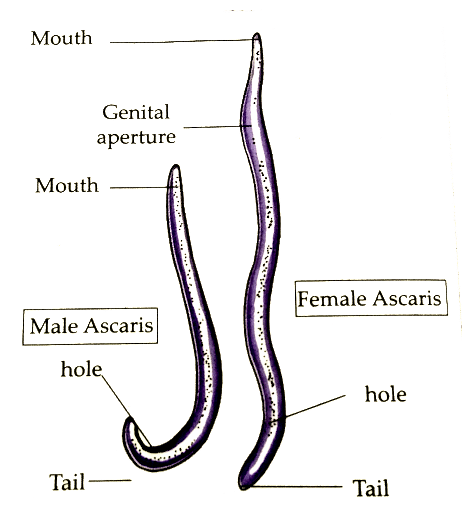
Sexes: Sexes are divorcing (dioecious). In general, they exhibit sexual dimorphism, with females frequently being longer than males. Development: Development can take place in either direct or indirect manner. A larva is present during indirect development. Ancylostoma (hookworm) has filariform larvae, Wuchereria (filarial worm) has microfilaria larvae, and Ascaris and Enterobius have rhabditiform larvae (pinworm).
Also Check:
Unique Features
[Click Here for Sample Questions]
- Syncytial epidermis,
- Muscle layer of body wall consists of longitudinal fibres only,
- Pseudocoel
Advantage over Flatworms
[Click Here for Sample Questions]
- Pseudocoel is a pseudonym.
- The entire digestive tract,
- The condition is unisexual.
Classification of Aschelminthes Phylum
[Click Here for Sample Questions]
Aschelminthes is divided into two classes: Aphasmidia and Phasmidia.
Aphasmidia (Class 1):
- Phasmids are not present.
- Amphids come in a variety of shapes and sizes. Examples include Trichinella (Trichina worm), Trichuris (Whipworm), and others.
Phasmidia (class 2):
- Phasmids are found towards the body's end.
- Amphids can be found near the anterior end. Ascaris (Giant intestinal roundworm), Enterobius (Pm worm), Ancylostoma (Hookworm), Wuchereria (Filarial worm), are some examples.
Examples Of Phylum Aschelminthes
[Click Here for Sample Questions]
Rhabditis:
This genus contains both free-living and semi-parasitic species. Rhabditis maupasi is found in soil. The male has a copulatory bursa at the back of his body.
Ascaris lumbricoides (Giant Intestinal Roundworm.)
Ascaris lumbricoides is a human endoparasite of the small intestine. It is more prevalent in children. Adult worms live for about a year to two years. This parasite has no secondary hosts in its life cycle.
Ascaris' mouth is surrounded by three lips: one dorsal and two ventrolateral. The dorsal lip has two double papillae, while the ventrolateral lips each have one double papilla, one simple lateral papilla, and an amphid. Papillae respond to touch.
Ascaris causes ascariasis where a large number of adult Ascaris worms infest a single host, they obstruct the intestinal passage and cause abdominal discomfort, such as colic pain. In addition, the patient may experience impaired digestion, diarrhea, and vomiting.
Hookworm (Ancylostoma duodenale):
It is found as an endoparasite in the small intestine of human beings. There is no need for an intermediary host. Its larvae enter the human body through the skin of the feet by boring through moist soil. It causes ancylostomiasis.
Filaria (Wuchereria) — The Filarial Worm:
Adult Wuchereria bancrofti is an endoparasite that lives in human lymphatic vessels and lymph nodes (primary host). It spreads through mosquitoes (specifically Culex species) and as a result, its life cycle is digenetic, and it is viviparous.
The Pinworm, Enterobius:
Enterobius vermicularis (vem- "Chunna") is a parasite found in the human caecum, colon, or vermiform appendix. It has a monogenetic life cycle.
Trichinella—Trichina worm:
Adult Trichinella spiralis is found in the small intestines of humans and some other mammals such as pigs, domestic animals, and rodents, but its encysted larvae are found in the host's striated muscles. It is of viviparous species. Trichinella spiralis causes Trichinellosis.
The Guinea worm, Dracunculus:
Dracunculus medinensis is found in human subcutaneous tissue. When the host is exposed to cold water, the female worm found beneath the skin releases larvae into the water.
The larvae infiltrate the body of Cyclops, a freshwater crustacean and when any human being consumes an infected Cyclops with water, the larvae escape from the Cyclops and enter the human intestine. It causes dracunculiasis.
The Whip Worm, Trichuris:
Trichuris trichiura is named after its whip-like shape. It lives in human caecum, appendix, and colon, particularly in children.
The Eye Worm: Loa-loa
Loa loa lives in human and baboons' (large monkeys found in Africa and Southern Asia with a dog-like face) subdermal connective tissue. Humans become infected after being bitten by an infected deer fly chrysops. Loa loa causes loiasis, a disease characterised by subcutaneous swelling (called calabar swelling) primarily around the eyes. This parasite can cause conjunctivitis in the eye.
Things to Remember
[Click Here for Sample Questions]
- They are either free-living or parasitic. They live in soil, freshwater, and as parasites on plants, animals, and even humans. Ascaris is found in the human intestine as an endoparasite.
- The body is triploblastic and bilaterally symmetrical.
- The body is unsegmented, long, slender and tapering at the end. There is no evidence of metameric segmentation.
- Males are generally smaller than females because they are dioecious.
- Their bodies are organised on an organ-system level.
- Their digestive system includes the entire alimentary canal as well as the muscular pharynx. In Ascaris, the rectum opens into the anus in females and the cloaca in males, both of which are located posteriorly.
- Because the respiratory system is absent, gaseous exchange takes place through the body's surface.
Sample Questions
Ques: Give two examples of the phylum Aschelminthes. (2 marks)
Ans: 1. Ascaris
It is a very common endoparasite in the human small intestine and is commonly referred to as a roundworm. It affects children more than adults. Their skin is made up of syncytial epidermis. They have a cuticle that is resistant to the host's digestive enzymes. Its body wall consists of the following layers:
- Keratin makes up the cortex. It's immune to enzymes.
- The matrix is found beneath the cortex.
Ques: What is Medinensis Dracunculus? (2 marks)
Ans: It is commonly referred to as guinea worm. It is found in man's subcutaneous tissue. The parasite's toxic secretions cause blisters on the host's skin. It is a parasitic digenetic organism. The primary host is the human, and the intermediate host is the cyclops. Sexes are distinct as females are taller than male. Itching, diarrhoea, nausea, and vomiting are all symptoms of the parasite.
Ques: Write a short note on Filariasis and Enterobiasis. (2 marks)
Ans: Filariasis is a parasitic infection caused by roundworms. Wuchereria bancrofti, Brugia timori, and Brugia malayi cause lymphatic filariasis. It causes the skin and tissues beneath the skin to thicken.
Subcutaneous filariasis is caused by Loa loa. It infects the eyes and the skin.
The pinworm Enterobius vermicularis causes enterobiasis. It causes itching in the anal area and makes sleeping difficult.
Ques: Write a note on Habitat, body form and body wall of Phylum Aschelminthes. (3 marks)
Ans: Habitat: Many roundworms are parasites that live in plants and animals. They are a major source of agricultural, veterinary, and human health issues. Roundworms are also free-living organisms that can be found in freshwater, salt water, and soil.
Body Form: They are called round worms because their cross section appears circular. They're not segmented.
Body wall: It is made up of three layers: a firm, nonliving resistant cuticle, a syncytial epidermis (a continuous layer of cytoplasm with scattered nuclei), and a muscle layer.
Ques: Explain about the excretory system of Phylum Aschelminthes. (2 marks)
Ans: The excretory system is made up of gland cells, canals, or both. Ascaris has a 'H' shaped excretory system of canals and a complicated "giant cell" called "renette cell." The main excretory matter is ammonia. Ascaris, on the other hand, excretes urea.
Ques: Explain the development of Aschelminthes. (2 marks)
Ans: Development can take place in either a direct or indirect manner. A larva is present during indirect development. Ancylostoma (hookworm) has filariform larvae, Wuchereria (filarial worm) has microfilaria larvae, and Ascaris and Enterobius have rhabditiform larvae (pinworm).
Ques: Write a short note on Guinea worms. (3 marks)
Ans: Dracunculus medinensis is found in human subcutaneous tissue. When the host is exposed to cold water, the female worm found beneath the skin releases larvae into the water.
The larvae infiltrate the body of Cyclops, a freshwater crustacean that serves as the guinea worm's intermediate host. When an infected Cyclops is consumed with water, the larvae escape from the Cyclops and enter the human intestine. This worm's disease is known as dracunculiasis.



Comments