



Education Journalist | Study Abroad Lead
Polar compounds are referred to the chemical compounds that are held together by polar covalent bonds, with distinctive regions of positive and negative charge. A polar compound consists of more than one type of atom that are held together by a covalent bond. The covalent bond is essentially polar in nature. This only occurs when the two atoms differ in their electronegativity, or capability to attract a shared electron towards itself. The polar nature of a compound is determined by various factors like the shape and polarity of the bond.
The heteronuclear molecules are also polar compounds because the electronegative atom attracts the electron pair towards them making them polar in nature. This polarity causes molecules to develop dipole moment.
Key Terms: polar compound, ionic compound, polarity, dipole moment, electronegativity, ethanol, polarity of water, covalent bond.
What are polar compounds?
[Click Here for Sample Questions]
Polar compounds are two atoms having differences in charges, i.e., positive and negative, are bonded together by a covalent bond. The term ‘polar compound’ refers to the chemical compound containing two or more atoms bonded by a covalent bond that is polar in nature due to unequal electron sharing.
No compound is 100% ionic or covalent in nature. For example, even two hydrogen bonds, combined by a covalent bond, possess some ionic charge on them. Dipole moment refers to the product of the magnitude of charge and distance between the separation of charges. It is expressed in Debye.
Mathematically, it is expressed as
Μ = q x d
Formation of polar compound
[Click Here for Sample Questions]
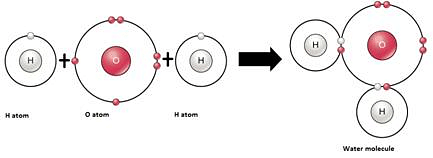
Formation of a polar molecule
When two atoms are bonded by a covalent bond, the electronegativity difference of the bonded atom causes the bond pair of electrons to shift closer to the more electronegative atom. This is due to the fact that partial positive charge accumulates at the location of the more electropositive atom and partial negative charge accumulates at the location of a more electronegative atom.
Differences in polar and ionic compounds
[Click Here for Sample Questions]
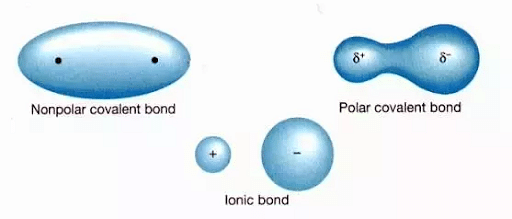
Polar covalent bond and ionic bond
- Polar compounds, however, are not the same ionic compounds because polar compounds share a covalent bond and the latter has the transfer of ions.
- The ionic compounds are held together by electrostatic forces which exist between the ions. This results when one atom loses an electron to form a cation and the other atom gains an atom to form an anion.
- In polar compounds, the two chemical species share the electron pair. The electron pair is shared in an unequal manner due to the electronegativity due to the two chemically bonded species.
Determination of polarity of molecules
[Click Here for Sample Questions]
The polarity of a bond is determined by –
- Determining the shape or geometry of molecules
- Determining the polarity of bonds in the molecule.
If the molecule is bent and trigonal pyramid in shape then it is always polar in character.
- When the electronegativity difference is less than or equal to 0.4, then the compound is said to be non-polar.
- When the electronegativity difference is between 0.5 to 1.7, the compound is said to be polar.
Examples of polar compounds
[Click Here for Sample Questions]
-
Water (H2O )

Partial positive and negative charge on water molecular
Water is a polar compound because there is formation of a covalent bond between hydrogen and oxygen, which results in its polar character.
The electronegativity of oxygen is more than that of hydrogen hence it has the power to attract the bond pair of electrons toward itself strongly, making hydrogen electropositive in nature. The bond polarity occurs due to the electronegative differences between hydrogen and oxygen.
A partial positive charge is developed on hydrogen and a partial negative charge is developed on oxygen.
- Hydrogen Fluoride (HF)

Partial positive and negative charge of HF molecule
Hydrogen Fluoride is a colorless gas or liquid which has a chemical formula HF. It is a polar molecule with a dipole-dipole force. The polarity is due to the covalent bond formed between them. The electron generally shifts towards more electronegative elements and since fluorine is more electronegative than hydrogen, it pulls the electron bond towards itself strongly.
It, therefore, develops a partial negative charge on Fluorine and a partial positive charge is developed on hydrogen.
- Ethanol (CH3OH)
Ethanol is an organic compound that is commonly known as simple alcohol. It is a flammable, volatile, and colorless liquid with a pungent taste and wine-like odor.

Polar covalent bond in ethanol molecule
The polar covalent bond occurs between terminal carbon and the hydroxyl group. In this oxygen-carbon bond, which is polar in nature, Oxygen is more electronegative than a carbon atom. As a result, the bond shifts to the electronegative oxygen, and a partial negative charge is developed on it. In this process, carbon acquires a positive charge on it.
Things To Remember
- Polar compounds are held together by polar covalent bonds, where a distinctive negative and positive charge is present on both the atoms forming the compound.
- Dipole moment is formed due to the polarity in the compound. It refers to the product of the magnitude of charge and the separation distance between them.
- In polar compounds, an unequal charge distribution is there, where the positively charged atom has less attractive power than the negatively charged atom. But, in ionic compounds, an equal distribution of charge is enjoyed by both the joining atoms.
- If the electronegativity is less than or equal to 0.4, it is called non-polar. It is polar if the electronegativity difference is between 0.5 to 1.7.
Sample Questions
Ques. What are polar compounds? Give examples. (2 marks)
Ans: Polar compounds are chemical compounds held together by polar covalent bonds, with a distinctive negative and positive charge cloud.
Some examples of polar compounds are water, hydrogen sulfide, and ethanol.
Ques. How can you determine the polarity of a compound? ( 4 marks)
Ans: One can determine the polarity of the compound by –
- Determining the shape of shape or geometry of the compound
- Determining the polarity of the compound
Also, if a molecule is bent and trigonal pyramid in shape then it is always polar in character.
The compound is said to be polar if the electronegativity difference is between 0.5 to 1.7.
The compound is said to be non-polar if the electronegativity difference is less than or equal to 0.4.
Ques. What is a dipole moment? (2 marks)
Ans: Dipole moment refers to the product of the magnitude of charge and distance between the separation of charges.
It is expressed in Debye. The mathematical formula is expressed as -
μ = q x d
Ques. Br2 is Polar or Nonpolar. Explain. (2 marks)
Ans: The Bromine molecule is nonpolar in nature. This is because bromine atoms have the same electronegativity in the molecules, thereby, both the atoms have the same distribution of charge and this contributes to a net-zero dipole moment.
Ques. Although CH2Cl is polar, why is CCl4 non-polar? (2 marks)
Ans: The carbon in the carbon tetrachloride (CCl4) bonds is polar, but its molecule is nonpolar in nature. This is only due to the fact that symmetric tetrahedral form cancels the polarity of the bond. The symmetry is broken only when some other atoms replace some of the atoms of Cl and that is when the molecule becomes polar.
Ques. Is IF3 Polar or is it Non-polar? ( 3 marks)
Ans: IF3 is a polar molecule in nature due to the difference in electronegativity between I & F atoms. The electronegativity of I is 2.5 & F electronegativity values at 4.0, hence the electronegativity difference between I and F is (4.0- 2.5) or 1.5.
As we know that a molecule is polar in nature if the electronegativity lies between 0.5-1.7 and the electronegativity between I and F is found to be 1.5 so it is polar in nature.
Ques. Why are molecules having perfect tetrahedral shapes nonpolar in nature? (2 marks)
Ans: The tetrahedral shape is seen when sp3 hybridization is achieved. The orbitals have the same energy and are called degenerate orbitals. All of the tetrahedral molecules have no nonbonding electron pairs and all bond angles are identical.
An example is a methane (CH4) molecule.
Ques. What is the difference between polar and nonpolar compounds? (ICSE SAMPLE PAPER) (5 marks)
Ans: Polar compounds refer to the formation formed due between two atoms of different elements. The pair of electrons are not shared equally but are drawn towards the more electronegative center. The atom with higher electronegativity develops a slight negative charge and the other one develops a slight positive charge. Example – HCL AND HF
Non-polar compounds refer to the formation of a compound due to the covalent bonds. The electrons are mutually shared by each other and as a result, no electronegativity or electro positivity is seen. Example- Cl2, Br2
Ques. Are polar covalent compounds good conductors of electricity? Why? (3 marks)
Ans: Polar covalent compounds are unable to conduct electricity in their natural form.
However, when they are dissolved in water, they become capable of conducting water and it is only because the electrons become free to conduct electricity.
Ques. Why is hydrogen peroxide a polar molecule? (3 marks)
Read Also:



Comments