



Content Curator
Physical properties of water are associated with appearance of water including color, turbidity, temperature, taste, and odor. Water is a colourless and odourless compound. It exists in three forms — as liquid form at room temperature, as ice at low temperatures, and as gas (water vapours) at very high temperatures. And about 65% of the human body is composed of water. It is irrefutably essential for the core sustainable development of humankind.
Read Also: Specific Heat of Water
| Table of Content |
Key Terms: Polarity, solvency, autoprotolysis, H2O, 1 gm/cc, chemical properties, redox reactions, freezing points
Properties of Water
[Click Here for Sample Questions]
A major part of earth is covered with water. It is universally liquid and will find a use in 99% of life’s functions. We require water for almost everything, for example - drinking, bathing, cooking etc. Its unique ability to be so multifaceted and ubiquitous is due to some of its very impressive properties. Under standard conditions, water is primarily in liquid state, unlike other analogous hydrides of the oxygen family, which are customarily gaseous. This unique property of water is due to hydrogen bonding.
Did You Know?
|
Check Important Notes for Properties of Matter
Physical Properties of Water
[Click Here for Sample Questions]
- Appearance: Water is a colourless, odourless and tasteless liquid in its natural state. The crystal structure of water is hexagonal.
- Density: The density of water is about 1 gm/cc and it varies with temperature in an undefined pattern. In solid state, the density remains close to 0.9gm/cc.
- Viscosity: Viscosity is explained by the resistance to deformation at a given rate. In other words, the thickness of the liquid - eg, syrup or water. Viscosity of water is 0.89 cP.

- Boiling Point: The temperature at which the vapour pressure of the liquid is equal to the pressure surrounding the liquid, thus changing the liquid to vapour, is known as boiling point. The boiling point of water is known to be 100°C.
- Freezing Point: The temperature at which the substance changes state from liquid to solid is called freezing point. The freezing point of water is 0°C or 32°F.
Also Read:
Chemical Properties Of Water
[Click Here for Sample Questions]
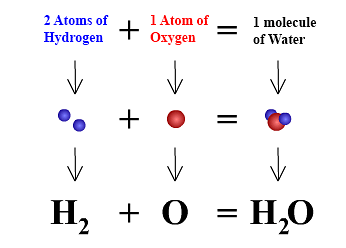
- Chemical Formula: Water is a chemical substance with a chemical formula H2O, one molecule of water and two hydrogen atoms covalently bonded to a single oxygen atom.
- Amphoteric Nature: A chemical that can act as both an acid and a base is known as amphoteric. Water is neither acidic nor basic, although it performs both functions. This is owing to its ability to contribute as well as absorb protons. It works as a base for acids that are stronger than water. It also functions as an acid against bases that are stronger than it. The following reaction shows water’s amphoteric nature.
Read More: Hydrogen Bonding

- Reaction of Hydrolysis: Water has a relatively high dielectric constant. As a result, it has a powerful moisturising effect. Water reacts strongly with salt ions, forming hydrated shells around them.
SiCl4 + 2H2O → SiO2 + 4HCl
- Redox Reactions: Because it can be reduced by reacting with highly electropositive metals like Sodium, water is an excellent source of dihydrogen.
H2O + Na → 2NaOH + H2
- Solvency of Water: The universal solvent is characterised as water. This is due to its chemical and physical properties, as well as its high dielectric constant, making it the most soluble substance. Because hydrogen and oxygen have positive and negative charges, they can attract other molecules of compounds, destroying their molecular forces and allowing them to disintegrate and dissolve.
Also Check:
Things to Remember
[Click Here for Sample Questions]
- Water is the only substance to exist in all three states of matter – liquid, solid and gas.
- The density of water is about 1 gm/cc and it varies with temperature in an unusual pattern.
- The chemical formula of water is H2O. It is formed by the covalent bond of hydrogen and oxygen atoms.
- Water can act as both acid and base, which means that it is amphoteric in nature.
- Water has a very strong hydrating tendency due to its dielectric constant. It dissolves many ionic compounds.
Read Further: Hydrogen Bonding
Sample Questions
Ques. What is the structure of water? (3 marks)
Ans. One oxygen atom is linked to two distinct hydrogen atoms in this basic molecule. The bonds present are polar due to the oxygen atom's strong electronegativity (the tendency of an element to attract bonding electrons towards itself). The shared pair of electrons is attracted to oxygen atoms more strongly than hydrogen atoms, resulting in dipole formation (pair of opposite charges).
Ques. How is a water molecule formed? 3 marks)
Ans. The chemical link between hydrogen and oxygen forms a water molecule. The best example of a polar covalent bond is water. The chemical link in which electrons share the atoms unequally. Every water molecule forms a covalent link with two hydrogen atoms and one oxygen atom, resulting in the following reaction:
H2O = H2 + O2
Ques. Discuss the physical properties of water in brief. 3 marks)
Ans. Hydrogen bonds exist between water molecules. Water has a density of 0.99 g/ml at 4 degrees Celsius. Water has a melting point of 0°C and a boiling point of 100°C. Solids, liquids, and gases are the three phases or states in which water can exist.Water is known as a universal solvent because of its polar nature, which allows it to dissolve practically any substance.
Ques. Explain the autoprotolysis property of water. (2 marks)
Ans. Autoprotolysis of water is a chemical reaction in which 2 water molecules react to produce a hydroxide ion (OH-) and an hydronium ion (H3O+). Autoprotolysis of water indicates its amphoteric nature, ie., its ability to act as both an acid and base.
Ques. Which of the following are properties of water? (2 marks)
Ans.
- I. It has a permanent dipole moment attributed to its molecular structure.
- It is a very good conductor of electricity.
- III. It has its polar covalent bonds with hydrogen on opposite sides of the oxygen atom so that the molecule is linear.
- I only
- II only
- Both I and II
- Both II and III
The correct answer is “a”.
Ques. State 3 unique properties of water. (3 marks)
Ans.
- Polar molecule: Water molecules have a polar structure, with partial positive charges on hydrogens and partial negative charges on oxygen, as well as a bent overall shape. This is because oxygen is more electronegative than hydrogen, which means it attracts electrons better.
- Cohesive and adhesive properties: Because of their ability to establish hydrogen bonds with one another, water molecules exhibit high cohesive forces. Surface tension, or the tendency of a liquid's surface to resist rupture while under tension or stress, is caused by cohesive forces. Water also possesses adhesive characteristics, allowing it to adhere to objects other than itself.
- Universal solvent: Water has the uncanny ability to dissolve a wide range of polar and ionic compounds. This is crucial to all living things because water brings many valuable nutrients with it as it goes through the water cycle!
Ques. What do you understand about the hardness of water? (2 marks)
Ans. Water can dissolve numerous compounds in it. As the compounds get dissolved, it changes some of the properties of water, making it ‘hard’ and ‘soft.’ The dissolution of calcium and magnesium salts in water leads to hydrogen carbonate, chloride, and sulphate, which eventually makes the water ‘hard.’ Hard water doesn’t give lather with soap.
Ques. Is demineralised or distilled water useful for drinking purposes? If not, how can it be made useful? (2 marks)
Ans. Water is the core essential of our existence. It consists of numerous dissolved nutrients that are required for us as well as plants and animals to survive. Demineralized water is free from all soluble minerals and so it cannot be consumed for drinking purposes. Only after adding desired minerals in specific amounts required for growth can water become fit for consumption.
Chemistry Related Links:



Comments