



Content Curator
Rational numbers include the Integers as exponents, whole numbers, and natural numbers. Numbers that may be expressed as fractions are known as rational numbers. They may all be expressed as p/q rational numbers, terminating decimal numbers, or non-terminating but recurring decimal numbers. The general characteristics of rational numbers include associative, commutative, distributive, and closure features.
| Table of Content |
Key Takeaways: Integers, Closure Property, Commutative Property, Associative Property, Distributive Property, Additive Property, Multiplicative Property
Also read: Calculus Formula
Properties of Rational Numbers
[Click Here for Sample Questions]
When numbers are represented in the form p/q, they are called rational numbers since both p and q are integers and q is less than zero. Rational numbers have six qualities, which are mentioned below:
- Closure Property
- Commutative Property
- Associative Property
- Distributive Property
- Multiplicative Property
- Additive Property
Closure Property of Rational Numbers
In all three cases, the Closure Property of rational numbers states that any two rational numbers added, subtracted, or multiplied will give a rational number.
Addition of Rational Numbers Under the Closure Property
The outcome of adding two Rational Numbers, such as 'a' and 'b,' is likewise a Rational Number, according to the closure property, hence a + b is also a Rational Number.
We have two numbers, 1/2 and 3/4.
Let's assume a = 1/2 and b = 3/4.
On these two integers, we will now do the mathematical operation of addition.
a + b = 1/2 + 3/4 = (1*2 + 3*1)/4 = 5/4, which is also a Rational Number.
Subtraction of Rational Numbers Under the Closure Property
The result of subtracting two Rational Numbers, such as 'a' and 'b,' is likewise a Rational Number, according to the closure property, hence a - b is also a Rational Number.
We have two numbers, 1/2 and 3/4.
Let us assume a = 1/2 and b = 3/4.
On these two integers, we will now do the mathematical operation of subtraction.
a - b = 1/2 - 3/4 = (1*2 - 3*1)/4 = -1/4, which is also a Rational Number.
Multiplication of Rational Numbers Under the Closure Property
The outcome of multiplying two Rational Numbers, such as 'a' and 'b,' is likewise a Rational Number, according to the closure property, hence a * b is also a Rational Number.
We have two numbers, 1/2 and 3/4.
Let us assume a = 1/2 and b = 3/4.
On these two integers, we will now conduct the mathematical operation of multiplication.
a * b = 1/2 * 3/4 = 3/8, which is also a Rational Number.
Division of Rational Numbers Under the Closure Property
4/3 = 1/3 x 1/4. The result is 4/3, which is a Decimal Expansion of Rational Numbers in this case. However, we see that a 0 is not defined for any rational integer a. As a result, rational numbers are not closed when divided. If we leave zero out, however, the collection of all other rational numbers is closed under division.
Commutative Property of Rational Numbers
The commutative property of rational numbers includes addition, subtraction, multiplication, and division.
Commutative Law of Addition
For two Rational Numbers, say 'a' and 'b,' the commutative law of addition states that a + b = b + a.
We have two numbers, 2/5 and 7/6.
Let's assume a = 2/5 and b = 7/6.
LHS
a + b = 2/5 + 7/6 = (2*6 + 7*5)/30 = (12 + 35)/30 = 47/30
RHS
b + a = 7/6 + 2/5 = (7*5 + 2*6)/30 = (35 + 12)/30 = 47/30
LHS = RHS
Commutative Law of Subtraction
1/3 - 1/4 ≠ 1/4 - 1/3 = 1/12 ≠ -1/12.Subtraction is not commutative for rational numbers, as you shall see. That is, a - b ≠ b - a for any two rational integers a and b.
Commutative Law of Multiplication
For two Rational Numbers, say 'a' and 'b,' the commutative property of multiplication states that a * b = b * a.
We have two numbers, 2/5 and 7/6.
Let us assume a = 2/5 and b = 7/6.
LHS
a * b = 2/5 * 7/6 = 14/30 = 7/15
RHS
b * a = 7/6 * 2/5 = 14/30 = 7/15
LHS = RHS
Commutative Law of Division
1/3 ÷ 1/4 ≠ 1/4 ÷ 1/3 = 4/3 ≠ 3/4. You'll notice that the expressions on both sides aren't identical. In general, for any two rational integers a and b, a b ≠ b a. As a result, division for rational numbers is not commutative.
Associative Property of Rational Numbers
The Associative Property of rational numbers states that when any three rational numbers are added or multiplied, the result remains the same regardless of how they are grouped.
Associative Property of Rational Numbers for Addition
The associative property for addition is given for any three rational integers as A, B, and C, (A + B) + C = A + (B + C). For example, (1/3 + 1/4) + 1/2 = 1/4 + (1/3 + 1/2) = 13/12. For rational numbers, we say that addition is associative.
Associative Property of Rational Numbers for Subtraction
The associative condition for subtraction for any three rational numbers is A, B, and C, (A - B) - C ≠ A - (B-C). For example, (1/3 - 1/4) - 1/2 ≠ 1/3 - (1/4 - 1/2) = 1/24 ≠ 1/12. Subtraction is not associative for rational numbers, as you shall see.
Associative Property of Rational Numbers for Multiplication
The associative property for multiplication is provided for any three rational integers as A, B, and C, (A × B) × C = A × (B × C). For rational numbers, you'll see that multiplication is associative.
Associative Property of Rational Numbers for Division
If three rational numbers are given, For division, the associative property is given as A, B, and C, (A ÷ B) ÷ C ≠ A ÷ (B ÷ C). You'll notice that the expressions on both sides aren't identical. For rational numbers, the division is not associative.
Distributive Property of Rational Numbers
Any equation containing three rational numbers A, B, and C, given in the form A (B + C), is resolved as A (B + C) = AB + AC or A (B – C) = AB – AC. Multiplication distributivity over addition or subtraction is another name for this property.
Additive Property of Rational Numbers
Additive identity and additive inverse are the two primary additive characteristics of rational numbers. The link between additive identity and any rational integer a/b, b≠0.
Additive Identity
According to the additive identity feature of rational numbers, the sum of any rational number (a/b) and zero equals the rational number itself. Assuming that a/b is any rational integer, a/b + 0 = 0 + a/b = a/b.
Additive Inverse
If a/b is a rational number, the additive inverse property asserts that there exists a rational number (-a/b) such that a/b + (-a/b) = (-a/b) + a/b = 0.
Multiplicative Property of Rational Numbers
The multiplicative identity and multiplicative inverse are the two main multiplicative characteristics of rational numbers.
Multiplicative Identity
The additive identity characteristic of rational numbers asserts that any rational number multiplied by 1 equals the rational number. For rational integers given in a/b form, 1 is the multiplicative identity. If a/b is any rational number, then a/b × 1 = 1 × a/b = a/b.
Multiplicative Inverse
The multiplicative inverse property of rational numbers asserts that there exists a rational number b/a such that a/b b/a = 1. In this situation, the multiplicative inverse of a rational number a/b is the rational number b/a.
Also read: Isosceles Triangle Theorems
Points to Remember
Following are some important points:
- When a rational number is multiplied by 0 it equals 0. If a/b is any rational number, then a/b × 0 = 0 × a/b = 0.
- When a rational number's numerator and denominator are divided by a common divisor, the rational number stays unchanged.
- If we multiply the numerator and denominator with the same integer, the rational number remains unchanged.
- The additive identity for rational numbers is the rational number '0,' i.e. x/y + 0 = x/y.
- The multiplicative identity for rational numbers is 1, which means that x/y 1 = x/y.
Also read: First Order Differential Equation
Sample Questions
Ques: Solve this with associative property 1/2 + (1/4 + 2/3) = (1/2 + 1/4) + ?. (2 Marks)
Ans: 17/12 = 17/12
And in case of multiplication:
1/2 x (1/4 x 2/3) = (1/2 x 1/4) x 2/3
⇒ 2/24 = 2/24
⇒1/12 = 1/12
Ques: Help Jack in solving 7/2(1/6 + 3/7) by using the distributive property of rational numbers. (2 Marks)
Ans: Using the distributive property of rational numbers let us write the given expression in the form A (B + C) = A × (B + C) = AB + AC
=> 7/2(1/6 + 3/7)
=> 7/2 × (1/6 + 3/7)
=> (7/2 × 1/6) + (7/2 × 3/7)
=> 25/12
Ques: If 8/3 × (7/6 × 5/4) = 35/9, then find (8/3 × 7/6) × 5/4. (2 Marks)
Ans: The associative property of rational numbers says that for any three rational numbers (A, B, and C) expression can be expressed as (A × B) × C = A × (B × C)
Given = 8/3 × (7/6 × 5/4) = 35/9
To verify: (8/3 × 7/6) × 5/4. First, solve the terms inside parentheses.
= 56/18 × 5/4
= 35/9
It means that, 8/3 × (7/6 × 5/4) = (8/3 × 7/6) × 5/4 = 35/9.
Ques: If a = 1/2, b = 3/4, verify the following:(2 Marks)
(i) a × b = b × a
(ii) a + b = b + a
Ans: Given: a = ½ and b = ¾

Ques: Find 7 rational numbers between 1/3 and 1/2. (2 Marks)
Ans: Solution is as follows:

Ques: Prove that  (4 Marks)
Ans: Solution is as follows:

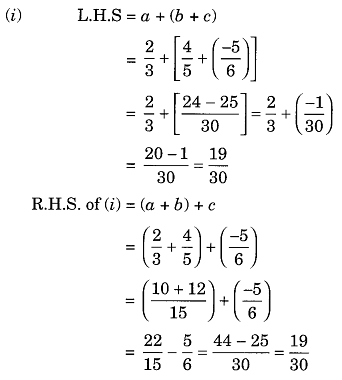
Ques: Let a, b, c be the three rational numbers where a = 2/3, b = 4/5 and c = −5/6. (2 Marks)
Verify: (i) a + (b + c) = (a + b) + c (Associative property of addition)
(ii) a × (b × c) – (a × b) × c (Associative property of multiplication)
Ans: Solution is as follows:
Ques: One-third of a group of people are men. Find the total number of people if the number of women is 200 more than the men. (3 Marks)
Ans: Number of men in the group = 1/3 of the group
Number of women = 1 – 1/3 = 2/3
Difference between the number of men and women = 2/3 – 1/3 = 13
If difference is 1/3, then total number of people = 1
If difference is 200, then total number of people
= 200 ÷ 1/3
= 200 × 3 = 600
Hence, the total number of people = 600.
Also Read:



Comments