



Education Journalist | Study Abroad Lead
Soil is an important natural resource that aids in plant development and growth. You might have seen how many plants you come across are healthy and fresh while on the other hand some plants dry up quickly and wither away. So why does this happen? Why do some plants grow healthy while others die away? This growth and the health of plants mainly depend on the properties of the soil it grows in. Soil can be understood as the uppermost layer of Earth. This layer is a mixture of the materials of rock on which the growth of plants takes place, the organic remains, and clay. Soil is affected by various factors such as various physical, biological, and chemical processes that include erosion and weathering which strips the soil of its nutrients. These processes alter the properties of soil and therefore also impact the growth and health of plants. In this article, we will look at the various properties of soil.
Read More: Natural Resources Management
| Table of Contents |
Keyterms: Soil, Plant, Natural resources, Earth, Clay, Gas, Living organisms, Water, Minerals, Slit soil, Clayey soil, Sandy soil
What is soil?
Most of our land is covered by a loose surface material which is referred to as the soil. Soil is very important for plant growth as it provides structural support to plants for their growth while also supplying them with the water and the necessary nutrients required for their development. Soil is mainly composed of organic matter of the soil, gas, living organisms, water, and various minerals. Mainly soil can be classified into three types which are:
- Slit soil
- Clayey soil
- Sandy soil
The texture of the soil depends on the percentage of these particles present in it.

Soil
Structure of Soil
The structure of soil mainly refers to the individual particles of clay, sand, and slit that assemble together to form soil. The larger particles are formed by combining these smaller particles that are also known as aggregates. The structure of the soil is majorly decided by the presence of humus. This is because humus is responsible for making the soil more porous which allows air and water to penetrate deep into the soil. The soil structure can be of various types such as:
- Very fine soil structure
- Fine structure of soil
- Medium structure of soil
- Thick structure of soil
- Very coarse structure of soil
Structure of Soil
Properties of soil
The various physical properties of soil are its density, temperature, color, structure, texture, porosity, etc.
-
Texture of soil
The texture of the soil, also called soil texture refers to the ratio of minerals and the relative amount of these particles that make up the soil. These separated minerals can be classified mainly as silt, sand, and clay. Slit and sand don't contribute anyhow to the ability of the soil to restore nutrients or water, hence, they are of no importance to the soil. An active part of the soil texture is clay as it has a larger amount of surface area per unit of mass and smaller size. Clay in the soil helps in storing water and ions. If there is more clay in the soil, the soil will be smooth in texture as clay has the smallest particle in soil. The particles of the slit are larger than the particles of clay so it isn't smooth. Sand particles are the largest in size in the soil.
- Size of slit particles: 0.002 mm to 0.02 mm
- Size of sand particles > 0.02 mm

Different Types of Texture of Soil
-
Soil color
The soil varies in color from place to place. In some places, the soil may be brown, yellow, or even red. The color of the soil depends on the ferric or oxidized compounds of iron. The more organic content and remains are present in the soil, the darker is the color of the soil. The darker the color of the soil the higher is the temperature of the soil as the soil absorbs more heat due to the higher amount of organic content.

The colors of soil vary depending on the ferric compounds
-
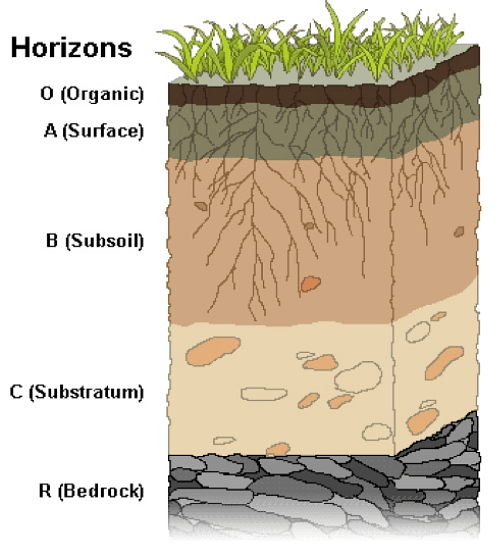
Soil Horizon
The soil is divided vertically to classify it into different layers or horizons which are organized from top to bottom. These horizons are as follows:
- A-Horizon = The uppermost layer of soil is known as the A-Horizon. This is also known as the topsoil. This upper layer is rich in minerals and humus. This horizon is referred to as a home to many organisms that live inside the soil such as earthworms, snakes, etc. Compared to the other layers, this layer holds the most amount of water and also consists of clay, slit, and sand.
- B-Horizon = From the top, the second vertical layer in the soil is known as the B-Horizon. As compared to the top layer, this layer is richer in minerals. This layer supports moisture and is rich in humus content a bit. This layer is comprised of clay, weathered rocks, slit, and some of the nutrients.
- C-Horizon = This third layer of soil, also referred to as the C Horizon, is composed of broken pieces of rocks that are broken down into smaller parts due to processes of weathering.
- BedRock = This last layer of the soil, the bedRock, is composed of various layers of solid rocks that are unweathered.

Different Horizons of Soil
-
Percolation rate/Porosity/Water absorption
Water is absorbed in the soil due to the porosity of the soil. Different types of soils have varying capacities for holding and retaining water. Sand soil has lesser water capacity than clay soil therefore it absorbs less water while clay soil retains and absorbs more water than sandy soil.
Water retention in Sandy soil < Water retention in Clay Soil
- Sandy soil allows the highest level of percolation of water through the soil as the sandy particles are really loose while clay soil has minimum percolation of water.
- Rice Crops are grown in the field in standing water. Hence for the growth of paddy crops, soil with low percolation of water is the most ideal as the water is retained in the field for a longer duration of time.
-
Air in the soil
In between the particles of soil, there are certain spaces where the air is present. This air is required for respiration by the plants as it provides the plants with oxygen through their roots.
As sand particles are larger, they can't fit together closely. Therefore, there is maximum space between sand particles. This space is filled with air. Clay particles on the other hand are packed together tightly so there is very little space for air to exist in between.
-
pH of soil
Many plants such as potatoes grow well in soil that is acidic in nature while garlic, beans grow well in the basic soil. Lettuces and carrots on the other hand grow healthy in soil that is neutral in nature. Hence, soil can be acidic, neutral, or alkaline (basic) in nature.
- Acidic: pH below 7
- Neutral pH: 7
- Alkaline: pH above 7
Read More: Importance of pH in Everyday life
Soil Conservation
Many human activities have led to a degradation in the quality of the soil which has also led to soil pollution. One of the greatest causes of soil degradation is the erosion of soil wherein the top layer of soil is removed due to wind or water. But soils as we saw have a vital role in our ecosystem to ensure the survival of plants in our atmosphere. Hence, a need arises to keep a check on soil pollution while also adapting practices that promote the conservation of soil through its judicious use.
Soil Conservation refers to a technique or a practice that is followed to prevent the process of soil erosion. Soil erosion is mainly responsible for eroding or removing the topmost soil layer. This in turn removes all the nutrients and the organic matter that is necessary for the healthy growth of plants and aids in the production of fruits. We can help to conserve soil fertility by conserving the soil. This practice can be followed by various methods which can be practiced while agriculture and growing crops. Some of them are as follows:
- Contour Plowing
- Use of green manures
- Crop rotation
- Salinity management
- Terrace farming
- Windbreakers
- Perimeter runoff control
- Keyline design
- Streambank projections
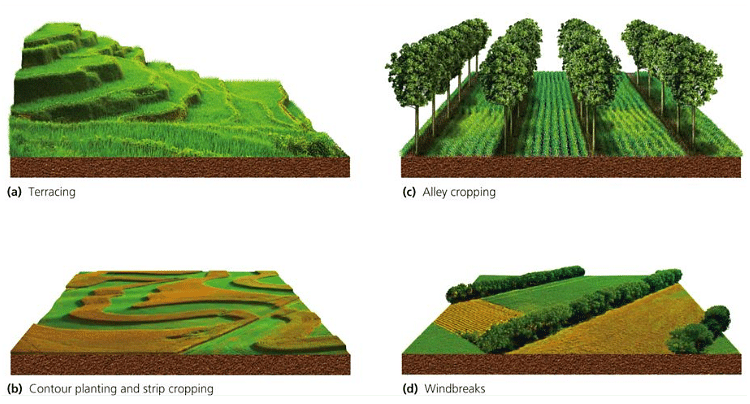
Some methods or practices of soil conservation
Read Also:
Things to Remember
- Soil is an important natural resource that aids in plant development and growth.
- Soil is mainly composed of organic matter of the soil, gas, living organisms, water, and various minerals.
- The texture of the soil, also called soil texture refers to the ratio of minerals and the relative amount of these particles that make up the soil.
- The color of the soil depends on the ferric or oxidized compounds of iron.
- The more organic content and remains are present in the soil, the darker is the color of the soil.
- The uppermost layer of soil is known as the A-Horizon and it is rich in minerals and humus.
- Water is absorbed in the soil due to the porosity of the soil.
- Soil erosion is mainly responsible for eroding or removing the topmost soil layer. This in turn removes all the nutrients and the organic matter that is necessary for the healthy growth of plants and aids in the production of fruits.
- Rice Crops are grown in the field in standing water, therefore, soil with a low rate of percolation of water is the most ideal as the water is retained in the field for a longer duration of time.
Sample Questions
Ques. Explain what is soil? (3 marks)
Ans. Soil is referred to as a kind of mixture of organic matter, minerals, gases, liquids, and tiny organisms which play a great role in the growth of plants and sustenance of life. Soil is the uppermost layer of the surface of the Earth where organic matter is present and where the growth of plants takes place. Various physical, chemical, and biological processes alter the properties of soil and therefore impact the plant growth process.
Ques. How many types of soil are there? (5 marks)
Ans. Soil is mainly divided into four types which are as follows:
- Sandy soil: This type of soil has very few nutrients. It can't hold water for much longer.
- Slit Soil: slit soil holds better water retention than sandy soil. It is highly fertile and is lighter. It can be compressed and can be easily washed out by rain.
- Clay soil: clay soil has good water retention quality and thus air and moisture are able to penetrate this soil easily. It becomes dry in summer, while in winters this soil remains cold and wet.
- Loamy soil: loamy soil is able to retain nutrients and moisture the most and is, therefore, an ideal soil for the purpose of farming. Hence it is also known as agricultural soil. It is an equilibrium of all three classifications of soil which are sandy, slit, clay, and even hummus.
Ques. What do you mean by percolation of soil? (2 marks)
Ans. Percolation refers to the process wherein water is slowly passed down through the soil. As soon as the water is sprinkled on the ground, the soil absorbs the water. This absorption happens due to the percolation of water through the soil. Various types of soils have different percolation rates.
Ques. what are some practices that can be adopted for the conservation of the soil? (3 marks)
Ans. Some of the practices that aid in soil conservation are:
- Contour Plowing
- Crop rotation
- Perimeter runoff control
- Keyline design
- Stream-bank projections
Ques. In how many layers is the soil horizon divided? (5 marks)
Ans. The soil is divided vertically to classify it into different layers which are as follows:
- A Horizon = The uppermost layer of soil is known as the A-Horizon. This is also known as the topsoil. This upper layer is rich in minerals and humus.
- B Horizon = From the top, the second vertical layer in the soil is known as the B-Horizon. This layer supports moisture and is rich in humus content a bit.
- C Horizon = This third layer of soil is comprised of broken pieces of rocks.
- Bed Rock = This last layer of the soil is comprised of various unweathered layers of solid rocks.
Ques. What refers to the structure of the soil. On the basis of soil structure, how many types of soil can be classified? (3 marks)
Ans. The structure of soil mainly refers to the individual particles of clay, sand, and slit that assemble together to form soil. The structure of the soil is majorly decided by the presence of humus as it is responsible for making the soil more porous which allows air and water to penetrate deep into the soil. The soil structure can be of various types:
- Very fine
- Fine structure
- Medium structure
- Thick
- Very coarse structure
Ques. Which type of soil is preferred for paddy crops? (2 marks)
Ans. Rice Crops are grown in the field in standing water. Hence for the growth of paddy crops, soil with low percolation of water is the most ideal as the water is retained in the field for a longer duration of time. Clay soil has the lowest rate of percolation of water, hence it is widely used for growing paddy or rice Crops.
Ques. How do air particles percolate in sandy and clay soil? (2 marks)
Ans. As sand particles are larger, they can't fit together closely. Therefore, there is maximum space between sand particles. This space is filled with air.
Clay particles on the other hand are packed together tightly so there is very little space for air to exist in between.
Ques. State some properties of soil. (5 marks)
Ans. Some properties of soil are as follows:
- The structure of soil mainly refers to the individual particles of clay, sand, and slit that assemble together to form soil.
- The soil varies in color from place to place. The color of the soil depends on the ferric or oxidized compounds of iron.
- Water is absorbed in the soil due to the porosity of the soil.
- soil can be acidic, neutral, or alkaline (basic) in nature.
- The soil is divided vertically to classify it into different layers or horizons which are organized from top to bottom.
Ques. What are the sizes of composition materials of soil? (3 marks)
Ans. Soil is composed of various materials of distinct sizes which are as follows:
- Clay particles < 0.002 mm
- Slit particles: 0.002 mm to 0.02 mm
- Fine sand particles: 0.02 mm to 0.2 mm
- Coarse sand particles: 0.2 mm to 2.0 mm
Ques. What does soil buffering mean? (2 marks)
Ans. Soil buffering refers to a resistance to change of the pH level in the soil. This helps in regulating the nutrient availability to plants for their healthy growth as the growth of the plants and their development is affected by changes in the pH levels of soil.
Read More:



Comments