



Education Journalist | Study Abroad Lead
The separation of one substance from another is required in multiple situations to make the substance useful. There are various methods by which the substances that are mixed together can be separated. Sedimentation is a natural process that includes building up layers of small particles such as mud or sand. It is the simplest method of separation. Sedimentation is used to eliminate particulates in order to improve the filtering process.
| Table of Content |
Key Terms: Sedimentation, Layers, Soil, mud, rocks, fossils, separation method
Sedimentation Process - Experiment
[Click Here for Sample Questions]
The process of sedimentation can be understood through a small experiment.
- Take a jar and fill it with mud from the garden and pour some water.
- Shake it well and leave it untouched for a few minutes.
- In a while, the gravel and rocks are settled below.
- The garden variety mud forms layers of soil.
In a similar way while looking at a cliff, different layers can be observed. The layers are formed by the process of sedimentation. Fossils can be found in these sedimentation layers. A landslide where mud and rock fall down a mountain can cause a type of sedimentation.
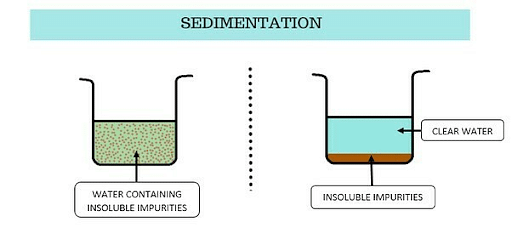
Sedimentation
Read More: Handpicking
Uses of Sedimentation
[Click Here for Sample Questions]
Some of the uses of sedimentation are as follows -
- Sedimentation helps to determine the medical conditions of a person. The sedimentation rate of Red Blood Cells or RBCs for example is measured by how long it takes for the RBCs to settle in a test tube. As time passes, RBCs separate from the other contents of plasma and settle down at the bottom with serum above it.
- The sedimentation rate or the ESR (erythrocyte sedimentation rate) is measured by recording how far the top of the Red Blood Cell layer has fallen (in millimeters) from the top of the serum layer in an hour.
- Water treatment plants use the sedimentation method to filter unwanted particles out from the unclean water. Filtering through several layers of soil and sand, allowing only certain sizes of particles to pass through.
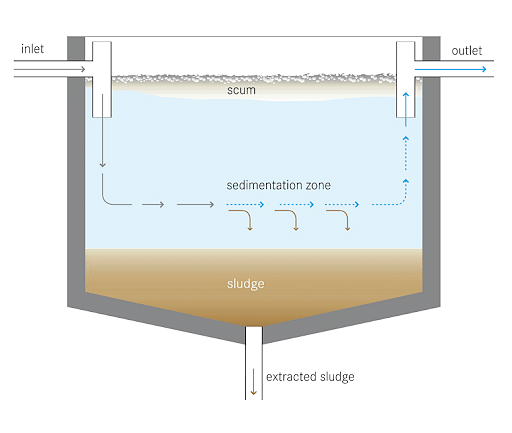
Sedimentation in water treatment
Read More: Methods of separation
Centrifugation
[Click Here for Sample Questions]
Sedimentation is used to separate particles on the basis of their size by applying a centrifugal force to a solution. In the Centrifugation process, a centrifugal force is applied to a heterogeneous mixture that separates it according to its density.
- The denser components are shifted away from the centrifugal axis.
- The less dense ones, however, stay closer to the centrifugal axis. Therefore, the components of the mixture are separated.

Centrifugation
Read More: Separation of mixtures
Types of Sedimentation
[Click Here for Sample Questions]
The different types of sedimentation are -
Plain Sedimentation: Plain Sedimentation is the process of settling down of impurities and solids in the raw water to the bottom of the sedimentation basin. This happens by a natural gravity force alone, with no chemical being added. This is a cheaper sedimentation method and is used in every water filtration and purification system.
Sedimentation Using Clarifier and Contact: Here, the chemicals are mixed in water, and the same water is rotated with the help of pumps for a period of two hours per day, and suspended solids are settled down in the bottom of the reservoir or tank, and more.
Chemically Assisted Sedimentation or Clarification: In this process, chemicals are added to water, and through mixing, the suspended solids, and other impurities are stuck together and form floc, settling at the bottom of the basin.
Generally, the most used process is chemically assisted as horizontal sedimentation based on some assumptions. Basically, water flows through a tank in an irregular flow, and thus the intention of sedimentation is to create conditions where the flow takes place uniformly for a long enough period, permitting the maximum practical amount of floc to get settled before the water reaches the end of the tank.
Read More: NCERT Solutions of Separation of Substances
Things to Remember
- Sedimentation is a separation technique that is used to filter out elements in a particular order.
- Water purification is done using the sedimentation process.
- The different layers of a cliff are formed by sedimentation.
- Centrifugation separates particles on the basis of their density.
- The various types of sedimentation are plain sedimentation, sedimentation using a clarifier, and chemically assisted sedimentation.
Sample Questions
Ques 1: What is churning? (1 mark)
Ans: The process of separation of butter from milk is known as churning.
Ques 2: Define Filtration. (1 mark)
Ans: The elements of a liquid and an insoluble substance are separated using filtration.
Ques 3: What is Sieving? (1 mark)
Ans: The method of separation of stones and pebbles from sand is known as Sieving.
Ques 4: Which materials can be used as filters? (2 marks)
Ans: The following materials can be used as filters:
- Filter Paper
- Cotton
- Filter Cloth
- Ceramic
Ques 5: Define Decantation. (2 marks)
Ans: The technique of separating insoluble solids from liquids is known as decantation. For a period of time, a suspension of solid particles in liquid may be left to stand. Because of their weight, solid particles settle to the bottom.
Ques 6: For separating the following mixtures, name the property of the components used: (2 marks)
(a) Husk and wheat
(b) coconut oil and water
(c) salt and camphor
(d) iron fillings and saw-dust
Ans: a. Winnowing
- separating funnel
- sublimation
- magnetic separation
Ques 7: Explain Strainer. (2 marks)
Ans: Strainer is the term for a wire mesh. We use a filter such as wire mesh to separate tea leaves from water when we're preparing tea, for example. The holes in the mesh are bigger than tea leaves.
Read More:



Comments