



Exams Prep Master
Pyramids are three-dimensional structures with triangular faces and a base containing an encompassing polygon shape. When the bottom of the pyramid is rectangular, the pyramid is referred to as a rectangular pyramid. The base of a rectangular pyramid is rectangular, but the sides of the pyramid are triangular in shape. To the naked eye, a pyramid appears to be a triangle on all sides. The shape of the pyramid aids a student in determining the surface area and volume of the pyramid. So far we have learned in geometry that like other shapes, a pyramid is also defined by its properties. The major properties of the rectangular pyramid are based on edges, faces, and vertices. Let’s have a close look at the topic and discuss some important questions.
| Table of Content |
Also read: Isosceles Triangle Theorems
What is a Rectangular Pyramid?
[Click Here for Sample Questions]
A rectangular pyramid is a type of pyramid with a rectangular base shape. When viewed from the bottom, this type of pyramid appears to be a rectangle. As a result, the opposite sides of the base are parallel and equal.
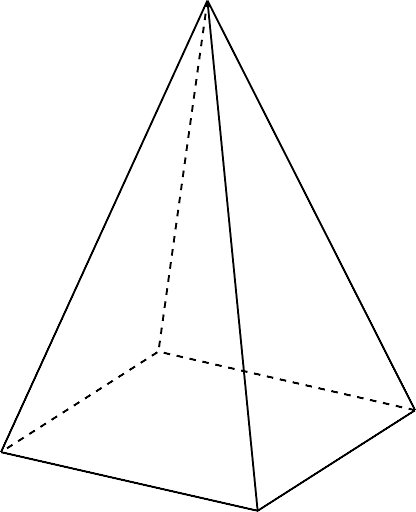
A pyramid is crowned at the top of the base at a point known as the apex. There are two types of rectangular pyramids: right pyramids and oblique pyramids. The apex of a right pyramid is located directly over the center of the base, whereas the apex of an oblique pyramid is located at the same angle from the center.
Also read:
Classification of Pyramids
[Click Here for Sample Questions]
Aside from the rectangular pyramid, there are several other types of pyramids classified by the shape of their bases. Here are a few examples of these pyramids: Triangular & Rectangular Pyramid.
Faces, Edges, and Vertices
[Click Here for Sample Questions]
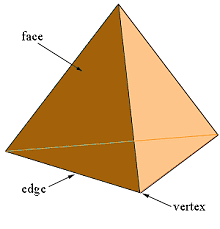
A pyramid's main characteristics are its faces, edges, and vertices. Let's go over these three pyramid features briefly so that students have a better understanding:
Faces - A rectangular pyramid has five faces in total. One of these faces is rectangular in shape, while the other four are triangular in shape. This rectangular pyramid's triangular faces are all congruent with their opposite triangular faces.
Vertex - There are five vertices in a rectangular pyramid. Vertices are the points where the edges meet or intersect. One of the vertices is located at the top, directly above the base; this is the point where the pyramid's triangular faces meet. The four remaining vertices are located at the four corners of the rectangular-shaped base.
Edges - A rectangular pyramid has eight edges in total. When two faces or surfaces intersect, an edge is formed. Four of these eight edges are located at the rectangular base, while the other four form slopes directly above the rectangular base that meet at the peak point, which is known as the pyramid's vertex.
Right Rectangular Pyramid
If the apex of the rectangular pyramid is directly above the centre of the base, it forms a perpendicular to the base, indicating the height of the pyramid. This type of rectangular pyramid is known as the right rectangular pyramid. When we talk about a rectangular pyramid, we usually refer to the right rectangular pyramid.

Oblique Rectangular Pyramid
When the apex of a rectangular pyramid is not directly above the centre of the base, the pyramid is referred to as an oblique rectangular pyramid. This particular pyramid appears to be slanted. In the case of an oblique rectangular pyramid, height is defined as the length of the perpendicular drawn apex to the pyramid's base.
Also read:
Rectangular Pyramid Formula
[Click Here for Sample Questions]
The rectangular pyramid contains various formulas that students must thoroughly understand in order to achieve high grades in their exams. Formulas serve as the foundation for each geometrical chapter.
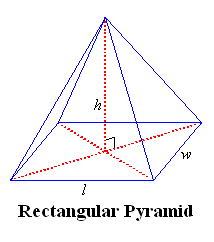
The rectangular pyramid formulas are as follows:
Surface Area of a Rectangular Pyramid: A=lw+l√ (w/2)2+h2 +w √ (l/2)2+h2
Where,
l = The rectangular base's length.
w = The rectangular base's width.
h = The pyramid's height.
The formula above is known as the rectangular pyramid surface area formula.
Volume of Rectangular Pyramid
[Click Here for Sample Questions]
The volume of the rectangular pyramid is defined as its capacity and is the number of unit cubes that can fit inside it. The volume unit is cubic units. Depending on the units, it can be expressed as m3, cm3, in3, and so on. The volume of a rectangular pyramid can be calculated using the following formula:
Volume = 1/3 × Base Area × h
Where,
Base area = Length of the rectangular base x Width of the rectangular base
h is the perpendicular height base area
The volume of the rectangular pyramid can be calculated by first determining its length, width, and height, and then entering the measurements into the above-mentioned formula.
Lateral Area of a Rectangular Pyramid
LA=1/2(ps)
Where,
p = Perimeter of the rectangular base.
s = Slant height.
Things to Remember
- Pyramids are three-dimensional structures with triangle faces and a polygon shape at the base. When the base of a pyramid is rectangular, it is referred to as a rectangular pyramid. The sides of all pyramids are triangular, despite the fact that the base is rectangular. As a result, whenever we see a pyramid, we see a triangle on each of its sides. The shape of the pyramid will aid us in determining its surface area and volume.
- Pyramids are classified into the following types: Rectangular Pyramid, Triangular Pyramid, Square Pyramid, Pentagonal Pyramid, Hexagonal Pyramid.
- Here is the formula for calculating the surface area and volume of a rectangular pyramid:
A rectangular pyramid's surface area is: A= lw+l√ (w/2)2+h2 +w √ (l/2)2+h2
A rectangular pyramid's volume is: Volume = 1/3 × Base Area × h
Read More:
Sample Questions
Ques: What are the Features of a Rectangular Pyramid? (2 marks)
Ans: Every structure in geometry has unique properties. Similarly, as a geometrical figure, the rectangular pyramid has the following characteristics:
The rectangular pyramid's base is shaped like a rectangle, and the remaining sides are triangles.
The rectangular pyramid has five faces, one of which is rectangular in shape and the other four are triangular in shape.
The rectangular pyramid has five vertices, one of which is at the vertex and the other four at the point where the triangular faces meet.
The rectangular pyramid has eight edges in total.
Ques: Create a Triangular Pyramid. (2 marks)
Ans: A triangular pyramid is also known as a tetrahedron in geometry. A triangular pyramid is made up of four triangular-shaped faces. There are six straight edges and four vertex corners in this structure. The triangular pyramid is the most basic of all the ordinary convex polyhedra in geometry. The only polyhedra with fewer than five faces is a triangular pyramid. The triangular faces are equilateral and match the opposite triangular shape. This shape is related to the octahedron, triangular prism, square pyramid, and icosahedron. A triangular pyramid is a useful structure.
Ques: What is the volume of a regular rectangular pyramid with 12 in and 10 in base sides and a height of 20 in? (3 marks)
Ans: The formula for the volume of a pyramid is given by:
V = 1/3 × Base Area × h
The area of the base = Length × Width = 12 × 10 = 120 in2.
Substituting,
Base area = 120 and h = 20 in the formula.
V = 1/3 × 120 × 20 = 800 in3.
Therefore, the volume of the given rectangular pyramid is 800 in3.
Ques: Determine the total surface area of a rectangular pyramid with base lengths and widths of 14 and 9 units, respectively. In addition, the pyramid's height is 7 units. (3 marks)
Ans: Base length, l = 14 units
Height of the pyramid, h = 7 units
Width of a base, w = 9 units
The total surface area of a rectangular pyramid is A = lw +l √[(w/2)2 + h2] + w√[(l/2)2 + h2]
Substituting
=14 × 9 + 14 √(9/2)2+72+9√(14/2)2+72.
T.S.A. = 126 + 116.503 + 89.09
T.S.A. = 331.59 square units.
Therefore, the total surface area of a rectangular pyramid is 331.59 sq units.
Ques: Determine the total surface area of a rectangular pyramid with a base rectangle area of 35 square units and a lateral surface area of 20 square units. (3 marks)
Ans: Area of the base rectangle = 35 square units
Lateral surface area = 20 square units
Total surface area of a rectangular pyramid = Area of the base rectangle + Lateral surface area of a pyramid.
Putting the values together,
The surface area of a right rectangular prism = 35 + 20 = 55 square units.
Therefore, the total surface area of a rectangular pyramid is 55 sq units.
Ques: Calculate the surface area of a rectangular pyramid with following conditions: l = 10, w = 5, h =10. (2 marks)
Ans: A = lw +l √[(w/2)2 + h2] + w√[(l/2)2 + h2
A= (10∗5)+√10(5/2)2+(10)2+ 5√ (10/2)2+(10)2
A= 50+10(25)+5(11.20)
A = 356
Ques: Calculate the volume of a rectangular pyramid with following conditions: l = 10, w = 5, h =10. (2 marks)
Ans: v=(lwh)/3
v = (10*5*10) / 3
v = 166.66
Ques: Calculate the volume and surface area of a rectangular pyramid with following conditions: l = 20, w = 10, h =15. (3 marks)
Ans: A = lw +l √(w/2)2 + h2 + w√(l/2)2 + h2
=(20∗10) + 20 √10/2)2 + (15)2 + 10√(20/2)2 + (15)2
A = 200 + 316.2 + 179.4
A = 695.6
Volume of a rectangular pyramid
v=(lwh)/3
v = (20*10*15) / 3
v = 1000
Related Mathematics Links:



Comments