



Content Curator
Geometrically, a rectangular prism is a three-dimensional, polyhedron figure that has two equal and parallel bases. The six faces of a rectangular prism are paired in a way that they remain opposite, yet congruent. It is also referred to as a cuboid by many. The opposite faces of a rectangular prism are usually identical, with three dimensions – length, breadth and height. Every three-dimensional figure automatically has its own surface area and volume, much like a rectangular prism in this case.
| Table of Content |
Key Takeaways: Prism, Rectangle, Rectangular Prism, geometry, length, breath, width
What is a Rectangular Prism?
[Click Here for Sample Questions]
A rectangular prism, in geometry, is a three-dimensional polyhedron that has six faces, and twelve edges. It is usually referred to as a cuboid by many. The faces of a rectangular prism are paired in a way that it remains parallelly situated, yet congruent to one another. A rectangular prism has six faces in total – which means, it has three pairs of identically parallel faces. A rectangular prism can be best depicted by several equipment people use on a daily basis, much like storage sheds, monitors, bricks and more. It is typically known as a prism because it has a cross-section along its length.
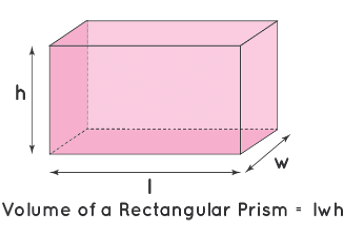
What is a Rectangular Prism
[Click Here for Sample Questions]
We can determine the volume of a rectangular prism by multiplying its dimensions – length, breadth, and height of the prism. Therefore, the volume of a rectangular prism can be obtained by following formula,
Volume of a Rectangular Prism = l * b * h
Wherein,
- “l” refers to the length of the rectangular prism.
- “b” refers to the breadth of the rectangular prism.
- “h” refers to the height of the rectangular prism.
Also Read:
The Volume Formula of Rectangular Prism
The volume of a three-dimensional object can be determined by the amount of space it has occupied. In simple words, it means that the amount of space a rectangular prism has occupied is its volume. The unit of volume is denoted by “cubic unit.” The determined solution with the formula can be further expressed in several values in cubic units, much like cm3, m3, in3, and others. We can determine the volume of a rectangular prism by multiplying its length, width and height. The base of a rectangular prism is typically a rectangle itself, which gives the area as “l * b”.
That being said, the formula for the volume of a rectangular prism can be acquired by: (V) = l × w × h.
Besides, the area of Rectangular prism can be evaluated by the following formula: (S) = 2(lw + lh + wh)
Calculation of Volume of a Rectangular Prism
Prior to evaluating the volume of a rectangular prism, it is vital to ensure whether the dimensions are equally of the same unit. After determining, the following steps should be used to obtain the volume of a rectangle,
- Primarily, it is important to recognize the base and equally also determine the area by using the formula mentioned above.
- After evaluating its area, you can jump onto identifying the height of the prism, which is usually found perpendicular from the top vertex, connecting with the base.
- Following the same, you can multiply the area (length * breadth) and height of the base of the respective prism to obtain the volume of the rectangular prism. The answer is typically derived in cubic units. Hence, the Volume of a Rectangular Prism = l * b * h.
Types of Rectangular Prism
[Click Here for Sample Questions]
There are two major types of rectangular prisms,
Right Rectangular Prism
It is a type of rectangular prism that has all the angles in a right angle. Simply, a right rectangular prism can be defined as a prism that occupies bases perpendicular to one another.
Oblique Rectangular Prism
It is a form of rectangular prism that does not comprise of angles that all form a right angle. In simple words, an oblique rectangular prism is typically known to have bases that are not perpendicular to one another.
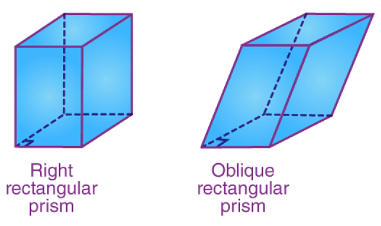
Properties of Rectangular Prism
There are several properties of a rectangular prism, some of them are:
- A rectangular prism occupies 6 faces, 12 edges and 8 vertices.
- A rectangular prism also has dimensions similar to a cuboid, namely length, width and height.
- Usually, the top most area alongside the base always forms a rectangle.
- The opposite faces of a rectangular prism are typically identical or congruent.
- A rectangular prism also generally has a rectangular cross-section.
- The laterally located faces usually form a right rectangular prism. The laterally located faces are in the shape of a parallelogram in oblique rectangular prisms.
Also Read:
Points to Remember
Following are some important points:
- A rectangular prism is a three-dimensional, polyhedron figure that can be constructed using two equal and parallel bases.
- It is found that the opposite faces of a rectangular prism are generally identical, with three dimensions of its own – length, breadth and height.
- The Volume of a Rectangular Prism can be acquired by the following formula = (V) = l × w × h; where l signifies length, w signifies width and h refers to its height.
- The area of Rectangular prism can be calculated by the following formula: (S) = 2 (lw + lh + wh).
- The amount of space a rectangular prism has occupied is its volume. The unit of volume can be denoted by “cubic unit.” In this case, the cubic units typically used are cm3, m3, in3, and others.
- There are two types of rectangular prisms: Right Rectangular Prism and Oblique Rectangular Prism.
Sample Questions
Ques: The length, breadth, and height of a rectangular prism Shreya has are 17 cm, 15 cm, and 6 cm respectively. With the given data, determine the volume of the rectangular prism? (4 Marks)
The breadth of the rectangular prism is = 15 cm,
And the height of the rectangular prism is = 6 cm.
Thus, with the formula we have of the volume of a rectangular prism, it can be said,
Volume of a rectangular prism = l * b * h
That being said, the volume of the rectangular prism Shreya has can be calculated by = l * b * h
= 17 cm * 15 cm * 6 cm
= 1,530 cm3
Ques: The volume of a rectangular prism has been measured as 30 cubic units by a girl, alongside the base area as 15 square units. With the given data, determine the height of the rectangular prism. (4 Marks)
The volume of the rectangular prism is measured as = 30 cubic units
And the base area of the rectangular prism is = Length * Breadth = 15 square units.
Now, the height of the rectangular prism, as per the given equation = 15 * height = 30
Therefore, the height of the rectangular prism can be given by = 30 / 15 = 2 units.
Thus, the answer is 2 units.
Ques: Tina is planning on building a rectangular water tank with length, breadth, height as 15 m, 5 m, 5 m respectively. Find the total amount of water it can hold when it is half full. (4 Marks)
And the breadth of the rectangular tank is = 5 m
The height of the rectangular tank has been measured as = 5 / 2 m
Total volume of water it will hold when it is half filled,
L x B x (H / 2)
= (15 x 5 x 2.5)
= 187.5 m3
The total amount of water it can hold is 187.5 m3
Ques: Assuming that the base length of a rectangular prism is 6 inches, the base width is 4 inches, alongside the height of the rectangular prism being 16 inches. Given the data, determine the volume of the rectangular prism. (4 Marks)
And, the base width of the rectangular prism has been measured as = 4 inches
Hence, to determine the volume of the rectangular prism, we have to consider the base area
= l * w
= 6 * 4
= 24 sq inches.
Now, the height of the prism is given as = 16 inches
Therefore, now we should use the formula of the volume of the rectangular prism, which is = l * b * h = (24 * 16) = 384 cubic inches.
Hence, the answer is 384 cubic inches.
Ques: Soumili has found that the volume of water contained in her rectangular reservoir is 450 m3. If the length and breadth of the reservoir is 5 m and 2 m respectively, find the height of the reservoir. (4 Marks)
The Length of the reservoir that Soumili measured is = 5 m
The Breadth of the reservoir is = 2 m
And the volume of the reservoir, as per the question, is = 450 m3
Therefore, the height of the reservoir can be determined by the following equation = 450 / (5 x 2) m = 45 m
Hence, the height of the reservoir is 45 m.
Ques: 6 cm, 4 cm and 3 cm are the respective measurements of a rectangular prism. Given the equation, find out the volume of the rectangular prism, and also determine its surface area. (4 Marks)
The width of it is = 4 cm
The height of it is = 3 cm
We can determine the volume by the formula associated with rectangular prism,
Thus, Volume = l * w * h
= 6 * 4 * 3 cm3
= 72 cm3
Now, to determine the surface area of a rectangular prism formula,
Thus, the Rectangular prism area formula (S) = 2 (lw + lh + wh)
The Rectangular prism area formula = 2 (24 + 18 + 12 )
The Rectangular prism area formula = 108 m2
Hence the surface area of a rectangular prism is 108 m2
Ques: Arya is planning on casting a metal cube from a rectangular prism which has length, width, height as 9 cm, 7 cm, 5 cm respectively. Find the volume of the metal cube she made from this cast. (4 Marks)
The Length of it is = 9 cm
The Width is = 7 cm
And the Height is = 5 cm
Now, given the dimensions, the total volume of the metal cube can be estimated by the following formula = (l x b x h)
=(9 x 7 x 5) cm3
= 315 cm3
Thus, the volume of the metal cube is 315 cm3.
Also Read:



Comments