



Education Journalist | Study Abroad Lead
Tetrahedron is an interesting three-dimensional figure with four triangular faces and has six straight edges, and four vertex corners. One of the triangles is considered the base and the other three triangles together form a pyramid. For ease of visualization, you can think of it as a triangular pyramid. A tetrahedron is a type of pyramid, a polyhedron with a flat polygonal base and triangular faces connecting the bases and common points. It can be also called a triangular pyramid because its base is a triangle. Elaborated below are the various tetrahedral formulas related to surface area and volume in detail in order to understand the meaning of the symbols used in each formula.
| Table of Contents |
Key Terms: Tetrahedron, Three-dimensional Figures, Triangle, Pyramid, Polyhedron, Surface Area, Lateral Surface Area, Vertices, Interior Angles
What is Tetrahedron?
[Click Here for Sample Questions]
A tetrahedron is a polyhedron with 4 faces, 6 sides, and 4 vertices, all of which are triangles. It can also be called a triangular pyramid whose base is also a triangle. An equilateral tetrahedron has equilateral triangles so all its interior angles are equal to 60°. Since each plane in a tetrahedron is a triangle, thus, the interior angles of a tetrahedron in each plane add up to 180°.
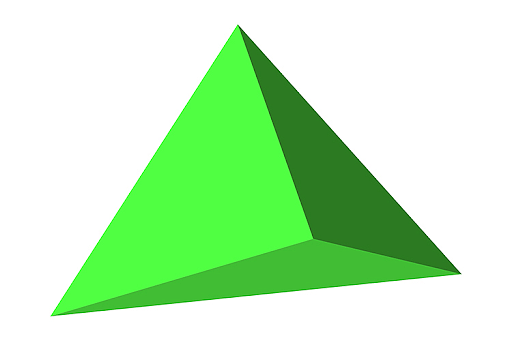
Tetrahedron
Properties of Tetrahedron
[Click Here for Sample Questions]
A tetrahedron is a three-dimensional shape that features several different properties. The below mentioned are the characteristics of the tetrahedron that make it easy to identify the shape.
- There are 4 faces, 6 edges, and 4 vertices (corners).
- A regular tetrahedron has all four corners equidistant from each other. There are 6 planes of symmetry.
- Unlike other regular polyhedra, there are no parallel faces.
- A regular tetrahedron has four equilateral triangles as faces.
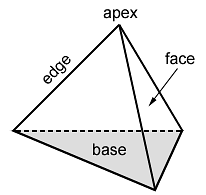
Faces and Edges of a Tetrahedron
Read More: Area of Equilateral Triangle
Surface Area of Tetrahedron
[Click Here for Sample Questions]
The surface area of a tetrahedron is defined as the total area or area covered by all faces of the shape. It is expressed in squares such as m2, cm2, ft2, yd2. A tetrahedron has two types of surface area namely the Lateral Surface Area of Tetrahedron and the Total Surface Area of Tetrahedron.
-
Lateral Surface Area of Tetrahedron
The lateral face of a tetrahedron is defined as the surface of the lateral or slant faces of the tetrahedron. The formula for the area of the sides of a regular tetrahedron is given by,
Lateral Surface Area of Regular Tetrahedron = Sum of 3 congruent equilateral triangles, i.e. lateral faces) = 3 × (√3)/4 a2 square units
Here ‘a’ denotes the side length of a regular tetrahedron.
Read More: Edges, Faces, and Vertices
-
Total Surface Area of Tetrahedron
The total area of a tetrahedron is defined as the area of all the faces of a tetrahedron. The formula for the total area of a regular tetrahedron is given by,
Total Surface Area of Equilateral Quadrilateral = Sum of 4 congruent equilateral triangles (i.e. side faces) = 4 × (√3) / 4 a2 = √3 a2 square units.
Here ‘a’ denotes the length of the side of the regular tetrahedron
Volume of Tetrahedron
[Click Here for Sample Questions]
The volume of a tetrahedron is defined as the total space it occupies in a three-dimensional plane. The formula for the volume of a tetrahedron is given by,
Volume of a regular tetrahedron = (1/3) × base area × height = (1/3) (√3) / 4 a2 × (√2) / (√3) a = (√2 / 12) a3 cubic units.
Here ‘a’ is the lengths of the sides of a regular tetrahedron

Tetrahedron Figure
Read More: Difference between Area and Volume
Things to Remember
- A tetrahedron is a triangular pyramid with all four sides triangular.
- Basically, a tetrahedron has 4 faces, 6 edges, and 4 vertex corners.
- A tetrahedron can be drawn using a geometric net as it has a 3D shape.
- A tetrahedron is made up of 4 triangular faces, that’s why its base is considered a triangle.
- Michigan artist David Barr developed the Four Corners project in 1976. A typical Earth-sized tetrahedron crosses the planet with only the four corners protruding at the tips.
- The total surface area of a tetrahedron is √3 a2 square units while the lateral surface area is 3 × (√3)/4 a2 square units.
- The volume of a tetrahedron is given by the formula (√2 / 12) a3 cubic units.
Solved Questions
Ques. What is the volume of a tetrahedron with sides of 25 cm? (3 Marks)
Ans. Here, a = 25 cm
Let’s use the formula of Volume of a Regular Tetrahedron: (√2 / 12) a3
= (√2 / 12) 253
= 1,841.4 cm3
Ques. What is the volume of a Regular Tetrahedron, if its Total Surface Area is 36√3 cm? (5 Marks)
Ans.Here, TSA of Tetrahedron: 36√3 cm
Let's first find out the side of the tetrahedron.
Using the formulae of TSA of Tetrahedron = √3 a2
Now putting the TSA of Tetrahedron = √3 a2
36√3 = √3 a2
36√3 / √3 = a2
36 = a2
Hence a = 6,
Now Using the formulae of Volume of Regular Tetrahedron = (√2 / 12) a3
= (√2 / 12) 63 = 25.45 cm3
Ques. A tetrahedron has four faces and six edges. How many vertices will it have? (3 Marks)
Ans.A tetrahedron will have 4 vertices.
We know that V−E+F=2
Here V, E, F denotes
V= no. of vertices =?
E= no. of edges =6
F= no. of faces =4
V−6+4=2
V−2=2
V=4
Ques. How many vertices and edges does the truncated tetrahedron have? (3 Marks)
Ans.A truncated tetrahedron has 12 vertices and 18 edges in total. A truncated tetrahedron has 4 regular hexagonal faces, 4 equilateral triangle faces, 12 vertices, and 18 edges (of two types). You can construct it by truncating all 4 vertices of a regular tetrahedron at one-third of the original edge length.
Ques. Find out the edge of the tetrahedron if its volume is 1/3? (3 Marks)
Ans.Using the formulae to find out the edge of a tetrahedron,
e = √23√3V
Substituting the volume and solving.
e = √23√3( 1/3)
e = √23√1
e = √2
The edge of the tetrahedron will be √2.
Ques. Find out the edge of the tetrahedron if its volume is 9 cm3? (3 Marks)
Ans.Using the formulae to find out the edge of a tetrahedron,
e = √23√3V
Substituting the volume and solving.
e = √23√3(9)
e = √23√27
e = 3√2
The edge of the tetrahedron will be 3√2.
Ques. Find out the total surface area of a tetrahedron, the edge of a tetrahedron is 12 cm? (3 Marks)
Ans.Using the formulae of the total surface area of tetrahedron= √3a2
Here ‘a’ denotes the edge of the tetrahedron.
= √3(122) = 249.4 cm2
The total surface area of the tetrahedron will be 249.4 cm2.
Ques. Find out the lateral surface area of tetrahedron if its volume is 18√3cm3? (3 Marks)
Ans. Let ‘a’ be the edge of the tetrahedron.
Firstly, we will be using the formulae of the volume of tetrahedron = (√2 / 12) a2
18√3 = (√2 / 12) a3 [Putting the given volume of a tetrahedron to find out the edge of the tetrahedron.]
216 = a3
a = 6 cm
Using the formulae of Lateral Surface Area of Tetrahedron = 3 × (√3)/4 a2
= 3 × (√3)/4 (62)
= 27√3 cm2
The lateral surface area of the tetrahedron will be 27√3cm3.
Ques. The surface area of a regular tetrahedron is 156 cm2, find the length of an edge of a regular tetrahedron? (3 Marks)
Ans. Given SA = 156 cm2, Let ‘a’ be the length of an edge.
Using the formulae of SA = √3 a2
(Putting the value of SA) 156 = √3 a2
√156√3 = a
a = 9.5 cm
The length of an edge of a regular tetrahedron would be 9.5 cm.
Ques. Find the volume of the regular tetrahedron if its edge is 9.3 m? (3 Marks)
Ans. Given the edge of regular tetrahedron = 9.3 m
Using the formula of Volume of regular tetrahedron = (√2 / 12) a3
=(√2/12) 9.33
= (0.11785) 9.33
= 94.79 m3
Related links:



Comments