



Education Journalist | Study Abroad Lead
Pressure is referred to as the physical force that is exerted upon an object. The force that is applied is usually perpendicular to the surface of the object on which it is being exerted per unit area. There are a number of units used to represent pressure. Bar and Pascal are the most common of them. A Pascal is equivalent to one newton of force acting on 1 m2 area. A Bar, on the other hand, is used to represent atmospheric pressure. Understanding the relationship between unit of pressure: bar and pascal is important for solving complex problems. In this article, we will look at this relationship and some conversion values.
| Table of Content |
Key Takeaways: Pressure, Bar, Pascal, Units of Pressure, Atmospheric Pressure, SI Units
What is Atmospheric Pressure?
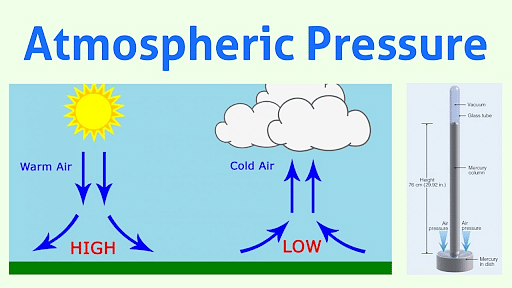
The atmospheric pressure at any point is measured as the weight of the column of air of unit cross-sectional area extended from the point under consideration to the top of the atmosphere.
Atmospheric Pressure = P = ρgh
Here, h is the height of the mercury column,
ρ is the density of the fluid,
P is the atmospheric pressure, and
g is the acceleration due to gravity
Also Read: Hooke’s Law
Units of Pressure
The most commonly used units of pressure are: -
- Pascal: Pascal is the SI unit of pressure, equal to one newton per square meter (approximately 0.000145 pounds per square inch, or 9.9 × 10⁻⁶ atmospheres).
- Bar: Bar is the SI unit of pressure, equal to one newton per square meter.
- Torr: Torr is the SI unit of pressure, equal to 1 mm of mercury in a barometer and equivalent to 133.32 Pa.
- PSi: Psi is another SI unit of pressure, generally used to denote air pressure in tires and balloons.
- Atm: Atmospheric Pressure is the SI unit of pressure, to denote atmospheric pressure.

Read More:
Relationship Between Bar and Pascal
Mathematically, we can describe the relationship between bar and pascal in the following way:
- Bar to pascal formula: 1 bar = 100,000 pascals
- Pascal to bar formula: 1 pascal = 10-5 bar or 0.01mbar
To understand this relationship between bar and pascal even more efficiently, we would need to understand bar and pascal as individual terms.
| Unit | Definition | Symbol | Formula | Fundamental unit |
| 1 Pascal | The pressure exerted due to 1 N of force acting on 1 m2 area. | Pa | 1Pa = 1 N/m2 | Pa = kg/ms2 |
| 1 Bar | Unit of pressure almost similar to atmosphere unit | Bar | 1 bar = 10,000 N/m2 | Bar = kg/ms2 |
Also Read: Relation between Pressure and Velocity
Conversion of Values of Pressure
The conversion of values of pressure from one unit to another is done as tabulated below:
| Units | Values |
| 1 bar to kilopascal | 1bar = 100 kilopascals |
| 1 bar to mPa | 1 bar = 0.1 mPa (megapascal) |
| mbar to pascal | 1mbar = 100Pa |
| 1 bar to atm | 1 bar = 0.986923 |
| 1 torr to pascal | 1 torr = 133.32 Pa |
| 1 atm to pascal | 1 atm = 101,325 Pa |
| 1 atm to Psi | 1 atm = 14.696 Psi |
| 1 Psi to Pascal | 1 Psi = 6894.75 Pa |
Things to Remember
- Pascal is the SI unit of pressure, equal to one newton per square meter (approximately 0.000145 pounds per square inch, or 9.9 × 10⁻⁶ atmospheres).
- Bar is the SI unit of pressure, equal to one newton per square meter.
- Torr is the SI unit of pressure, equal to 1 mm of mercury in a barometer and equivalent to 133.32 Pa.
- Psi is another SI unit of pressure, generally used to denote air pressure in tires and balloons.
- Atmospheric Pressure is the SI unit of pressure, to denote atmospheric pressure.
- 1 bar is equivalent to 100 Kilopascal.
- 1 bar is also equal to 0.98 atm.
- 1 bar is equal to 0.1 mPa i.e., megapascal.
Sample Questions
Ques. What is Pascal? (2 marks)
Ans. Pascal (Pa) is said to be the SI unit of pressure which is used to define internal pressure and tensile strength. The unit is named after the scientist Blaise Pascal and defined as one newton per square meter and is equivalent to 10 Barye that is denoted by Ba in the CGS system.
Ques. What is the difference between pressure in atmospheres and pressure in pascals? (1 mark)
Ans. Atmospheric pressure means pressure exerted by the weight of the atmosphere. If seen at sea level, it is approximately equivalent to 101,325 Pa or 14.69 Psi.
Ques. Explain the five most common units of pressure. (5 marks)
Ans. The most commonly used units of pressure are: -
- Pascal: Pascal is the SI unit of pressure, equal to one newton per square meter (approximately 0.000145 pounds per square inch, or 9.9 × 10⁻⁶ atmospheres)
- Bar: Bar is the SI unit of pressure, equal to one newton per square meter.
- Torr: Torr is the SI unit of pressure, equal to 1 mm of mercury in a barometer and equivalent to 133.32 Pa.
- PSi: Psi is another SI unit of pressure, generally used to denote air pressure in tires and balloons.
- Atm: Atmospheric Pressure is the SI unit of pressure, to denote atmospheric pressure.
Read More:
Ques. How is bar related to pascal? (3 marks)
Ans. Mathematically, a bar is equivalent to 100,000 Pa, or 100,000 N/m2.
Theoretically, bar is the SI unit of atmospheric pressure used by scientists and engineers all over the globe, whereas pascal is also the SI unit of atmospheric pressure where 1 N of force acts on 1 m2 of area.
Ques. Why is bar a more used and preferred SI unit as compared to Pascal? (5 marks)
Ans. Bar is more commonly used in calculations by scientists and engineers. The main reason behind this is that 1 bar is equal to 100,000 Pascal. Thus, if they use Pa as the main unit, they would have to deal with a lot of large numbers, therefore increasing complexity.
To keep the calculations and results easy to understand, bar is more preferred. At times, meteorological advances prefer using millibars whereas oceanography uses decibars.
Ques An off-shore structure is designed to withstand a maximum stress of 218 Pa. Is this suitable for holding a well in the ocean? Take the depth of the ocean to be 6 km and ignore other external factors. (5 marks)
Ans. Given: The maximum stress the structure can handle, P = 218 Pa
Depth of the sea, d = 6 km = 6 × 10³ m
Density of water, ρ = 103 kg/m3
Acceleration due to gravity, g = 9.8 m/s2
We know:
Atmospheric Pressure = P = ρgh
Using this formula in terms of depth, it can be concluded that,
The pressure exerted by the seawater at depth,
d = ρdg = 218 x 6 × 103 × 9.8 = 1.32 × 10 Pa
Thus, the sea exerts a pressure less than what the structure can handle, so it can easily hold the well.
Ques. Explain why. (3 marks)
- The human body’s blood pressure is greater at the feet than the brain. Why?
- Even though the height of the atmosphere is over 100 km, atmospheric pressure at a height of about 6 km reduces to almost half of its value at sea level.
Ans. a) The column of blood towards the feet is at a greater height than the head, thus the blood pressure in the feet is greater than that in the brain.
b) The density of the atmosphere does not decrease with the increase in altitude, in fact, most of the air molecules are close to the surface. Thus, there is this non-uniform variation of atmospheric pressure.
Ques. A tank filled with water is of up to 2m height. Calculate the pressure exerted on the bottom of the tank. (3 marks)
(Take g = 9.8 m/s2, Water density = 1000 kg/m3).
Ans. Acceleration due to Gravity = 9.8 m/s2
Density of water = 1000 kg/m3,
The pressure is articulated as
P = ρ × g × h
P = 1000 × 9.8 × 2m
P = 19,600 Pascal.
Read More:



Comments