



Content Curator
Hydrostatic Pressure is the pressure exerted by a fluid at equilibrium at any given point of time due to the force of gravity on it. It is the measurement of force per unit area on an object in a fluid or on the surface of a closed container.
Check More: Mechanical Properties of Fluids
| Table of Content |
Key Terms: Hydrostatic Pressure, Equilibrium Position, Gravity, Liquid, Acceleration, Gravity, Pressure, Depth of Water, Force, Fluid
What is Hydrostatic Pressure?
[Click Here for Previous Year Questions]
Hydrostatic pressure is the pressure inside any point of a liquid that is kept in an equilibrium position. Pressure of a liquid is the force offered by a liquid per unit area on a surface or an object which is in contact with that force. Hydrostatic pressure is caused due to the force offered by gravity.
| Hydrostatic Pressure is the pressure exerted by a fluid at equilibrium at any given point of time due to the force of gravity on it. |
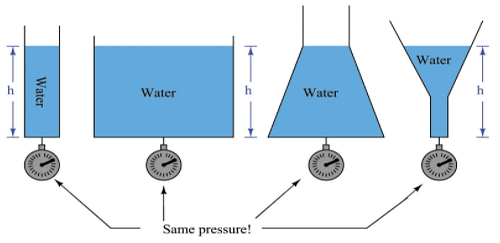
The pressure of a liquid kept in a container usually increases with the increase in depth of the container and will be maximum at the bottom layer of the container. Hydrostatic pressure is associated with any type of liquid.

When a liquid is kept inside a container, there will be no force applied on the top layer of the liquid. However, with the increase in depth of the liquid, the force of each layer will add up on the reference layer. Hence the pressure inside the liquid kept in a container will increase with the increase in depth.

A liquid kept inside a container always offers pressure in every direction as it spreads uniformly inside the container. The main cause of the pressure of any liquid which is kept inside a container is gravity. However, the pressure inside of a container of any liquid can be affected by forces present outside of a container as well as acceleration.
Calculation of Hydrostatic Pressure
|
Unit of Hydrostatic Pressure
[Click Here for Sample Questions]
In the SI system, the unit of Hydrostatic Pressure is Newton/Meter2 (N/M2) or Pascal.
In the cgs system, the unit of Hydrostatic Pressure is Dyne/cm².
The dimensional formula of Hydrostatic Pressure:
Hydrostatic Pressure = Force/ Area
| = [MLT-2]/[L2] = [ML-1T-2] |

Hydrostatic pressure
Hydrostatic Pressure and Depth of Water
Hydrostatic Pressure usually changes with the Depth of Water. The following table shows how:
| Hydrostatic Pressure | Depth of Water | ||
|---|---|---|---|
| Pa | bar | ft | m |
| 44849.97 | 0.45 | 15 | 4.57 |
| 29899.98 | 0.30 | 10 | 3.05 |
| 14949.99 | 0.15 | 5 | 1.52 |
| 29901 | 0.03 | 1 | 0.30 |
Derivation of Hydrostatic Pressure Formula
[Click Here for Previous Year Questions]
Let us assume that some amount of water is kept in a container with the surface area of the container is A in meter2 and the total volume of the water is V in meter3. Also assume, the mass of the entire water is m in kg.
Then the weight of the entire water in the container will be = W = mg.
Here, g = acceleration due to gravity = 9.81 m/sec2 = 981 cm/ sec2.
Steps for Hydrostatic Pressure Formula Derivation
- Step 1: If the density of the water is ρ in kg/meter3, then the mass of that water = m = ρV.
- Step 2: Therefore, the weight of the same amount of water = W = ρVg.
- Step 3: Again, the volume of the same amount of water can be represented in terms of the product of the surface area of the container and the height of the water in the container.
- Step 4: If the height of the water in the container is h in meters, then the volume of the water in the container = V = Ah.
- Step 5: Therefore, we can write, that the weight of the water in the container = W = ρAhg
- Step 6: Now, hydrostatic pressure = P = Force of the water on a surface/ Area of the surface.
- Step 7: Here, the force of the water on a surface = weight of the water = W = ρAhg (Area of that surface = A)
- Step 8: Therefore, Hydrostatic Pressure, P = ρAhg/ A = ρhg
Do Check-Out:
| Concept Related Topics | ||
|---|---|---|
| Archimedes Principle | Barometer | Surface Tension |
| Reynolds Number | Fluid Friction | Fluid Pressure |
| Surface Energy | Temperature | Poisson’s Ratio |
Previous Year Questions
- A large drop of oil density … [BITSAT 2012]
- A square plate of 0.1 m side moves parallel to a second plate … [AP EAPCET]
- A rain drop of radius 0.3mm has a terminal velocity … [VITEEE 2019]
- Raindrops are falling from a certain height … [DUET 2009]
- Two non-mixing liquids of densities … [NEET 2016]
- Two small spherical metal balls, having equal masses, are made … [NEET 2019]
- Iceberg floats in water with part of it submerged … [KCET 2020]
- The coefficient of viscosity has following dimensions … [KCET 1994]
- The ratio of inertial force to viscous force of a fluid … [KEAM]
- When the temperature increases, the viscosity of … [JKCET 2006]
- If a liquid does not wet glass, its angle of contact is …
- An object of mass 26 kg floats in air and it is in equilibrium state … [UPSEE 2017]
- Viscosity decreases with increase in temperature is the reason for … [COMEDK UGET 2009]
- The viscous force acting on a rain drop of radius … [COMEDK UGET 2004]
- If Y, K and η are the values of Young's modulus … [JEE Mains 2021]
- The Young's modulus of steel is twice that of brass … [NEET 2015]
- Copper of fixed volume V … [NEET 2014]
Things to Remember
- The pressure of a liquid is the force offered by a liquid per unit area on a surface or an object which is in contact with that force.
- Hydrostatic pressure is the pressure inside any point of a liquid that is kept in an equilibrium position. Hydrostatic pressure is caused due to the force offered by gravity.
- A liquid kept inside a container always offers pressure in every direction as it spreads uniformly inside the container.
- Hydrostatic force is represented as P = F/A, where F is the Force applied and A is the Area of the Surface.
- In the SI system, the unit of Hydrostatic Pressure is Newton/Meter2 (N/M2) or Pascal.
- Hydrostatic pressure = P = ρAhg/ A = ρhg
Check Out:
Sample Questions
Ques. Why is the pressure of a liquid kept inside a container has higher pressure at the bottom and comparatively lower at the top? (2 marks)
Ans. The liquid has a lower density at the top of the container and has a much higher density at the bottom layer of the container. On the other hand, the acceleration due to gravity is more at the bottom layer of the liquid than the top layer of the liquid kept in the container. As a result, the pressure will be more at the bottom layer of the liquid than the top layer.
Ques. Why is the hydrostatic pressure of the same liquid kept inside the same container less on the top floor of a building and much higher on the ground floor of a building? (3 marks)
Ans. The only reason for this difference in hydrostatic pressure is due to the acceleration due to gravity. The value of acceleration due to gravity is higher on the ground floor. However, it is less on the top floor of the building. As a result, there will be a significant difference in hydrostatic pressure because the same liquid kept in the same container differs at two different floors.
Ques. Two liquids of the same volume are kept in two identical containers. The first one has a higher density than the other, then which liquid will have higher hydrostatic pressure and why? (2 marks)
Ans. We know that the hydrostatic pressure of a liquid is the product of the density of the liquid, height of the liquid from the ground level, and the acceleration due to gravity. In between the two liquids which are given here one has a higher density than the other. Therefore, the liquid with a higher density will have higher hydrostatic pressure.
Ques. Will the hydrostatic pressure of any liquid depend upon the acceleration due to gravity? If so then how? (2 marks)
Ans. Hydrostatic pressure of any liquid is directly proportional to the acceleration due to gravity when the other factors remain constant. Therefore, when acceleration due to gravity increases, hydrostatic pressure will increase. Similarly, when the acceleration due to gravity decreases, then hydrostatic pressure will decrease.
Ques. What is Hydrostatic pressure? (2 marks)
Ans. Hydrostatic Pressure can be defined as the pressure exerted by a fluid at equilibrium at any given point of time due to the force of gravity on it. It is the measurement of force per unit area on an object in a fluid or on the surface of a closed container.
Ques. How can you represent Hydrostatic Pressure? (1 mark)
Ans. Hydrostatic force can be represented as P = F/A, where F is the Force applied and A is the Area of the Surface. Hydrostatic pressure is caused due to the force offered by gravity.
Ques. Determine the pressure which is acting on water that is at a depth of 3 ft (32°F). (3 marks)
Ans. As per the question, depth of water = 3 ft
And, density of water at 32°F = 1.940 slugs.ft-3
Now, as we already know the the formula to be used, p = ρgh:
Thus,
= (1.940 slugs.ft-3) (32.17405ft.s-2) (3ft)
= 187.3lb.ft-2
Ques. Define Pressure of a Liquid. (1 mark)
Ans. Pressure of a liquid can be defined as the force offered by a liquid per unit area on a surface or an object which is in contact with that force.
Ques. Cite examples of hydrostatic pressure. (2 marks)
Ans. Hydrostatic pressure is known to affect every kind of fluid, including both air and water. One other major example of Hydrostatic Pressure is the pressure exerted by the blood on walls of blood vessels.
For Latest Updates on Upcoming Board Exams, Click Here: https://t.me/class_10_12_board_updates
Also Read:



Comments