



Content Curator
Volumetric analysis is a quantitative analytical method used to measure volume of a solution whose concentration is known. It is applied to the concentration of an analyte or known solution. Volumetric analysis was first used for determining the proportion of nitrogen mixed with other elements in organic compounds.
Related Links
- Appearing for JEE Main, Download JEE Mains PYQ for all sabjects
- Appearing for NEET, Download NEET PYQ for all subjects
| Table of Content |
What is Volumetric Analysis?
[Click Here for Sample Questions]
Volumetric Analysis is the method in which the concentration of a substance in a solution is estimated by adding the same number of compounds of another substance present in a solution of known concentration. Volumetric Analysis is also known as Titration.
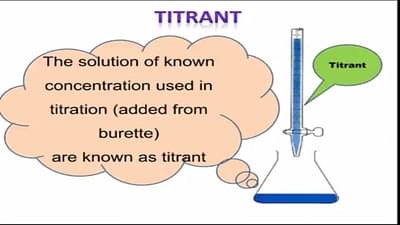
Titrant
The titrant is the component whose solution is used to determine the concentration of an unknown solution. The component whose concentration is to be estimated is known as titrate. Titrimetric analysis is another name for volumetric analysis.
Also read: Volumetric Analysis in Detail
Types of Titration
[Click Here for Sample Questions]
Titration is a category of volumetric analysis. Volumetric analysis methods involve titrations. However, the term titration is used when volumetric analysis is used to determine concentration of an unknown component in a solution.
There are three different types of titration:
1. Simple Titration
Simple titration is used to determine the concentration of an unknown solution using the concentration of another known solution. Simple titration can be further divided into four categories:
- Acid-base
- Redox
- Precipitation
- Complexometric
2. Back Titration
Back titration determines the concentration of an analyte by reacting it with a known amount of excess reagent, whereas a direct titration examines the concentration of an unknown chemical directly. Excess reagents are not added in back titrations. Back titration is also known as indirect titration.
| Example: Where is the method of Back Titration used? |
3. Double Titrations
Double titration is used to determine the amount of substance present in the form of a solution with another solution. Gilson's titration method for estimating the concentration of organometallic compounds in hydrocarbon solvents is also known as double titration. The overall concentration of the base in the solution is determined in the first stage. The residual amount of alkali after the organometallic compound reacts with the halide is determined in the second stage, allowing the concentration of the metal-organic compound to be calculated.
Read More: Normality and Molarity
Apparatus Used for Volumetric Analysis
[Click Here for Sample Questions]
The apparatus used for Volumetric Analysis are:
- Burette, pipette, measuring flasks, and measuring cylinders.
- Flasks for general titration, beaker, tile, glass rod, funnel, weighing bottle, and wash bottle.
- Weighing machine with a chemical balance
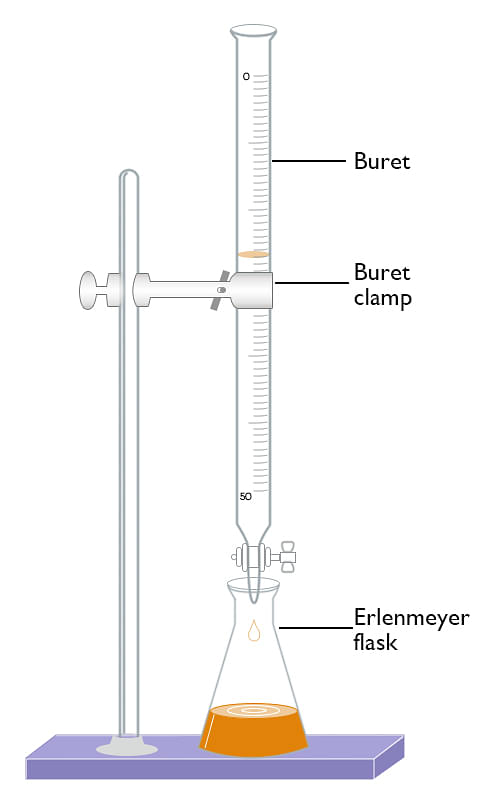
Experimental Setup
Principles of Volumetric Analysis
[Click Here for Sample Questions]
The principles of Volumetric Analysis includes:
- An unknown number of chemicals must be present in the solution which needs to be examined.
- To show the end-point, a reagent with an unknown concentration reacts with the chemical of an unknown amount in the presence of an indicator (usually phenolphthalein). The end-point is the point at which the reaction is finished.
- The reaction between the solution and the reagent is completed by titration which is used to measure the volumes.
- The amount of reagent and solution is shown by the volume and concentration of reagent used in the titration.
- The mole fraction of the equation determines the amount of an unknown chemical in the specific volume of solution.
Procedure for Volumetric Analysis
[Click Here for Sample Questions]
A typical titration begins with a calibrated burette or pipette containing the titrant and a beaker or flask with a precise volume of the analyte and a small amount of indicator placed beneath it.
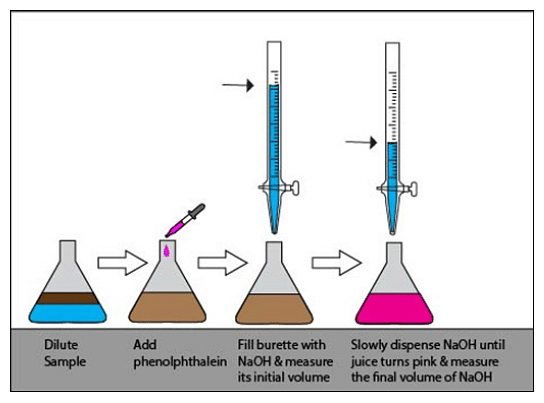
Titration Procedure
| Following are the steps used for Volumetric Analysis:
|
Volumetric Analysis Formulae and Important Terms
[Click Here for Sample Questions]
Important terms of volumetric analysis are:
- Normality: number of solute gram-equivalents /volume of solution(liters)
- Molarity: moles of solute/volume of solution
- Endpoint: It's when the reaction between the two solutions is almost finished.
- Indicator: A material that shows the achievement of a result. The colour of the indicator changes at the termination point.
- Standard solution: A standard solution is a solution that has a known concentration.
To calculate the analyte concentration, the following formula is used:
| Ca= Ct x Vt x M / Va |
Where,
- Ct = Titrant concentration
- Vt = Volume of the titrant used
- M = Mole ratio (Analyte)
- Va = Volume (Analyte)
Check out:
Things to Remember
- Volumetric Analysis is used to measure the concentration of a substance in a solution by adding the same number of compounds of another substance present in a solution of known concentration.
- The Volumetric Analysis method is also known as Titration.
- The titrant is the component whose solution is used to determine the concentration of an unknown solution.
- The titrate is the component whose concentration is to be estimated.
- Titration is of three types: simple titration, back titration and double titration.
Sample Questions
Ques: What is the principle of volumetric analysis? (1 Mark)
Ans: In volumetric analysis, the concentration of a solution is determined by giving a known volume of the solution to react quantitatively with another solution of known concentration.
Ques: What is titration? (1 Mark)
Ans: Titration is the process of adding one solution from the burette to another in the conical flask in order to complete the chemical reaction involved.
Ques: What is complexometric titration? (1 Mark)
Ans: In this method of titration, the titrate reacts with the titrant, resulting in the formation of complex salts. The complex salts are not soluble in complexometric titration.
Ques: What is the equivalent mass of KMnO4 when it acts as an oxidizing agent in acidic medium? (2 Marks)
Ans: When KMnO4 acts as an oxidizing agent in the presence of acids, it loses 5 electrons per molecule. Therefore, the equivalent mass of KMnO4 is one-fifth of its molecular mass.
Eq. Mass = Molecular mass / 5 = 158/5 = 31.6
Ques: Why must Burette and pipette be rinsed with the solution with which they are filled? (2 Marks)
Ans: The burettes and pipettes are rinsed with the solution with which they are filled with to prevent water from sticking to their sides, which would otherwise reduce the cone of the solution taken in them.
Ques: Why should a titration flask not be rinsed? (2 Marks)
Ans: Titration flask should be rinsed because during rinsing, some liquid will remain sticking to the titration flask. Due to this the pipetted volume taken in the titration flask will increase.
Ques: (i) What is the indicator used in KMnO4 titration?
(ii) Why does KMnO4 act itself as an indicator? (2 Marks)
Ans: (i) KMnO4 acts as a self-indicator. No other indicator is used in the KMnO4 titration.
(ii) In the presence of dilute sulphuric acid, KMnO4 reacts with a reducing agent (oxalic acid or ferrous sulphate). When all the reducing agent gets oxidised, the excess of KMnO4 is not decomposed and gives a pink colour solution.
Ques: What are the precautions to be taken while pipetting? (3 Marks)
Ans: The precautions that are needed to be taken while pipetting are:
- Never use your thumb to close the pipette.
- Maintain constant dipping of the lower end in the liquid while sucking the liquid.
- Pipette out hot or corrosive fluids with caution.
- The last drop of solution from the endpoint should not be blown out.
Ques: List a few measures that should be kept in mind handling the analytic balance? (3 Marks)
Ans: Few measures that should be kept in mind while handling the analytic balance are:
- Do not shift the balance from its original position.
- Overloading the balance beyond the maximum load (typically 100 g) might cause harm.
- Wet or unclean objects should not be placed on the balance. Nothing should be spilled inside the balance case.
- Do not place the weighing object directly on the balance. Instead of using paper, place the substance on a watch glass, weighing bottle, test tube, or other suitable container.
For Latest Updates on Upcoming Board Exams, Click Here: https://t.me/class_10_12_board_updates
Do Check Out:



Comments