



Content Curator
The area of seismology, S waves are referred to as a type of elastic wave that takes place to be one of the two major types of elastic body waves. These kinds of waves are also known as secondary waves or shear waves or elastic S waves. Further, their name secondary wave is because of the fact that they are the type of wave whose detection arises by a seismograph, succeeding the P wave.
| Table of Content |
Key Terms: Sound Waves, Sound, Frequency, Wavelength, Vibration, Waves, Pressure, Medium, Speed, Earthquakes
Definition of S Waves
[Click Here for Sample Questions]
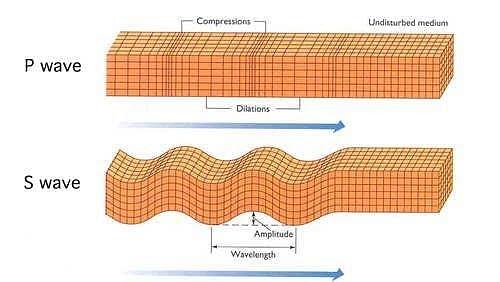
S waves are a kind of Transverse waves. What is meant by this is that the oscillations of the S wave particles are perpendicular (in nature) to the wave propagation of direction. The most important restoring force is because of the shear stress. Hence, the propagation of S waves cannot take place in zero viscosity or very low liquids. However, the propagation of S waves may take place in liquids with high viscosity.

Earthquake Waves
[Click Here for Sample Questions]
When an earthquake occurs, it liberates waves of energy that are known as Seismic waves. It is like the wavelet created in water when you throw a stone in it. Seismic waves are like those wavelets which can travel into and out of the inside of the earth, as well as on the surface of the earth.
P Waves, S Waves and Surface Waves
[Click Here for Sample Questions]
Emanate from the medium they travel in, earthquake waves can be classified into two categories i:e:
- Body waves
- Surface waves
Body waves are those waves which tend to travel through the earth. These waves originate at the epicenter of the earthquake and travel through the earth at a very high speed. There are two types of body waves namely,
- P waves
- S waves
Whereas, Surface waves are those waves which tend to travel on the surface of the earth. The destruction that is caused by earthquakes is primarily done by these waves i:e done by surface waves.
S waves also known as secondary waves and shear waves, these are the second waves to hit the seismographs when an earthquake occurs. They are transverse waves, which means that the motion of the waves is perpendicular to the direction of the wave propagation. S waves can only travel through solids and scientists have successfully studied the routes of these waves by mapping the interior of the earth.
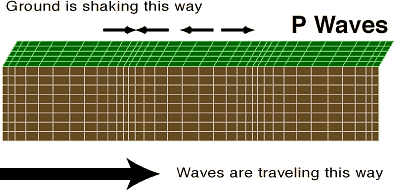
P waves are also known as Primary waves, these waves are the first waves to hit the seismographs when an earthquake occurs. The nature of p waves are longitudinal waves which means that the direction of motion of waves and propagation of waves are the same.
Also Check:
Methods of Predicting S Waves Velocity
[Click Here for Sample Questions]
Prediction of S waves or shear-wave velocity is very important in seismic modelling, amplitude survey with offset, and a large number of other exploration applications. Further, one can easily predict S wave or shear wave velocity from the P wave velocity on the basis of the moduli of the dry rock. If experts can form an impression of the moduli of the dry rock from the P wave velocities, then they can easily predict S wave velocities (shear velocity) from the moduli.
Moreover, the dry rocks bulk modulus might have a relation to the shear/ S modulus by compaction constant. Also, the result of the numericals give us the indication of the predicted S wave velocities for consolidated as well as unconsolidated sediments and agrees well with measured velocities if differential pressure turns out to be of greater than value of approximately 5 MPa. The important advantage of this method is that there is no requirement for adjustable parameters such as pore-aspect ratios that are needed in various other methods. Hence, the prediction of the velocities of S waves is only measured on p wave velocity.
Difference Between S Waves and P Waves
[Click Here for Sample Questions]
| S Waves or Shear Waves | P Waves or Primary Waves |
|---|---|
| S waves travel in a transversal direction. | P waves travel in a linear direction. |
| S waves arrive after P waves. These are the second waves to hit the seismograph. | P waves are the first wave to hit the seismograph when an earthquake occurs. |
| S waves are approximately 1.7 times slower than P waves. | P waves travel in the speed range of approximately 1.5-13 km/s. |
| S waves travel through solids only. | P waves can travel through solid, as well as liquids , and gases. |
| Formula for s waves β 2 = μ / þ | Formula for p waves α 2 = λ + 2μ/þ |
Read more: Frequency and Wavelength, and Types of Waves
Things to Remember
- S waves are referred to as a type of elastic wave that takes place to be one of the two major types of elastic body waves.
- S waves travel in a transversal direction.
- P waves travel in a linear direction.
- S waves also known as secondary waves and shear waves, these are the second waves to hit the seismographs when an earthquake occurs.
- P waves are also known as Primary waves, these waves are the first waves to hit the seismographs when an earthquake occurs.
- Body waves are those waves which tend to travel through the earth. These waves originate at the epicenter of the earthquake and travel through the earth at a very high speed.
- Surface waves are those waves which tend to travel on the surface of the earth. The destruction that is caused by earthquakes is primarily done by these waves i:e done by surface waves.
- S waves travel through solids only.
- P waves can travel through solid, as well as liquids , and gases.
- S wave or shear wave velocity from the P wave velocity on the basis of the moduli of the dry rock.
Sample Questions
Ques: What are S waves ? (2 marks)
Ans: S waves also known as secondary and shear waves, these are the second waves to hit the seismographs when an earthquake occurs. They are transverse waves, which means that the motion of the waves is perpendicular to the direction of the wave propagation. S waves can only travel through solids and scientists have successfully studied the routes of these waves by mapping the interior of the earth.
Ques: What do you mean by P waves ? (2 marks)
Ans: P waves are also known as Primary waves, these waves are the first waves to hit the seismographs when an earthquake occurs. The nature of p waves are longitudinal waves which means that the direction of motion of waves and propagation of waves are the same.
Ques: What are Body Waves and Surface Waves? Explain. (2 marks)
Ans: Body waves are those waves which tend to travel through the earth. These waves originate at the epicenter of the earthquake and travel through the earth at a very high speed. There are two types of body waves namely,
- P waves
- S waves
Whereas, Surface waves are those waves which tend to travel on the surface of the earth. The destruction that is caused by earthquakes is primarily done by these waves i:e done by surface waves.
Ques: Define Earthquake Waves. (2 marks)
Ans: When an earthquake occurs, it liberates waves of energy that are known as Seismic waves. It is like the wavelet created in water when you throw a stone in it. Seismic waves are like those wavelets which can travel into and out of the inside of the earth, as well as on the surface of the earth.
Ques: What are the difference between p waves and s waves ? ( 3 marks )
Ans: S waves arrive after P waves. These are the second waves to hit the seismograph. P waves are the first wave to hit the seismograph when an earthquake occurs.
S waves travel in a transversal direction. P waves travel in a linear direction.
S waves travel through solids only. P waves can travel through solid, as well as liquids , and gases.
Ques: What is the method of prediction of s waves velocity ? ( 3 marks )
Ans: Prediction of S waves or shear-wave velocity is very important in seismic modelling, amplitude survey with offset, and a large number of other exploration applications. Further, one can easily predict S wave or shear wave velocity from the P wave velocity on the basis of the moduli of the dry rock. If experts can form an impression of the moduli of the dry rock from the P wave velocities, then they can easily predict S wave velocities (shear velocity) from the moduli.
Moreover, the dry rocks bulk modulus might have a relation to the shear/ S modulus by compaction constant. Also, the result of the numericals give us the indication of the predicted S wave velocities for consolidated as well as unconsolidated sediments and agrees well with measured velocities if differential pressure turns out to be of greater than value of approximately 5 MPa. The important advantage of this method is that there is no requirement for adjustable parameters such as pore-aspect ratios that are needed in various other methods. Hence, the prediction of the velocities of S waves is only measured on p wave velocity.
Read Also:



Comments