



Education Journalist | Study Abroad Lead
Sampling error in statistics refers to a statistical error that can arise when a sample is used to estimate the population mean. Such errors are possible considering that the calculation only considers a small part of a whole to determine something. In simple words, it refers to the difference between the population and the sample used to estimate the same. While sample error is as the name suggests, an error, there are also various methods and ways by which the error can be minimized or corrected as well.
Key Takeaways: Sampling, Population mean, Sample Error, Non-sampling error, statistical errors
What is Sample and Sampling in Statistics?
[Click Here for Sample Questions]
In the discipline of Statistics, Sample and Sampling are important concepts. The two can be defined as:
- Sample: In simple words, when an amount of observations is basically used to analyze a population in its entirety, the observation used then becomes a Sample.
- Sampling: Sampling refers to the process or method by which the sample is analyzed to make observations about the population.
What are Sampling Errors in Statistics?
[Click Here for Sample Questions]
When there is a difference between the estimation based on a sample and the actual population is the characteristics that were analyzed, it means that a sample error has occurred. Sampling error is a statistical error which is one of the two types of errors that usually occur in statistics, which are, non-sampling error and sampling error. This error is also often referred to as error variance.
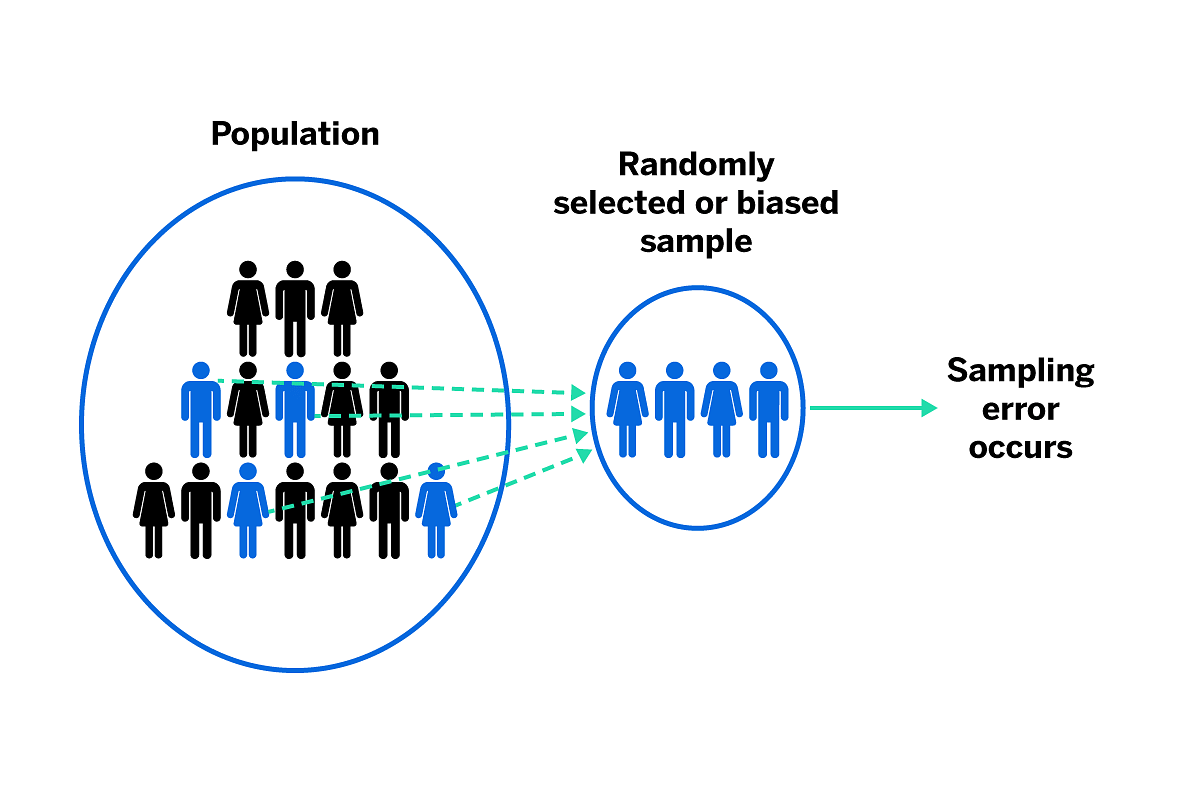
Sampling Errors in Statistics
Sampling Error Formula
[Click Here for Sample Questions]
The sampling error formula is used to calculate the error that occurs when the sample that is used to represent the entire population is not correctly selected. This error is then calculated by using the sampling error formula, which is:
Sampling Error = Z x (σ/√ n)
Here,
Z = score value based on the confidence interval
σ = population standard deviation
√ n = the sample size used
The formula which is used to denote the error itself is:
|x? − μ|
Here, x? = Sample mean, μ = Population mean
Solved Example
Ques. If Sample mean is 45 and Population mean is 30. Find the sampling error.
Solution: Using the sampling error formula = |x? − μ|.
Here, x? = Sample mean, μ = Population mean
Therefore, Sampling error = |45 - 30| = 15
What is the role of sample size?
[Click Here for Sample Questions]
The role of sample size is crucial and of key importance in Sampling and sample error. It is very important that the sample size is carefully determined because a very small sample size can lead to inaccurate results which are way far off than the actual population. In the formula of Sample error, the sample size is denoted by n and when the sample size increases then the increase in sample size changes the sampling error (often decreases the error because the sample including much more sets of data leads to the sample being much closer to the actual population).
Also read: Union of sets
Step by Step Calculation of Sampling and Sampling Error
[Click Here for Sample Questions]
The step by step method of calculating sampling error is:
Step 1: As the first step, data is collected which is called population, this data is then used to determine two more things, that is, population variance and population mean.
Step 2: For the next step, the size of the sample is examined, it needs to be of a perfect size while being smaller than the whole population to have accurate results.
Step 3: Now, the confidence level is determined, followed by calculating the Z value.
Step 4: Next, the Z score is multiplied by variance and then divided by a root of sample size. Giving us the margin of error.
Correction of Sampling Errors
[Click Here for Sample Questions]
Sampling errors can be minimized by using the following methods and steps:
- Increasing the sample size: The bigger the size of the sample used to study a population, the closer the sample size becomes more accurate and the results become closer to the actual population.
- Unbiased: Another important point to be kept in mind, is that the selection of samples should be completely unbiased.
- Careful Sampling: It is also important to make sure that the size of the sample is reasonable enough and the designing of the samples should be carefully done.
- Stratification: It is useful when a population does not have homogenous components/characteristics. It is very difficult to end up with accurate results in a non-homogeneous population, here stratification can help in dividing or differentiating between the population by dividing it into sub-groups, often called strata. By dividing the non-homogeneous components of the population into strata, we get results that are more accurate than one which uses only one sample of the population without considering the different components/characterististics of the population.

Sampling Error
Common mistakes to avoid on Sampling Errors
[Click Here for Sample Questions]
There are various ways to avoid or minimize sampling errors:
- Larger sample size can help reach more accurate results.
- Sample should be carefully designed.
- Sample selection should be unbiased and be selected at random.
- The team which will collect the data should be properly trained to avoid errors in the sample.
- If the population is too large or diverse, it should be stratified, dividing into subgroups. This helps in being closer to the population size and hence helps reach more accurate results.
- Taking very large samples can lead to high levels of deviance between the same and the population, hence too large of a sample can lead to inaccurate results.
- External records should be checked carefully before sample collection.
- It is also important to have a decent amount of knowledge about the population which is going to be studied.
Things to remember
- Sampling errors is one of the two types of errors that usually occur in a sampling of a population, one being sampling error and the other one being non-sampling error.
- Sampling error refers to the statistical error when there is a discrepancy or deviation between the sample used the actual population in consideration.
- The formula used to denote a sampling error is: |x? − μ|. (Here, x? = Sample mean, μ = Population mean)
- Sampling errors can be avoided by using methods or steps such as dividing the population as subgroups for accuracy, training the team to undertake the sampling, using a bigger size of the population.
- The formula for sampling error is: Sampling Error = Z x (σ/√n) Here, Z = score value based on the confidence interval, σ = population standard deviation, √n = the sample size used.
Sample Questions
Ques. Assume that a population standard deviation is 0.30 and the sample size is 1200. Find the Sampling error if the confidence level is found to be 95%. (3 Marks)
Ans. Here, using the formula Sampling Error = Z x σ / √ n
Where,
Z = score value based on the confidence interval
σ = population standard deviation
√ n = the sample size used
95% confidence level = 1.96
We get = 1.96 x (0.30 /√1200) = 0.01697
Ques. If the population standard deviation is 0.45, the confidence level is found to be 90%, and the sample size 1150. Find the Sampling error. (3 Marks)
Ans. Here, using the formula Sampling Error = Z x σ / √ n
Where,
Z = score value based on the confidence interval
σ = population standard deviation
√n = the sample size used
90% confidence level = 1.645
We get = 1.645 x 0.45 / √ 1150 = 0.0218
Ques. Assuming that a population standard deviation is 0.55 and the sample size 1400. Find the Sampling error where the confidence level is 99%. (3 Marks)
Ans. Using the formula Sampling Error = Z x σ /√n
Where,
Z = score value based on the confidence interval
σ = population standard deviation
√ n = the sample size used
And, 99% confidence level = 2.58
We get = 2.58 x 0.55 / √ 1400 = 0.0379
Ques. If the population standard deviation is 0.65 and the sample size is 1700. Find the Sampling error when the confidence level is found to be 90%. (3 Marks)
Ans. Using the formula Sampling Error = Z x σ /√n
Where,
Z = score value based on the confidence interval
σ = population standard deviation
√ n = the sample size used
And, 90% confidence level = 1.645
We get = 1.645 x 0.65 /√1700 = 0.0259
Ques. Assume that the population standard deviation is 0.77 and the sample size is 1670. Find the Sampling error where the confidence level is found to be 95%. (3 Marks)
Ans. Using the formula Sampling Error = Z x σ/√n
Where,
Z = score value based on the confidence interval
σ = population standard deviation
√n = the sample size used
And, 95% confidence level = 1.96
We get = 1.96 x 0.77 / √1670 = 0.03693
Ques. What is stratification in sampling? How can stratification help in minimizing sampling correction? (3 Marks)
Ans. Stratification in sampling is one of the important methods to minimize sampling errors while sampling. This method refers to the process in which a population that has non-homogenous components are divided into smaller groups which are called strata. These subgroups can be sampled. This helps prevent us from preventing sampling errors because of another measure that can help in avoiding sampling error, that is, more or bigger samples is equal to more accurate sampling error. Hence, when we divide a sample into smaller groups and pick up samples we reach a more accurate sample that is closer to the population.
Ques. If the population standard deviation is 0.75 and the sample size 1000. Find the Sampling error with the confidence level found to be 90%. (3 Marks)
Ans. Using the formula Sampling Error = Z x σ /√n
Where,
Z = score value based on the confidence interval
σ = population standard deviation
√ n = the sample size used
And, 90% confidence level = 1.645
We get = 1.645 x 0.75 / √ 1000 = 0.03901
Ques. If the population standard deviation is 0.85 and the sample size is 1560. Find the Sampling error with the confidence level found to be 90%. (3 Marks)
Ans. Using the formula Sampling Error = Z x σ /√n
Where,
Z = score value based on the confidence interval
σ = population standard deviation
√n = the sample size used
And, 90% confidence level = 1.645
Hence, we get = 1.645 x 0.85 /√1560 = 0.035401
Ques. Are Sampling Errors inevitable? How can Sampling errors be avoided? (5 Marks)
Ans. While Sampling errors are not inevitable, they can be present due to some common mistakes like taking a big sample, not properly training the team that is taking the sample and much more. These errors can be avoided through methods which are as follows:
- Stratifying the population which does not have homogenous components so that the results are nearest to the population.
- Taking a bigger sample size ensures that the results are more accurate.
- Unbiased selection of the sample.
- It is also important to have proper information about the population at hand.
Ques. What are the different types of Sampling methods? (3 Marks)
Ans. While there are different types of Sampling methods. The two of important sampling methods are:
- Probability Sampling which happens when a researcher uses some criteria in determining the population. After these criteria are selected the population then is selected at random.
- Non-probability Sampling: When the researcher uses no criteria or when the choice is not defined before it is non-probability sampling. Where the selection of a sample is completely random.
Also Read:



Comments