



Content Curator
Isotopes are variants of specific chemical elements. The word "isotope" comes from Greek. Iso means "equal", and topos means "place". Thus, it means that different isotopes of the single element occupy the same position in the periodic table.
| Table of Content |
Read More: Difference Between Atom and Molecule
What are Isotopes
Isotopes of a given element have the same number of protons, while the number of neutrons varies.

- Atoms of the same element with different numbers of neutrons in the nucleus are referred to as isotopes.
- The isotopes of an element have the same atomic number but different atomic numbers.
- Isotopes are identified by their mass numbers. For example, the isotopes of carbon are carbon-12, carbon-13, and carbon-14.
- Isotopes of an element have similar chemical properties but have different physical properties.
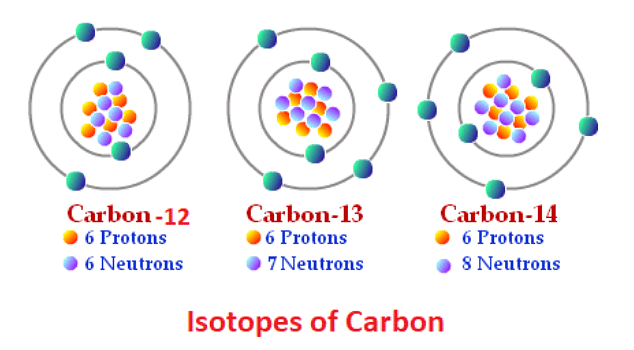
For Example: Consider the set,
126C, 136C, 146C
Carbon has three isotopes namely Carbon-12, carbon-13, and carbon-14 with mass numbers 12, 13, and 14, respectively.
Here the atomic number is the same (6) but the mass number is different, which means that they have the same number of protons but the number of neutrons varies.
Read More: Atomic Radius
Isotopes are also known as nuclides. Isotopic nuclei have different nuclear properties because the number of neutrons affects the behavior of the nucleus. Because of their small size, hydrogen isotopes have extraordinary chemical properties that are indistinguishable. Due to the significant change in mass, heavier isotopes tend to react more slowly than lighter isotopes. Owing to this, deuterium has twice the mass of tritium, and tritium has three times the mass of tritium.
Also Read:
Types of Isotopes
Isotopes can be naturally occurring or artificially produced.
- Radioactive Isotopes: Isotopes that are radioactive and tend to disintegrate into unstable forms are called radioactive isotopes. It is also known as radioisotopes.
- Stable isotope: An isotope that does not decompose over time is called a stable isotope. Stable isotopes are predominant, so there are many stable isotopes in nature, with a few exceptions.
Read More:
Uses of Isotopes
Isotopes can be used for medical, industry, and agricultural purposes.
Use of Isotopes in Medical
- Gamma-rays emitted from cobalt-60 can be used in radiotherapy to treat cancer.
- Superficial cancers such as skin cancer are treated by less penetrating radiation from the strontium-90 or phosphorus-32.
- A heart pacemaker that contains plutonium-238 can be used to control a patient's heartbeats with heart problems.
- Iodine 131 can be used in thyroid treatment.
- Carbon-14 is used to estimate the age of bones, fossils, or wood by measuring the amount of carbon-14 they contain.
Read More:
Use of Isotopes in Agriculture
- A phosphate fertilizer that contains phosphorus-32 is used to detect absorption and phosphorus metabolism by plants.
- In addition, the radioactive tracer studies by using carbon -14 help to understand protein synthesis and photosynthesis.
Use of Isotopes in the Industry
- Sodium-24 is used to detect leaks in natural gas or oil pipe leaks and ventilating systems.
- Krypton-85 radiation is used in industry to control the thickness of plastic panels.
- Cobalt-60 gamma rays are passed via food to kill bacteria. It spoils the food without changing the taste, quality, or texture of the food.
Read More:
What are Isobars
Isobar is an element with different chemical properties but similar physical properties. Thus, isobars are elements with different atomic numbers but the same mass numbers. Also, they possess different chemical properties due to the difference in the number of electrons. An isobar contains the same atomic mass, but the atomic number is different. This is because the additional number of neutrons compensates for the difference in the number of nuclei.
For example, Calcium and argon have the same atomic mass of 40 but different atomic numbers of 20 and 18, respectively.
Read More:
Use of isobars
Have a look at some uses of isobars:
- Nuclear reactors may use uranium isobars.
- Iodine isobar is used to treat goiter.
- Cobalt Isobaric can be used to treat cancer.
Also Read:
Difference between isotopes and isobars
The following table shows some of the differences between isotopes and isobars.
| Isobars | Isotopes |
|---|---|
| Isobars are chemicals elements which have the same mass | Isotopes has different atomic structure of the same element |
| The atomic masses of isobars are equal | The atomic masses of isotopes are different |
| The physical properties of isobars are often similar | Usually, physical properties of isotopes are different |
| Isobars has different atomic numbers are different | Isotopes have the same atomic numbers. |
| Chemical elements of isobars are different | Isotopes have same chemical elements but are in different forms |
Things to Remember
- Isotopes are variants of specific chemical elements.
- Atoms of the same element with different numbers of neutrons in the nucleus are referred to as isotopes.
- Isotopes can be used for medical, industry, and agricultural purposes.
- Isobar is an element with different chemical properties but similar physical properties.
- Nuclear reactors may use uranium isobars.
Read More:
Important Questions on Isotopes and Isobars
Q.1. How are isotopes formed?
Ans. Atoms with the same number of protons but different numbers of neutrons and protons are called isotopes.
Read More:
Q.2. Explain the isotopes and isobars with examples?
Ans. Isotopes contain the same number of protons, but different numbers of neutrons. The Pneumonic can be thought of as "isotopes containing the same number of protons". Therefore, carbon 12, carbon 13, carbon 14, and carbon 15 are isotopes.
The following table shows the examples of Isotopes:
| Examples of Isotopes | ||
|---|---|---|
| Element | Number of Isotopes | |
| Oxygen | Two | 168O 178O |
| Uranium | Two | 23592U 23892U |
| Hydrogen | Three | Protium (11H) Deoterium(21H) Tritium(31H) |
| Carbon | Three | 126C 136C 146C |
The isobar contains the same number of nuclei or atomic masses, but different numbers of protons and neutrons. The Pneumonic can be thought of as "isobars with similar atomic mass." Therefore, boron 12, oxygen 12, nitrogen 12, and carbon 12 are isobars.
The following table shows the examples of Isobars:
| Examples of Isobars | |||
|---|---|---|---|
| Isobars | Number of Protons | Number of Neutrons | Mass Number |
| Chlorine-37 | 17 | 20 | 37 |
| Argon-37 | 18 | 19 | |
| Cerium-76 | 32 | 44 | 76 |
| Selenium-76 | 34 | 42 | |
| Iron-58 | 26 | 32 | 58 |
| Nickel-58 | 27 | 31 | |
Q.3. Name some examples of stable isotopes.
Ans. Vanadium, carbon, calcium, and potassium are some examples of stable isotopes.
Read More:
Q.4. What rays do unstable isotopes emit?
Ans. Alpha, beta, and gamma rays are emitted by unstable isotopes.
Q.5. How many stable isotopes are known and Which element has the most isotopes?
Ans. There are Ans. 252 stable isotopes. Only 80 elements have at least 1 stable isotope. Tin, which has 10 stable isotopes, has the most stable isotope.
Q.6. What are the five uses of isobars and isotopes?
Ans. Radioactive dating, Isotope labeling of nuclear drugs, radiotherapy, nuclear energy and weapon development.
Also Read:



Comments