



Education Journalist | Study Abroad Lead
Rydberg formula is a mathematical equation that predicts the wavelength of light emitted or absorbed by atoms when electrons travel between different atomic energy levels. Each element has a distinctive spectral fingerprint.
- When a gaseous state of an element is heated, it emits light.
- Bright lines of various colors are observed when the emitted light passes through a prism or diffraction grating.
- Different elements exhibit bright lines of unique hues.
- Each element is distinct from the others in some way.
- This discovery marked the commencement of spectroscopic research.
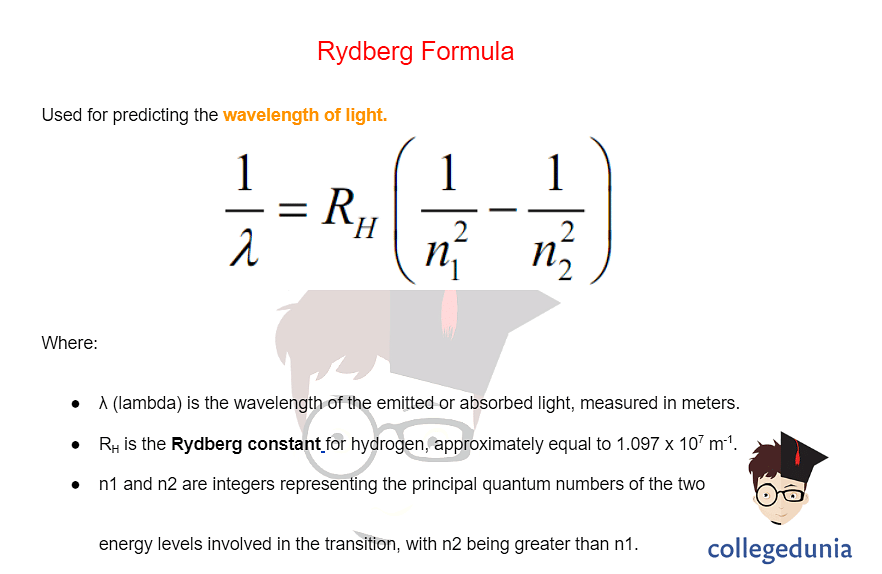
Rydberg formula: 1/λ = RH * (1/n1² - 1/n2²)
Where:
- λ (lambda) is the wavelength of the emitted or absorbed light, measured in meters.
- RH is the Rydberg constant for hydrogen, approximately equal to 1.097 x 10⁷ m-1.
- n1 and n2 are integers representing the principal quantum numbers of the two energy levels involved in the transition, with n2 being greater than n1.
Download Notes: Rydberg Formula PDF
| Table of Contents |
Key Terms: Rydberg Formula, Hydrogen Spectrum, Quantum Numbers, Light Spectrum, Hydrogen, Rydberg Constant
What is the Rydberg Formula?
[Click Here for Sample Questions]
The Rydberg Formula is a mathematical equation in atomic physics that predicts the wavelengths of light emitted or absorbed by atoms when electrons jump between different energy levels.
- Atoms have energy levels like stairs.
- Electrons can travel between these levels, releasing or absorbing light in the process.
- The Rydberg formula tells you the colour (wavelength) of light an atom will emit or absorb based on which stairs the electron jumps.
- A photon of light is produced when an electron moves from a high-energy orbital to a lower-energy orbital.
- When an electron transitions from a low-energy to a higher-energy state, a photon of light is absorbed by the atom.
- The Rydberg Formula may be used to calculate the spectra of various elements.
- The Rydberg constant (RH) for hydrogen is a fundamental physical constant that appears in the Rydberg formula.
- For hydrogen, the approximate value of RH is 1.097 x 10⁷m-1.
- It represents the constant of proportionality in the Rydberg formula, relating the observed spectral lines to the energy levels of electrons in hydrogen.
Rydberg Formula
Read More:
| Relevant Concepts | ||
|---|---|---|
| Planck's Quantum Theory and Black Body Radiation | Energies of Orbitals | Transverse Waves |
| Electron Mass | Spectral Series | Quantum Theory of Light |
Rydberg Equation
[Click Here for Sample Questions]
The Rydberg equation is named after the Swedish physicist Johannes Rydberg, who formulated it in 1888. Johannes Rydberg sought to establish a mathematical link between one element's spectral line and the next. He ultimately realized that the wavenumbers of successive lines had an integer connection.
This formula was created by combining his observations with Bohr's atomic model:
1/λ = RH2(1/n12 - 1/n22)
where
- where λ is the photon's wavelength (wavenumber = 1/wavelength)
- R is the Rydberg’s constant having a value of 1.0973731568539(55) x 107 m-1
- Z is the atomic number of the atom, n1 and n2 are integers, and n2 is greater than n1.
The main or energy quantum number was later shown to be connected to n2 and n1. This formula works well for transitions between energy levels of a single-electron hydrogen atom. This formula begins to break down and produce inaccurate results for atoms with many electrons. The inaccuracy is because the degree of screening for inner or outer electron transitions varies. To account for the differences, the equation is far too simple.
Solved ExampleCalculate the wavelength of light emitted when an electron in a hydrogen atom transitions from the n = 3 energy level to the n = 2 energy level. Solution: Identify the values: RH (Rydberg constant) = 1.097 x 10⁷ m-1 n1 (initial energy level) = 2 n2 (final energy level) = 3 Solve for λ: Convert to nanometers (nm): Therefore, the hydrogen atom emits red light with a wavelength of approximately 656 nm when an electron transitions from the n=3 to the n=2 energy level. |
The Rydberg formula may be used to calculate the spectral lines of hydrogen. The Lyman series is obtained by setting n1 to 1 and running n2 from 2 to infinity. Other spectral series can be determined as well:
| n1 | n2 | Converges Toward | Name |
|---|---|---|---|
| 1 | 2 → ∞ | 91.13 nm (ultraviolet) | Lyman series |
| 2 | 3 → ∞ | 364.51 nm (visible light) | Balmer series |
| 3 | 4 → ∞ | 820.14 nm (infrared) | Paschen series |
| 4 | 5 → ∞ | 1458.03 nm (far infrared) | Brackett series |
| 5 | 6 → ∞ | 2278.17 nm (far infrared) | Pfund series |
| 6 | 7 → ∞ | 3280.56 nm (far-infrared) | Humphreys series |
Rydberg’s formula can be denoted as 1/λ = RZ2(1/n12 - 1/n22). As you'll be dealing with hydrogen in most cases and since the Z of hydrogen is 1, the Rydberg formula is 1/λ= RH (1/n12 - 1/n22), where RH is Rydberg's constant.
Rydberg Formula Derivation
[Click Here for Sample Questions]
When an electron leaps from one energy level to another, it creates an energy difference (ΔE):
ΔE = Ef (final energy) - Ei (initial energy)
Bohr envisioned energy levels as circular orbits around the atom's nucleus. He proposed a formula for their energy: En = -RH/n2 (where RH is the Rydberg constant, n is the energy level)
Adding Bohr's formula into the energy difference equation, we get:
ΔE = RH(1/ni2 - 1/nf2)
∴ ΔE = 2.18 × 10⁻¹⁸(1/ni2 – 1/nf2) (Equation 1)
Light's energy (E) is tied to its frequency (ν) by Planck's constant (h): E = hν. Substituting E with ΔE and rearranging, we find the light's frequency –
v = E/h
v = 2.18 × 10⁻¹⁸/h × (1/ni2 – 1/nf2) → (h = 6.626 × 10⁻³⁴)
v = 3.29 × 10¹⁵(1/ni2 – 1/nf2) (Equation 2)
Now, c = λ
1/λ = v/c
Dividing equation 2 by c,
v/c = 3.29 × 10¹⁵/c × (1/ni2 – 1/nf2)
 = 1/λ = 1.0974 × 10⁷(1/ni2 – 1/nf2) m-1
Rydberg Formula for different Series and Hydrogen Spectrum
[Click Here for Sample Questions]
In an astounding display of mathematical intuition, Balmer came up with a simple formula for predicting the wavelength of any of the lines in atomic hydrogen in what is now known as the Balmer series in 1885. Three years later, Rydberg extended this such that the wavelengths of any of the lines in the hydrogen emission spectrum could be determined. Rydberg proposed (unaware of Balmer's work) that all atomic spectra formed families with this pattern. There are families of spectra that follow Rydberg's pattern, particularly in alkali metals such as sodium and potassium, but not with the accuracy with which the hydrogen atom lines match the Balmer formula and low values of n2 projected wavelengths that deviated significantly.
The following is Rydberg's phenomenological equation:
V=1/λ = RH (1/n12 - 1/n22)
RH = 109,737 cm-1, and n2 and n1 are integers bearing the whole numbers, with n2 being greater than n1.
n1=2 for the Balmer lines, while n2 may be any whole integer between 3 and infinity for the Balmer lines. The wavelength of any of the lines in the hydrogen emission spectrum may be calculated using the many combinations of integers that can be put into this formula; the wavelengths created by this formula and those observed in a real spectrum are quite close.
Things to Remember
- Electrons in atoms jump between energy levels, changing their energy.
- These jumps release or absorb light, creating "fingerprints" for each element.
- The Rydberg formula predicts the colors (wavelengths) of this light based on the electron's energy leaps.
- Developed for hydrogen, it applies to other atoms with adjustments.
- The Rydberg formula uses energy levels and constants to understand atomic spectra.
- It helps identify elements in distant stars, revealing their composition.
- Rydberg formula is 1/λ = RH(1/n1² - 1/n2²), where λ is wavelength, RH is the Rydberg constant, and n1 and n2 are energy levels.
Read More:
Sample Questions
Ques. Calculate the wavelength of electromagnetic radiation emitted by an electron as it relaxes from n = 3 to n = 1. (3 marks)
Ans. Start with the Rydberg equation to solve the problem:
1/λ = R(1/n12-1/n22)
Putting the given values that are n1 is equal to 1 and n2 is 3. For Rydberg Constant, the value is equal to 1.9074×10⁷ m-1 :
1/λ = (1.0974×10⁷)(1/12-1/32)
1/λ = (1.0974×10⁷)(1-1/9)
1/λ = 9754666.67 m-1
1= (9754666.67 m-1)λ
1/9754666.67 m-1 = λ
λ = 1.025×10⁻⁷ m
Ques. What is the wavelength of the emitted photon if an electron transition happens from n1 = 2 to n2 = 3? (2 marks)
Ans. Putting the given information in the Rydberg formula we get:
1/λ = 1.097*107 m(-1)*(1/2-1/3)
1/λ = 1.097*107 m(-1)*0.1666 = 0.182*107(1/m)
λ = 5.47*10(-7)m
Ques. Is the Rydberg formula only for hydrogen? (3 marks)
Ans. Because the Rydberg equation is an empirical formula based on the Bohr model of the hydrogen atom, it can only be used for hydrogen and other hydrogenic substances.
The Rydberg formula was originally derived for hydrogen, but it can be adapted for more complex atoms with adjustments. However, it is most accurate for simple atoms with a single electron, such as hydrogen, helium, and lithium.
Ques. Assume an electron transition happens from the n1= l and, and the emitted photon has a wavelength of 1.7* 10(-7)m. What is the integer number that corresponds to the transition, m? (3 marks)
Ans. Putting the given information in the Rydberg formula we get:
1/1.7*10(-7)m = (1.097*107m(-1))*(1-1/n)
We find n from the formula:
0.64 = 1-1/n =1-0.64 = 0.46 =1/0.46 =2.15 n ≈ 2
Ques. What Does Fine Structure Mean in Spectroscopy? (5 marks)
Ans. Fine structure refers to the splitting of an atom's primary spectral line into several components. Each spectral line indicates a wavelength that is somewhat different from the other. A fine structure is formed when an electron emits light while transitioning from one energy level to another. Interactions between an electron's orbital motion and its mechanical spin motion produce split lines.
The fine structure is created when an electron behaves like a small bar magnet and interacts with the magnetic field generated by the electron's revolution around the nucleus. The dimensionless fine structure constant determines the level of splitting. The fine structure constant's equation is as follows:
ke2/hc=α,
where K is the Coulomb constant,
h is the Planck constant,
and e is the electron's charge. α=1/137
Ques. Are there limitations to the Rydberg formula? (3 marks)
Ans. Yes, the Rydberg formula has the following limitations:
- It's most accurate for single-electron atoms and needs adjustments for multi-electron atoms.
- It doesn't capture all fine details of real spectra, which may involve additional interactions and effects.
- It doesn't predict the intensity of emitted light, only the wavelengths.
Ques. What is a Wave Number, and what does it mean? (3 marks)
Ans. In nuclear, atomic, and molecular spectroscopy, a wavenumber is a frequency unit. By dividing the real frequency by the speed of light, the wavenumber is derived. It's the number of waves per unit of distance. The frequency of a wave is indicated by the letter v and is equal to c (light speed)/v (wavelength). The following are the values for a typical spectral line in the visible spectrum:
5.8*10-5 cm is the wavelength.
5.17*1014 Hertz is the frequency.
Ques. What role does the Rydberg constant play? (5 marks)
Ans. Due to its relationship to the fundamental atomic constants (e, h, me, and c) and the great precision with which it can be computed, the Rydberg constant is one of the most significant constants in atomic physics. In 1890, the Rydberg constant was first published in scientific literature. The Rydberg constant is used to compute the wavelengths in the hydrogen spectrum - the energy absorbed or released as photons when electrons migrate between shells in the hydrogen atom.
The Rydberg formula, to put it another way, is a mathematical formula that predicts the wavelength of light generated by an electron traveling between energy levels in an atom. The energy of an electron varies when it moves from one atomic orbital to another.
Ques. What is the value of Rydberg's constant? (2 marks)
Ans. The Rydberg constant RH has a value of 10,973,731.56816 per meter. The number of waves per unit length, or wavenumbers, is obtained when this form is employed in the mathematical description of a series of spectral lines. The frequencies of the spectral lines are obtained by multiplying by the speed of light.
Ques. What are the applications of the Rydberg formula? (3 marks)
Ans. The Rydberg formula has many applications, including:
- Identifying elements: By analyzing the light emitted by a sample, scientists can use the Rydberg formula to identify the elements present. This is especially useful in astronomy, where we can analyze the light from stars and other celestial objects to determine their composition.
- Studying atomic structure: The Rydberg formula provides valuable insights into the structure of atoms and the behavior of electrons within them.
- Developing lasers and other technologies: The principles behind the Rydberg formula are used in the development of lasers and other light-based technologies.
For Latest Updates on Upcoming Board Exams, Click Here: https://t.me/class_10_12_board_updates
Check-Out:



Comments