



Content Curator
Silver Nitrate is arranged in a trigonal planar configuration in its solid-state. It's used as a starting point for other silver-based compounds. Silver nitrate is an inorganic compound that has antimicrobial properties. It can be used as a cauterizing or sclerosing agent. When exposed to light or organic substances, silver nitrate appears as a colorless or white crystalline solid that turns black. Silver nitrate is a precursor to a variety of silver compounds, including those used in photography.
| Table of Content |
Keyterms: Silver, Inorganic compound, Crystalline solid, Nitrogen, Oxygen, Atom, Molar mass, Celsius, Nitrogen Oxide
Also read: Silver Carbonate
Structure of Silver Nitrate
The structure of the silver nitrate molecule is seen in the figure below. The oxidation number of silver in this combination is one, as can be shown.
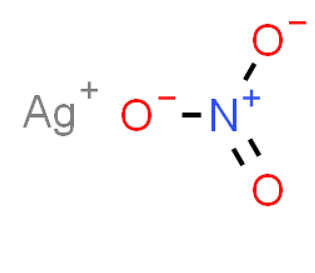
Silver Nitrate Structure
One nitrogen atom is surrounded by three oxygen atoms in the nitrate ion mentioned above. This ion's nitrogen-oxygen bonds are comparable to each other. The nitrogen atom has a formal charge of -1, while each oxygen atom has a charge of -2/3. The nitrate ion has a net charge of -1, which is quenched by the +1 charge held by the Ag+ ion in AgNO3 via an ionic connection. It's worth noting that the nitrate ion's structure is stabilized by resonance.
Properties of Silver Nitrate
In this part, we'll go over some of the most essential physical and chemical features of silver nitrate.
Physical Properties
- Silver nitrate has a molar mass of 169.872 grams per mole.
- In its solid state, AgNO3 has a colorless appearance and has no odor.
- It has a density of 4.35 grams per cubic centimeter in its solid condition. It has a density of 3.97 g/cm3 in the liquid state at 210 degrees Celsius.
- Silver nitrate has melting and boiling temperatures of 482.8 K and 713 K, respectively. At temperatures approaching its boiling point, however, this combination decomposes.
- Silver nitrate dissolves rapidly in water, as do other ionic substances. At 0oC, it dissolves in water at 122g/100mL, whereas at 25oC, it dissolves at 256g/100mL.
- AgNO3 has an orthorhombic crystal structure.
- Silver nitrate turns grey or greyish-black when exposed to air or light in the presence of organic materials.
- Silver nitrate is stable to 350 °C in the presence of a trace of nitric acid.
- When heated to breakdown, harmful nitrogen oxide gases are released.
Chemical Properties
- The poisonous and corrosive character of AgNO3 is one of its dangers.
- The interaction of silver nitrate with ethanol is extremely explosive.
- Copper nitrate is formed when the silver in this chemical is replaced by copper. 2AgNO3 + Cu → Cu(NO3)2 + 2Ag is the chemical equation for this reaction.
- This chemical entirely decomposes when heated to 440oC, yielding oxygen, nitrogen dioxide, and silver.
- Although metal nitrates normally break down to produce metal oxides, the decomposition reaction of silver nitrate produces elemental silver because silver oxide decomposes at a lower temperature than AgNO3.
Uses of Silver Nitrate
Silver nitrate has a wide range of uses in both medical and industrial settings. Silver nitrate is a precursor to a variety of different silver compounds. As a result, one of Silver Nitrate's uses is in the manufacture of other silver compounds.
Silver nitrate is a corrosive substance. This is a silver salt that is used to make other silver salts. Silver nitrate is also used to make colloidal silver compounds that are useful in medicine. Silver halides, which are created with Silver nitrate, are used in photographic emulsions. In labs, this is also used for volumetric analysis to determine halides, thiocyanates, and other compounds:
Medical Uses of Silver Nitrate
- Eye drops for children: It was originally employed in the production of eye drops in 1881. This was used to cure or prevent any inherited eye illnesses passed down from the mother to the child. However, it is no longer utilized as a preventative measure. This chemical has been shown to kill bacteria such as Gonococcal Bacteria, which is a common cause of eye infections.
- Moles can be found on the hands or bodies of some persons. To cauterize and remove such moles, silver nitrate is utilized.
- It is used to treat oral ulcers in the field of dentistry.
Silver Nitrate should not be ingested or used without the guidance or consultation of a doctor, even though it is known to be utilized in the treatment of some of the issues described above.
Read more: Oxides of Nitrogen
Industrial Uses of Silver Nitrate
- Electroplating: This type of plating is used to give jewelry and timepieces a sophisticated polish and appearance. When Silver must be plated on Nickel, Silver Nitrate is utilized.
- In our daily lives, we all use mirrors. Whatever is in front of the mirror is reflected in it. Silver Nitrate is used to generate a reflective surface. The employment of a Silver Nitrate coating on glass allows for the conversion of ordinary glass to mirror.
- It's also utilized in the production of dyes and inks, among other things. Some people use hair colors that include silver nitrate. Markers are used in the textile industry to make marks on the fabric. Silver Nitrate is also used in these markers. This chemical is also used in indelible inks, which are inks that cannot be erased.
- To shatter rocks, lay roads, and so on, explosives are used: Silver nitrate, as well as other silver salts such as silver acetylide, silver azide, and others, are used in the production of these explosives.
- Digital photography is widely used in today's globe. Photographs were previously taken with films that were washed and processed (called as Developing of photos). A small number of Silver halides (e.g. silver bromide, silver chloride) were employed in the production of photographic films. There would be decomposition to elemental silver when stuck with light while taking images, leaving an image. Other chemicals might subsequently be used to turn this into a photograph.
- We've all seen several types of ceramic pots in various hues. In ceramic works, silver nitrate is utilized to add similar colors.
- In the cut flower industry, pesticides using Silver Nitrate as an active component are employed. These are used to keep plants from withering too soon or shedding their buds and blossoms too soon. Cut stems produce ethylene, which aids in the ripening of fruits and the ageing of plants. This process is slowed when these stems are immersed in a very dilute solution of Silver Nitrate.
As a result, Silver Nitrate has a wide range of uses. However, it is critical to use this chemical with caution, as it can cause harm if handled incorrectly.
Health Effects of Silver Nitrate
According to the information now available, Silver Nitrate has the following effects:
Acute impacts
- Silver nitrate is a corrosive substance. As a result, this will irritate you. It creates a greyish discoloration of tissues when it is absorbed into the skin over a long period. The term for this phenomenon is argyria.
- Mucous membranes will be irritated and damaged if this is breathed.
- When Silver Nitrate is used by mouth, it can have significant side effects and could result in death. Vomiting, bloody diarrhea, dizziness, and seizures are all possible side effects.
Long-term impact of Silver Nitrate exposure
- It can lead to overall despondency, headaches, and mental impairment. Cancer has also been observed in certain people who have been exposed to Silver Nitrate.
- When someone comes into touch with Silver Nitrate, they must wash their hands thoroughly with plenty of freshwaters. Medical attention should be given to them right away.
- Fish and other aquatic life forms are likewise very poisonous to silver nitrate. As a result, disposal of this chemical should also be done by local laws and regulations.
- In criminal investigations, silver nitrate is also used. Fingerprints are commonly found at crime scenes. The latent print is a sort of fingerprint that is not apparent to the naked eye. When perspiration or natural body oils come into contact with other surfaces, they leave such prints. To solve or identify such prints, investigators employ a technique known as Latent Print Development. Silver Nitrate is employed in such latent print development techniques. Some chlorides can be found in human skin secretions. Silver chloride is formed when silver nitrate reacts with these secretions. When exposed to UV radiation, they turn a grey color. As a result, this chemical is useful in criminal investigations.
Things To Remember
- Copper nitrate is formed when the silver in silver nitrate is displaced by copper.
- Silver nitrate has an orthorhombic crystal structure.
- When storing Silver Nitrate in laboratories, it's best to keep it in dark bottles.
- Silver nitrate is a colorless, odorless substance.
- Silver nitrate has melting and boiling temperatures of 482.8 K and 713 K, respectively.
Sample Questions
Ques. Is silver nitrate dangerous? (2 Marks)
Ans. Since silver nitrate is an oxidant, it must be maintained away from organic substances. Despite its widespread use for gonorrhea prevention and nose bleeding control. Silver nitrate, on the other hand, is extremely poisonous and corrosive. Short-term exposure to silver nitrate has no negative consequences. Long-term exposure to silver nitrate, on the other hand, can harm the eyes.
Ques. How to handle large quantities of Silver Nitrate? (2 Marks)
Ans. Because silver nitrate is an oxidising agent, it readily releases oxygen. Combustion or fire is made possible by the presence of oxygen. As a result, care should be taken when storing these compounds to keep them away from any combustible or flammable chemicals. The reason for this is that when Silver Nitrate decomposes, it contributes to the fire by delivering oxygen. As a result, it's important to store them separately.
Ques. How is silver nitrate prepared? (2 Marks)
Ans. The most common way to make silver nitrate is to mix silver with nitric acid. Silver bullions and silver foils are common silver items used in these reactions. Silver nitrate, water, and nitrogen oxides are among the results of this process. The byproducts of this chemical reaction are determined by the concentration of nitric acid utilised. It's worth noting that this reaction must be done under a fume hood due to the formation of harmful nitrogen oxides during the chemical reaction.
Ques. How is silver nitrate prepared? (3 Marks)
Ans. Silver nitrate is made by reacting silver with nitric acid. Silver bullions and silver foils are common silver items used in these reactions. Silver nitrate, water, and nitrogen oxides are the end products. The by-products of this chemical reaction are determined by the amount of nitric acid present. Because of the development of harmful nitrogen oxides during the reaction, it is necessary to highlight that this reaction is carried out under a fume hood.
- 3Ag + 4HNO3 (cold and diluted)→ 3AgNO3 + 2H2O + NO
- Ag + 2HNO3 (hot and concentrated)→ AgNO3 + H2O + NO2
Ques. What are the uses of silver nitrate? (3 Marks)
Ans. In numerous organic synthesis procedures, silver nitrate is used in a variety of ways. For example, in the reactions of deprotection and oxidation. Because the Ag+ ion binds alkenes reversibly, silver nitrate can be used to isolate alkene mixtures by selectively adsorbing it.
Ammonia can be used to break down the resultant adduct and release the free alkene. Silver nitrate has been used for silver staining in the past (a process that employs silver or silver compounds to selectively change the appearance of a specific object). Because of its antibacterial properties, this chemical is also employed in medicine.
Ques. Is silver nitrate dangerous? (3 Marks)
Ans. Since silver nitrate is an oxidant, it must be maintained separate from organic molecules. Silver nitrate is typically exceedingly poisonous and corrosive, despite its widespread use (especially in extremely low doses) for the prevention of gonorrhoea and to halt bleeding from the nose.
Short-term exposure to this compound has no apparent negative effects other than the appearance of a violet, brown, or black stain on the skin area in touch with the silver nitrate. Long-term exposure to this chemical, on the other hand, is frequently associated with eye injury. This substance is commonly described as a skin and eye irritant.



Comments